How US Agencies Use Guest Posting to Build Authority for Clients
January 30, 2026


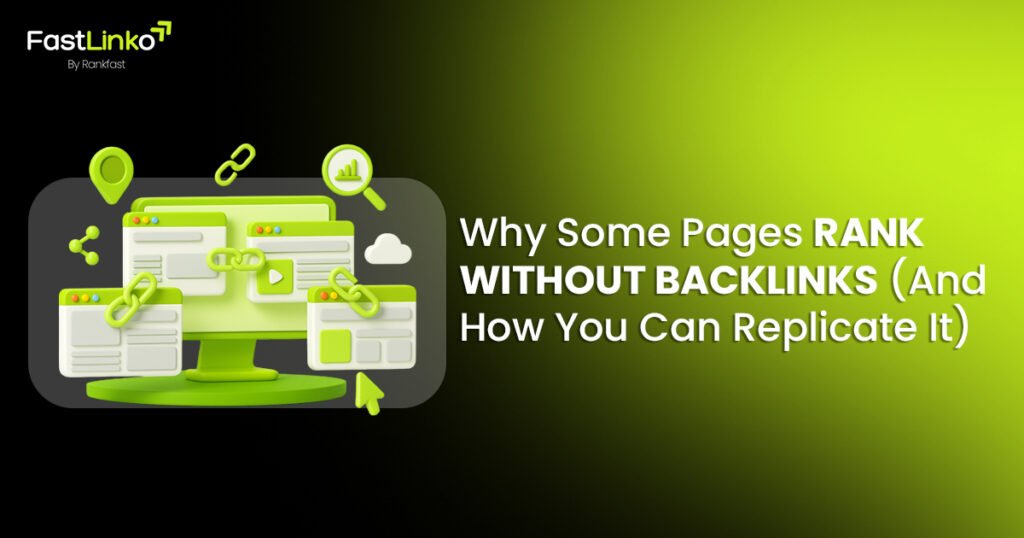

Pages ranking without backlinks reveal how search now responds to information architecture, not just authority signals.
When a page earns visibility in 2025, it’s usually because of one main reason. The topic is framed with plenty of semantic SEO and topical authority. This is done for Google to recognise its role within a broader concept graph. Today, search engines aren’t rewarding shortcuts. They’re rewarding pages that help them understand the subject faster.
For B2B teams, tight clusters, predictable entity relationships, and precise intent mapping make a page easier to classify, route, and surface. Now, ranking has moved past contextual link building services. This is why pages built with strong semantic logic and clean UX often move earlier in the SERPs and trust experts. Partners like Fastlinko can reduce processing ambiguity, which increases trust.
This piece outlines how teams can build those conditions without depending on guest post sites or artificial link momentum.
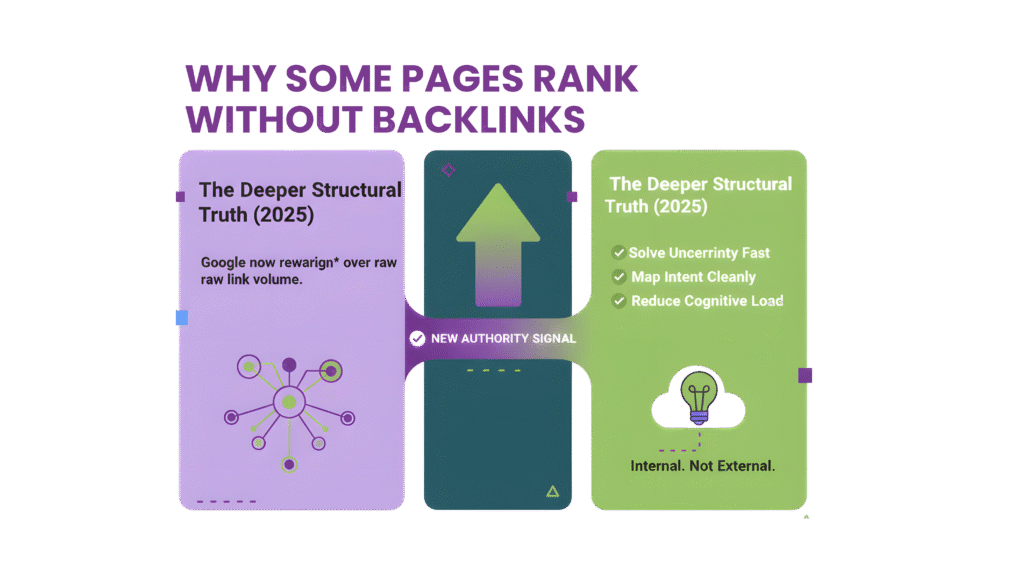
Pages that surface without backlinks often look like anomalies from the outside
But in 2025, they represent a deeper structural truth. Google now rewards meaning, clarity, and entity precision more than raw link volume. In a semantic-first ecosystem, the search engine and end user aren’t asking Who links to you?
It’s asking “Do you understand the topic better than anyone else?”
That shift explains why brands with thin backlink profiles still outperform competitors with heavier link portfolios. They’re building pages that solve uncertainty
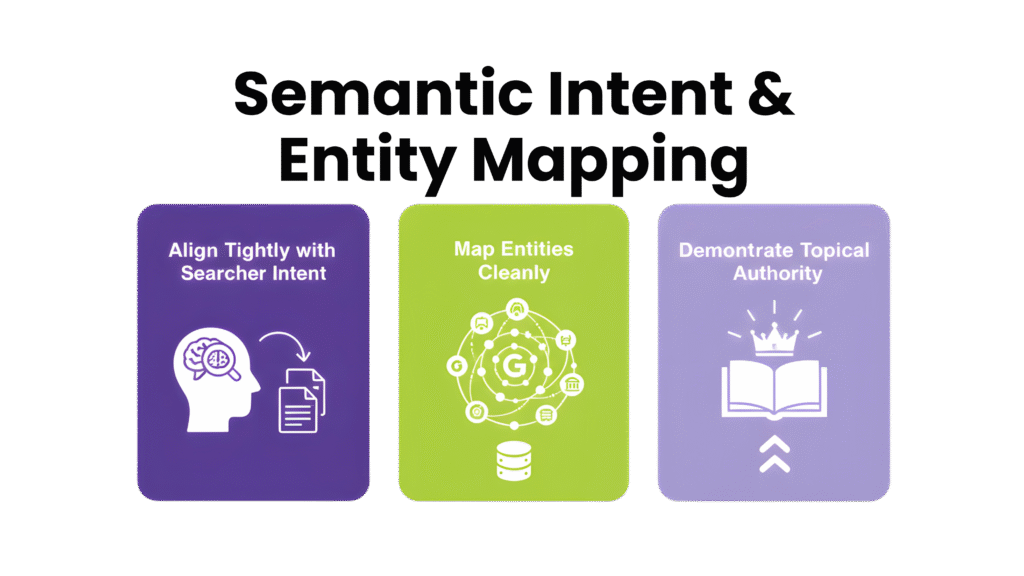
Google now evaluates whether a page mirrors how users actually think through a topic. Pages ranking without backlinks typically:
This is where semantic SEO becomes the real differentiator. Search platforms can infer authority without needing guest post sites or external references simply because the internal logic of the page already shows expertise.
fast, map intent cleanly, and present information in a way that reduces the engine’s cognitive load.
This becomes the new authority signal. An internal one, not dependent on external validation.
These zero-link performers almost always show architectural discipline:
When Google’s crawlers experience no friction, no semantic dead ends, no layout confusion, and no opaque transitions. Eventually, the ranking gap between pages with backlinks and pages without backlinks narrows dramatically.
A page that teaches well becomes a page that ranks well.
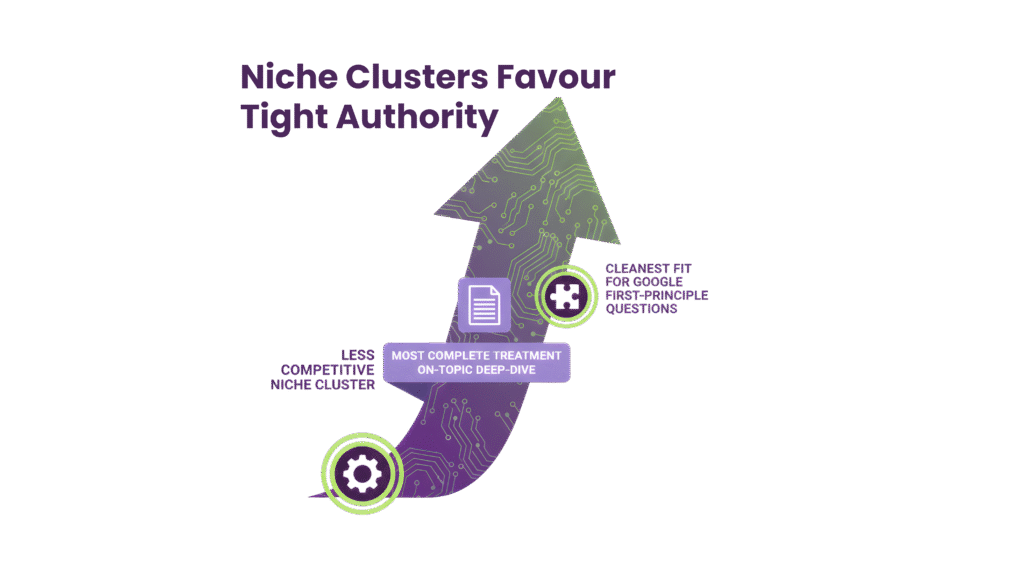
Pages ranking without backlinks often dominate micro-clusters rather than broad categories. They win because:
This is how topical authority becomes more valuable than accumulating traditional links.
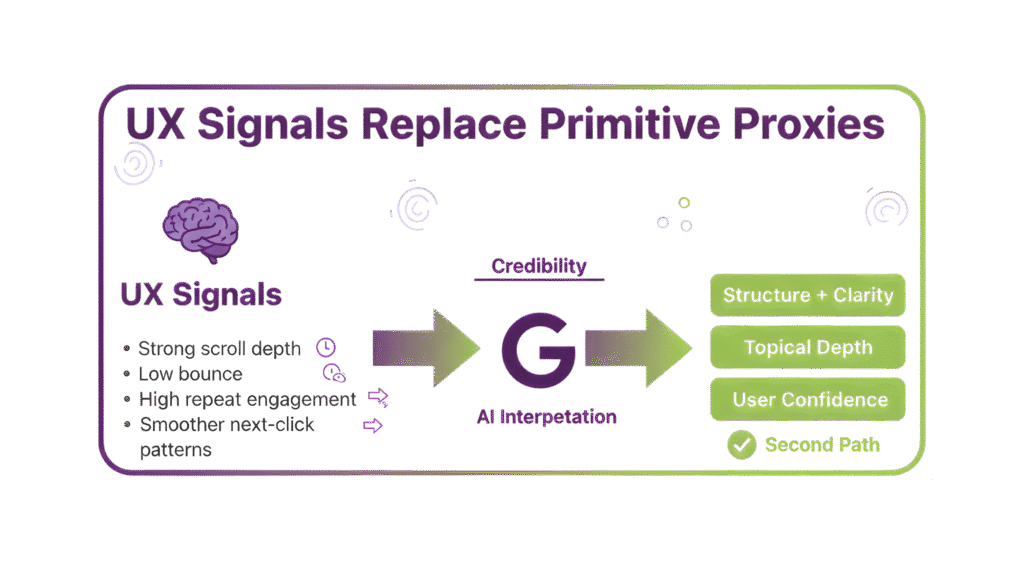
Google monitors behavioural clarity just as much as textual clarity. It examines content assets for :
These micro-signals indicate that the page is a decision accelerator, not just a passive information sheet.
Search engines interpret this as credibility. It has become a substitute for backlinks in many contexts.
Sophisticated B2B teams often assume that a contextual link building service or high-authority placements are mandatory prerequisites for ranking. But the semantic era reveals a second path:
It starts with structure, then clarity, followed by topical depth, and is preceded by user confidence before final rankings.
This is where semantic SEO aligns perfectly with B2B logic. The better the page understands the buyer’s mental model, the less it relies on external signals to validate its authority.
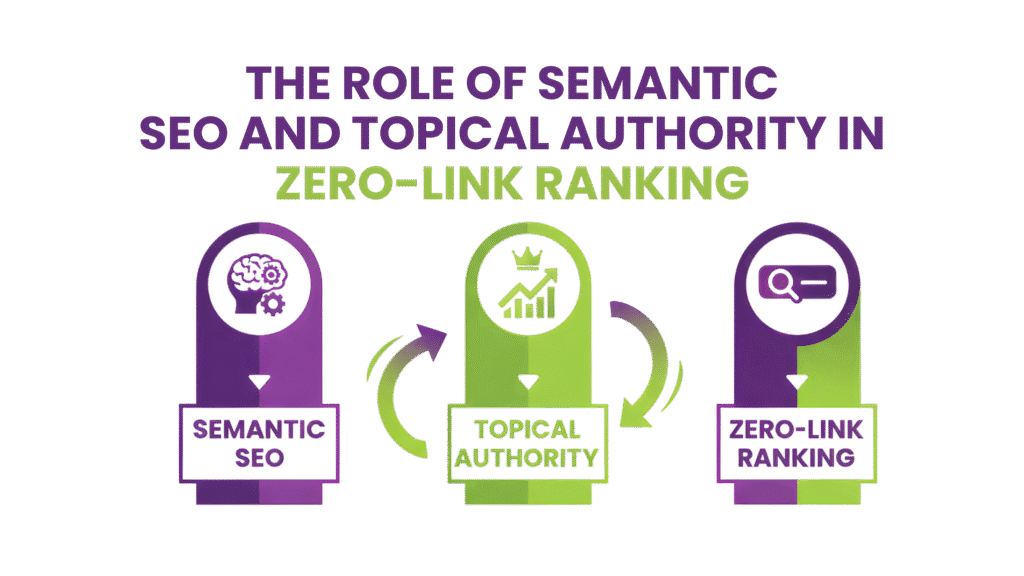
Once you understand how semantic modelling works, it becomes obvious why certain pages rise even without validation from links, syndication, or external mentions.
Their advantage isn’t volume of content or links, it’s structural clarity. That clarity signals confidence, which Google now treats as a ranking asset of its own.
Let’s read more about the role of semantic SEO and topical authority in zero-link ranking.
The old ranking logic looked for keyword repetition.
Today, semantic SEO evaluates whether the page genuinely understands the topic. Google checks concept groupings, question coverage, definitional consistency, and the narrative arc of information.
Pages ranking without backlinks usually succeed because they map user intent more completely than competitors with stronger link profiles. Their structure makes the meaning unmistakable.
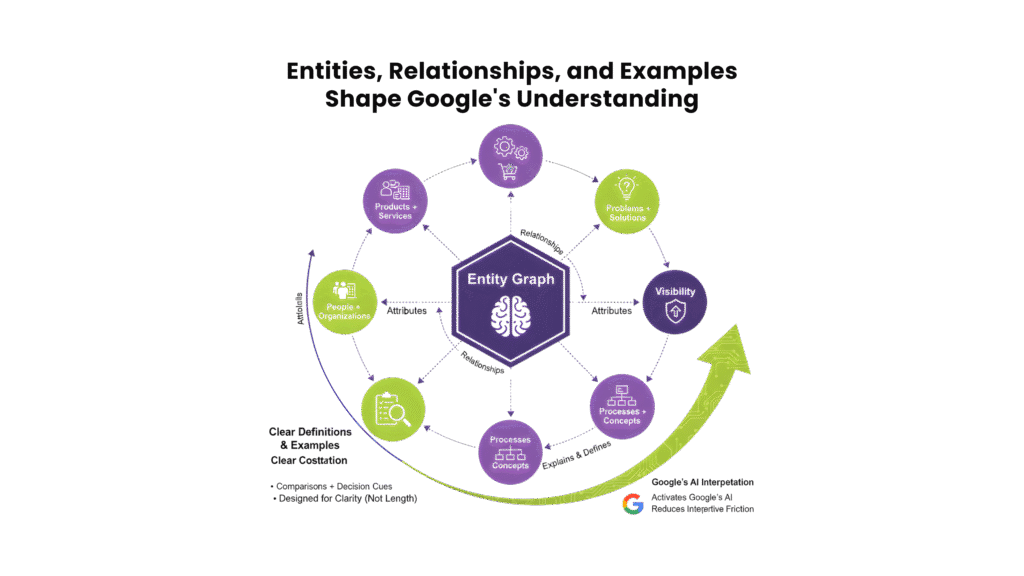
Every topic is an ecosystem of entities, attributes, and relationships. Traditional optimisation focuses on phrases; semantic optimisation focuses on context.
Pages with clear definitions, examples, comparisons, and decision cues activate Google’s entity graph more efficiently. That’s why zero-link winners tend to read like explanations that are designed for clarity rather than essays that are designed for length.
They reduce interpretive friction. It lifts visibility even without support from a contextual link building service or external citations.
High-authority domains still lose rankings when pages are scattered, broad, or superficial. Meanwhile, small sites climb because they stay narrow.
Depth signals expertise. Tight scope signals confidence.
When content answers one specific question deeply, Google doesn’t require backlinks to infer authority. The internal semantic cohesion itself is the authority.
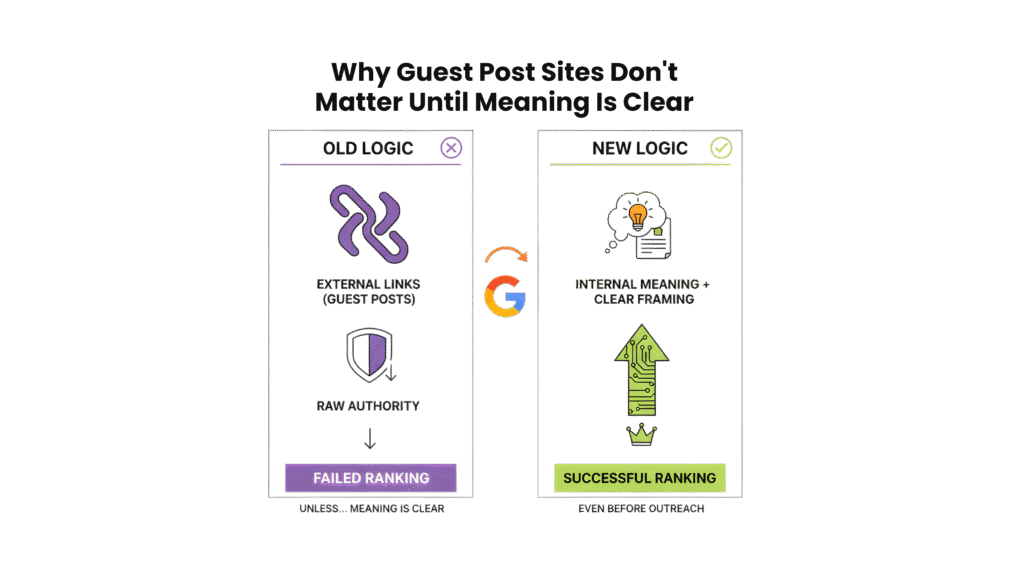
You can push links from guest post sites, niche edits, or branded campaigns. Yet, none of it holds unless the core meaning of the page is stable.
This is the algorithmic shift: Google values correct framing first, authority second.
That’s why link building outsourcing fails when the target page lacks semantic structure. It’s also why many new pages quietly rank before any outreach begins.
Google’s ranking logic increasingly rewards pages that declare structure early. It helps to align readers in the sales funnel with the brand:
This structure helps the crawler and the reader. When both find clarity fast, the page performs better, even without backlinks.
B2B brands investing in topical authority see pages rank earlier. This is because they build meaning consistently across a cluster. When the cluster is coherent, Google trusts new pages instantly, even with zero links.
This is the advantage small teams have discovered. When semantic coverage is disciplined, page ranking without backlinks is not a phenomenon; it’s an expected outcome.
It becomes the foundation on which contextual links, if added later, compound faster and more predictably.
B2B teams often assume that pages ranking without backlinks signal a rare anomaly.
In reality, they reveal how search has changed. The brands winning these placements don’t rank because they hack anything. They rank because their pages resolve intent faster and more confidently than anyone else on the SERP.
The following framework outlines how these patterns form and how B2B operators can intentionally replicate them.
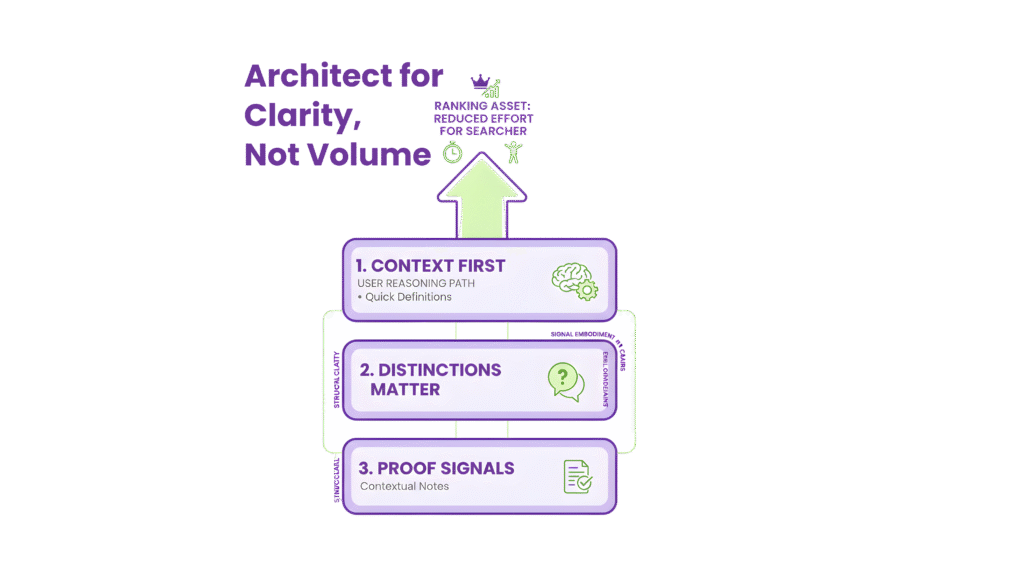
Pages ranking without backlinks tend to follow a structural discipline many large sites ignore.
Their content architecture reduces cognitive friction. Their header flow mirrors user reasoning rather than SEO convention. Their examples and definitions appear exactly where a reader expects them.
This clarity functions as a ranking asset. Engines now model how real humans move through information. If your page anticipates reasoning sequences like what context readers need first, which distinctions matter most, and where proof signals reinforce trust.
Somewhere, you outperform competitors relying on keyword density. High-performing pages also use short-form credibility anchors like quick definitions, micro-comparisons, checklists, and contextual notes.
These cues tell the engine you are reducing effort for the searcher, which is now a core measurement of relevance.
Zero-backlink pages win because they establish strong semantic logic. They identify core entities, show relationships between them, and answer supporting questions in a predictable, structured pattern. This creates semantic SEO alignment without forcing keywords.
Your goal is to build meaning, not text.
Each section should strengthen how the topic connects to adjacent concepts. For example, an article on “invoice automation” should subtly reference reconciliation workflows, compliance triggers, reporting gaps, and operational controls. These relationships deepen topical authority even before a single link is earned.
Over time, this creates an internal knowledge graph strong enough for pages to rank without backlinks.
Zero-backlink success is ranked by semantic completeness.
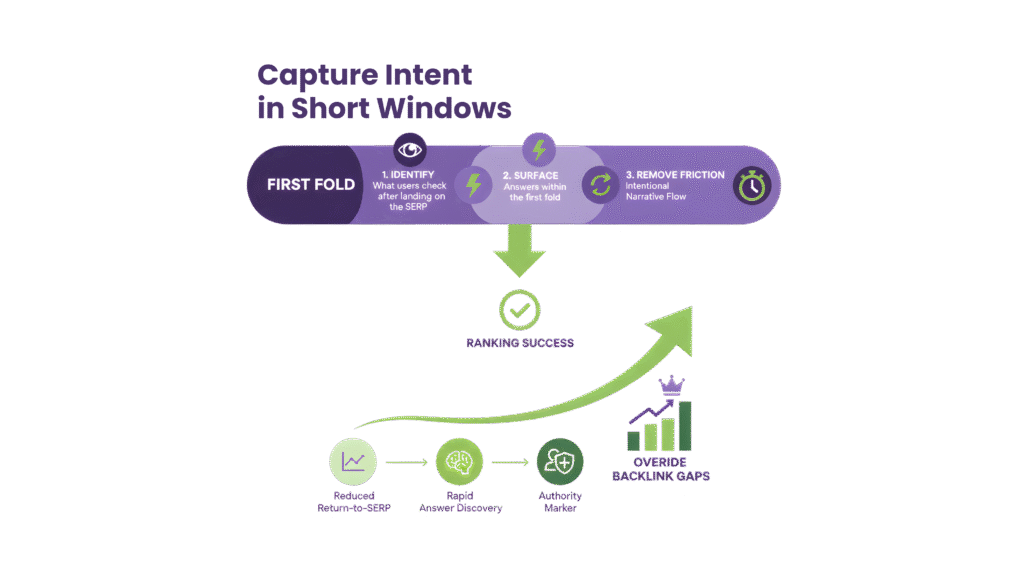
The window for proving relevance is shrinking. Engines track how quickly a page resolves uncertainty. This is where most B2B pages fail.
To replicate zero-backlink ranking patterns, you need to:
If users want distinctions, provide comparisons. If they want clarity, provide definitions. If they want signals, provide indicators and criteria.
Behavioural patterns matter more than ever. Scroll depth, return-to-SERP reduction, and rapid answer discovery act as authority markers. Your page satisfies intent better than alternatives, which often overrides backlink gaps entirely.
In 2025, user behaviour is the strongest ranking factor you don’t directly control. But you can influence it through better UX, cleaner layout, faster information delivery, and intentional narrative flow.
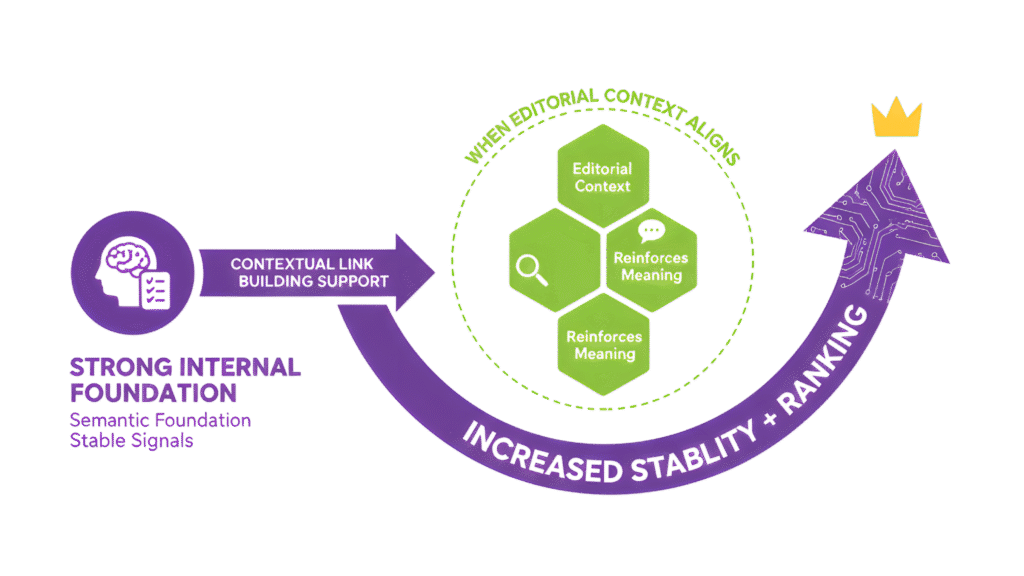
While zero-backlink pages can rank, contextual signals amplify stability.
A contextual link building service strengthens your semantic footprint by placing links where editorial context already aligns with your topic. These placements perform because they reinforce meaning, not because they inflate metrics.
High authority link building helps, but only when the target page already has a strong internal semantic foundation. Search engines and platforms can spot misalignment instantly. But authority without relevance delivers diminishing returns.
The winning model blends internal coherence with external context — a strategy most teams overlook when they treat link building as a numbers game instead of a context game.
Ranking without backlinks is a trust outcome. Engines trust predictable signals. They trust stable patterns. They trust coherence across content assets.
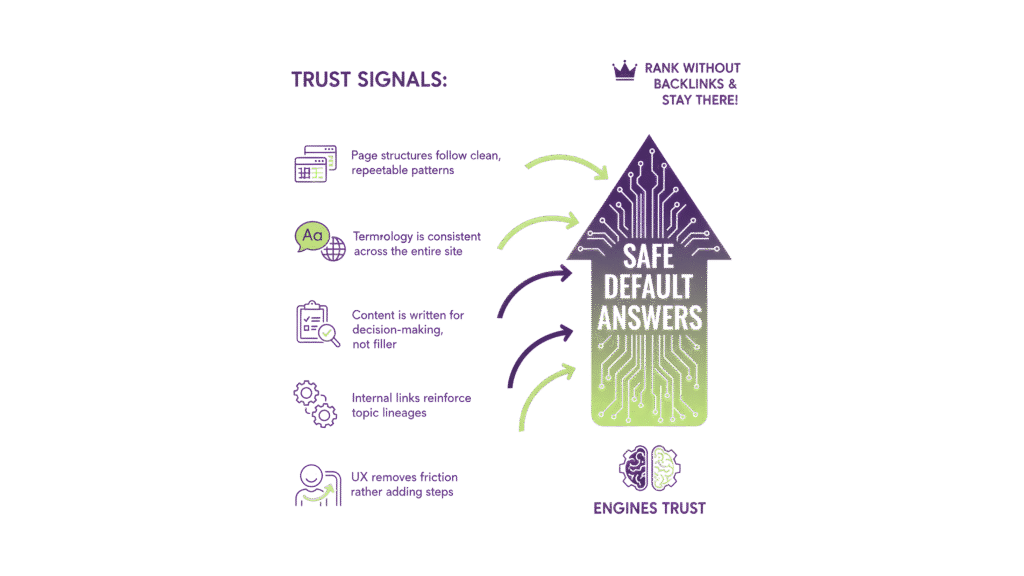
Trust is earned when:
With enough of these signals, engines treat your pages as safe default answers. Exactly why some rank without backlinks and stay there through multiple updates.
Success here depends less on content volume and more on operational discipline. B2B teams that replicate zero-backlink patterns typically invest in:
This is where contextual link building service support integrates naturally.
Specialists strengthen areas where semantic signals are already strong but need external reinforcement. They avoid shallow link practices and focus on meaning-driven placements.
This is the only model search engines reward long-term.
Pages ranking without backlinks aren’t breaking rules; they’re reflecting new ones.
Google rewards meaning, organisation, and usefulness before it rewards authority. This is good news for B2B brands with lean budgets and strong product expertise. Fastlinko can be their go-to partner. If the page resolves intent better than competitors, ranking becomes a function of clarity, not clout.
But the long-term advantage compounds when these strong pages get supported by high authority link building and contextual link building service executions that reinforce their core narratives.
Ranking without backlinks is the starting point. Defending those rankings is where smart, structured content and selective, contextual authority come together.
Google rewards pages that help users move fast. Pages with focused depth, clean semantics, and predictable flow reduce uncertainty. Engines see that behaviour and reward consistency. Backlinks amplify credibility, but usefulness creates the first lift.
Yes. When a site covers a theme with discipline, engines detect pattern strength. They use internal consistency as a trust signal. If the cluster is well-built, even a single page can surface without external support.
Semantic SEO helps engines understand the idea behind the content. When signals align, ranking becomes easier. The page appears comprehensive without feeling heavy. Engines value coherence and reward the ease of interpretation.
Brands replicate this by tightening structure. They build pages that answer intent without noise. They align topics with user pathways. Engines read that order and treat it as authority born from clarity, not popularity.
