
How US Agencies Use Guest Posting to Build Authority for Clients
January 30, 2026






Local citation sites still influence Google Maps rankings, but their role has become more selective. In 2026, Google Maps does not reward broad directory coverage. It relies on a smaller set of sources to:
Local citation building works as a validation layer. Google Maps cross-checks business details against USA directories it already trusts for geographic accuracy, operational legitimacy & update reliability. When information aligns across these sources, rankings stabilise. When it doesn’t, additional listings add little value. From a search systems perspective, citations for SEO contribute less through volume and more through confirmation.
Some local citation sites are important as they act like reference points in Google’s local data graph. Others lose influence as their data quality, regional relevance or governance weakens.
Explore US local citation sites that matter for Google Maps rankings. Learn which local citation sites still support rankings. Discover how local citation services like Fastlinko focus on precision instead of scale to maintain long-term Maps visibility.
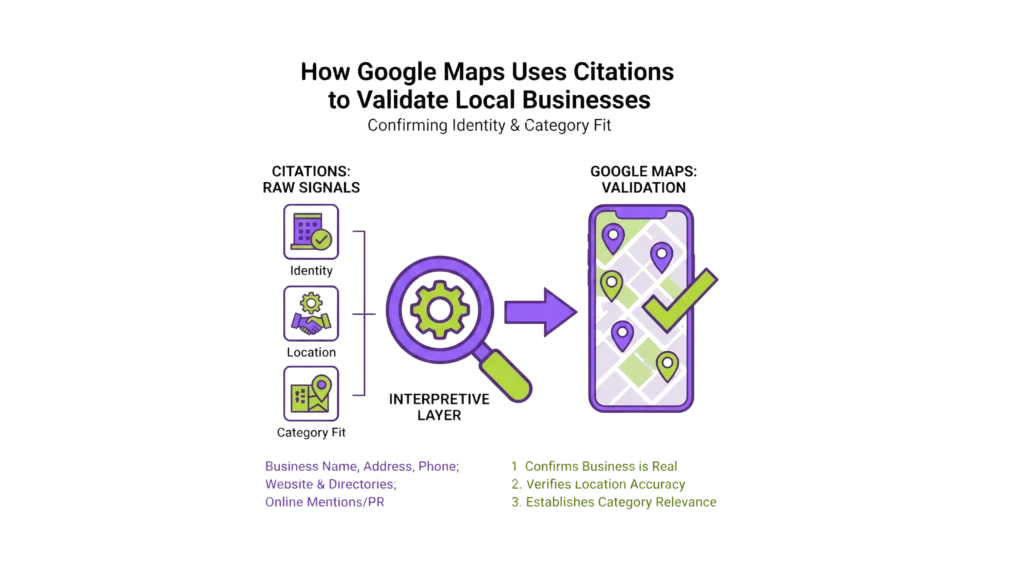
Before Google Maps decides where a business should appear, it must first resolve a more basic question, if this business is real & does it belong here. Rankings, proximity and competition come at a later stage. Citations support this early validation layer by helping the system confirm identity, location and category fit. Their role is interpretive, not promotional & that distinction matters.
Understanding this helps explain why citations influence Maps visibility without behaving like traditional ranking factors. Let’s see how google maps uses citations to validate local businesses:
Within Google Maps, citations are not treated as that push a business upward. They are treated as confirmation sources that reduce uncertainty. When a business appears consistently across trusted local citation sites, the system gains confidence that the entity exists beyond its own ecosystem.
This confirmation allows Google to reuse the business safely in Maps results. Without it, visibility is cautious and limited. Citations do not add competitive strength. They make participation possible. This is why citations for SEO behave differently in Maps than in organic search.
Google does not weigh all citation sources equally. It prioritises platforms with a history of accurate, maintained data. These sources act as reference points when conflicting information exists elsewhere.
In USA directories, some platforms are consistently updated and widely referenced, while others are noisy or outdated. Google learns these patterns over time. Citations from reliable sources resolve ambiguity faster. Those from unreliable sources add little clarity, even if they are numerous. Thus, it explains why local citation services focus on data quality rather than sheer volume.
Google Maps does not evaluate citations through a link-based lens. There is no equity transfer. Instead, the system asks whether all references describe the same business with the same core attributes.
When identity details align across citations, Maps can confidently associate searches with the correct listing. When they do not, visibility hesitates. This is why local citation building supports Maps stability even when no ranking lift is visible. The benefit lies in resolution, not amplification.
Location interpretation is especially sensitive in Maps. Service-area brands, multi-location businesses, and similar names increase ambiguity. Repeated, consistent citations help narrow that ambiguity.
Each aligned reference reinforces where the business operates and which searches it should appear for. Over time, repeated confirmation reduces the need for constant re-evaluation. The listing becomes stable because the system no longer questions its placement.
Citations inside Google Maps function as trust infrastructure. They confirm existence, resolve location, and validate category fit. They do not compete with proximity or prominence. They make those factors usable.
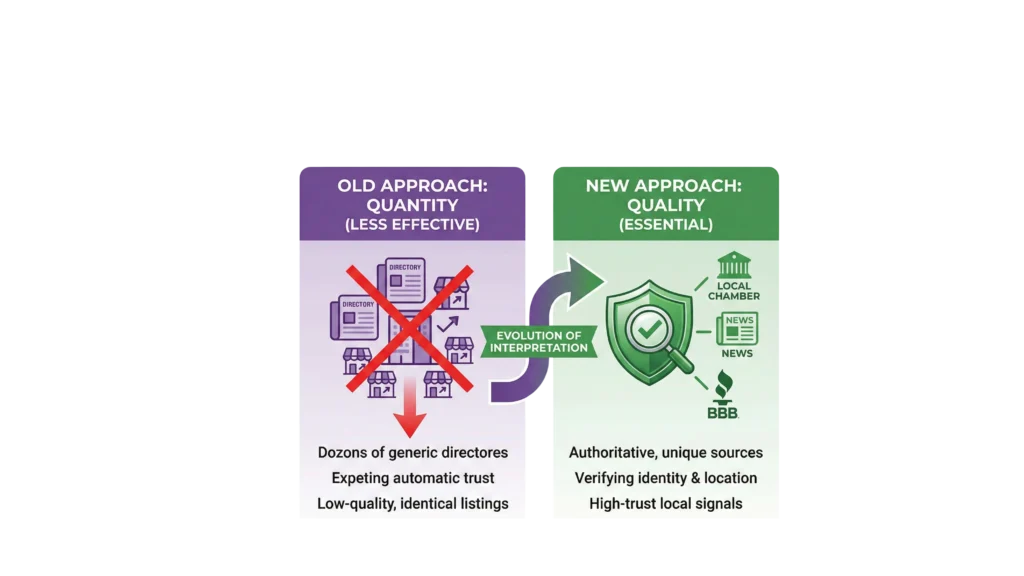
For a long time, local citation sites were treated as foundational inputs for Maps visibility. Businesses listed themselves across dozens of directories and expected trust to accumulate automatically. That expectation no longer holds.
Today, many listings remain accurate yet contribute little to ranking stability. The shift is not sudden or punitive. It shows how local search systems now interpret confirmation and risk. Let’s dive into why many local citation sites no longer influence maps rankings:
Many local citation sites expanded rapidly without strengthening editorial control. Listings are often accepted automatically, with minimal verification of business legitimacy, category accuracy, or location claims. From a system perspective, this lowers confidence. If a directory does not actively validate what it publishes, its confirmations carry less interpretive value.
Search engines learn which sources correct errors and which simply store submissions. Over time, directories with weak oversight stop functioning as reliable validators. Even when citations for SEO remain accurate, the lack of human or procedural review reduces their weight in Maps interpretation.
A large portion of usa directories now recycle the same underlying data. Listings are syndicated, mirrored, or scraped from shared aggregators. While this increases visibility on paper, it does not increase confirmation. Search systems recognise redundancy.
When multiple local citation sites repeat identical information from the same source, they are treated as a single signal, not many. No new certainty is created. This is why extensive local citation building across similar platforms often produces diminishing returns. The system is not ignoring the data. It has already accounted for it.
Maps ranking relies heavily on contextual relevance. Generic directories that serve every industry and every location equally struggle to provide that context. They confirm existence but offer little insight into where or why a business matters locally.
As local intent has become more granular, directories without regional depth or category focus contribute less to trust. Local citation services built around broad platforms often fail to influence Maps rankings because the listings do not reflect real-world commercial ecosystems. Relevance, not reach, now determines impact.
Automation accelerated directory growth, but it also introduced subtle inconsistencies. Formatting differences, delayed updates, and category mismatches accumulate quietly. Even small discrepancies increase interpretive friction.
Search engines are cautious with sources that introduce variability. When automated local citation sites show lagging or conflicting data, their confirmations are discounted to reduce risk. This does not result in penalties. It results in reduced reliance. Accuracy alone is no longer enough if consistency cannot be maintained.
The reduced impact of many local citation sites is not about age or popularity. It is about interpretive value. Maps rankings depend on sources that actively reduce uncertainty, not those that merely repeat information. As confirmation standards rise, directories that fail to add new clarity naturally lose influence.

Once Google’s validation logic and trust filters are clear, influential citation sites become easier to identify. Not all listings shape Maps visibility anymore. What matters now is where your business is validated, how often those sources are referenced, and whether the data reinforces real-world presence rather than directory noise.
This section focuses only on local citation sites that still move Google Maps rankings, and why those sources continue to matter in practice.
At the base of Google Maps validation sit a small group of primary data aggregators. These platforms act as upstream suppliers for hundreds of downstream listings across the web. When Google checks your business information, these sources are referenced repeatedly because they reduce ambiguity.
For local citation building, this layer matters because errors here propagate everywhere. A mismatch at the aggregator level does not just affect one listing. It creates conflicting signals across multiple usa directories at once. That fragmentation weakens confidence in location accuracy, category relevance, and operational legitimacy.
Effective citations for SEO start here, not because these sites drive traffic, but because they stabilise your identity across the ecosystem. When the core data is clean, every secondary citation inherits that clarity.
Beyond national data sources, Google places disproportionate trust in regionally authoritative directories. These include state-level business registries, city-specific platforms, and local chambers of commerce that reflect real economic participation.
These local citation sites matter because they validate where a business operates, not just that it exists. A listing on a state-trusted directory confirms geographic relevance in a way generic national platforms cannot. This is especially important for service businesses competing in dense metro areas or multi-city regions.
Local citation services that understand Maps dynamics prioritise these sources because they reduce distance ambiguity. They tell Google that the business is not just indexed nationally, but rooted locally in a specific service area.
Industry-specific directories play a different role. They do not primarily validate location. They validate category fit.
When Google evaluates Maps rankings, it cross-checks whether a business consistently appears in environments aligned with its declared services. Listings on category-aligned platforms signal that the business belongs in that vertical, not just that it operates at an address.
For example, a legal firm appearing across legal associations and practice-specific directories sends a stronger signal than appearing on dozens of unrelated free business citation sites. This is where citations for SEO become about intent matching rather than volume.
Local citation building that ignores industry context often produces inflated listing counts with weak validation value. Precision here matters more than scale.
Certain consumer platforms continue to matter because they combine citations with observable user behaviour. These platforms are not trusted solely because they are popular, but because they generate engagement that Google can measure.
When a citation exists alongside reviews, check-ins, or repeated user interactions, it reinforces that the business is operational and discoverable. These signals reduce the likelihood of spam or placeholder listings.
For Google Maps, this layer acts as behavioural confirmation. It supports what static directories claim with evidence of real usage. That is why these platforms remain a priority for local citation services focused on Maps outcomes rather than raw listing counts.
Listings on government or institutional platforms are difficult to manipulate and slow to update. That friction is precisely why they matter.
When a business appears on municipal portals, licensing databases, or educational and healthcare-linked registries, it sends a strong legitimacy signal. Google treats these sources as high-confidence validators because they are not designed for marketing exposure.
These citations rarely drive traffic. Their value lies in reinforcing trust layers that commercial directories cannot replicate. For businesses operating in regulated or service-heavy sectors, this category often has outsized impact on Maps stability.
When citations align across aggregators, regional authorities, industry platforms, and high-trust consumer sources, Maps rankings stabilise. When they don’t, volatility follows.
Local citation sites still matter for Google Maps rankings, but only when they reinforce trust. Rather than inflating presence, in 2026, Maps visibility is built through consistent confirmation. Experts like Fastlinko achieve this for US brands across a limited set of reliable, relevant sources.
US businesses that perform well locally focus less on directory volume and more on citation quality, regional relevance, and data stability. By aligning citation building with how Google Maps validates businesses, they reduce volatility and improve long-term visibility. The future of citation building isn’t broader coverage. It’s better confirmation.
Because Google now looks at usefulness, not just presence. Some directories still reflect how people discover businesses. Others exist only as databases. Listings that show real activity help Google build confidence. Listings that don’t are largely ignored.
Familiar names don’t always mean strong signals. Many large directories still collect data but don’t enforce accuracy. Over time, Google learned to discount listings that change often or remain outdated. Size stopped being a proxy for trust.
Consistency removes doubt. When business details match across listings, Google doesn’t have to reconcile conflicts. That clean signal supports steadier Maps rankings. Broad coverage with small errors does the opposite, even if the number of citations looks impressive.
They can create instability. Conflicting addresses or phone numbers force Google to guess. That uncertainty often shows up as ranking drops or inconsistent visibility. Cleaning errors rarely causes sudden jumps, but it helps rankings stay put.
