
How US Agencies Use Guest Posting to Build Authority for Clients
January 30, 2026









Choosing the best press release distribution service has become less straightforward for US brands. On the surface, most platforms promise similar outcomes: reach, pickup, and visibility. But experts like Fastlinko know distribution decisions increasingly shape how a brand is perceived, not just where it appears.
What has changed is how editors, news algorithms, and audiences interpret press releases. Reach alone no longer guarantees credibility. Wide submission without context can dilute trust, while selective placement can quietly strengthen authority. This is why many USA PR brands now evaluate distribution services less like media lists and more like reputation infrastructure.
The confusion isn’t about whether optimized press release services still work. It’s about understanding what different distribution models actually signal, to editors, to Google News, and to readers. Optimized press release submission services vary widely in how they influence narrative control, pickup quality, and long-term PR value.
This blog explains how US brands compare press release marketing services today, what factors matter beyond reach, and how to assess distribution options based on credibility, context, and strategic intent.

Press release distribution in the United States does not function as a neutral delivery mechanism. It is not simply a way to “get information out.” Within the US media ecosystem, distribution itself becomes a signal — one that editors, aggregators, and algorithms interpret long before they engage with the story’s substance.
At the screening stage, distribution answers a quiet but important question: what kind of source is this, and how should it be treated? That interpretation shapes whether a release is trusted, deprioritised, or ignored entirely.
Editors do not encounter press releases as isolated messages. They encounter them as outputs of specific distribution environments. Over time, those environments develop reputations.
Where a release appears influences how it is perceived. Certain distribution paths signal familiarity with editorial norms. Others signal mass broadcasting. This distinction matters because editors assess credibility defensively. Distribution choices help them decide whether a source understands the media ecosystem or is merely attempting to access it.
Trust, at this level, is inferred structurally. It is not about message quality yet. It is about perceived intent.
One of the strongest signals distribution creates is pickup behaviour. Editors and aggregators observe where stories travel, how they propagate, and which outlets replicate them.
A release picked up selectively sends a different signal than one replicated everywhere simultaneously. Pickup patterns suggest whether a story is being interpreted as newsworthy, contextually relevant, or simply available.
These patterns are not evaluated consciously every time. They are recognised through repetition. Over time, they train expectations about what a release represents.
Syndication density plays a subtle but powerful role. When a press release submission appears across many identical or near-identical placements, it creates saturation rather than validation.
Within the USA PR media ecosystem, density is not read as popularity. It is read as a distribution strategy. High-density syndication can flatten perceived value, making a story feel generic or pre-packaged.
This reaction is structural, not judgmental. Editors are sensitive to redundancy because redundancy increases editorial risk and reduces differentiation.
Distribution volume alone carries limited meaning. What matters is where a release appears relative to its subject, audience, and scope.
Editors and algorithms alike evaluate contextual fit. A story appearing in environments aligned with its topic, geography, or industry feels grounded. The same story appearing everywhere feels untethered.
This is why distribution is interpreted relationally. Placement context signals whether a story belongs somewhere, not just whether it exists.
When a release is distributed too broadly, too quickly, or too uniformly, it can weaken its own news signal. Instead of appearing timely or relevant, it begins to feel exhausted on arrival.

In the USA PR media environment, novelty is fragile. Editors are wary of stories that appear already consumed. Over-distribution compresses perceived lifespan, even if the content itself is new.
This is not about fairness. It is about signal decay.
The US media ecosystem is layered. National outlets, regional publications, local desks, and algorithmic aggregators all apply different filters.
Distribution choices interact with these layers differently. A path that works for national visibility may behave differently at a regional level. Local relevance, geographic proximity, and audience alignment alter how the same release is interpreted.
This is why US PR distribution is never singular. It is filtered, contextualised, and reframed as it moves through the system.
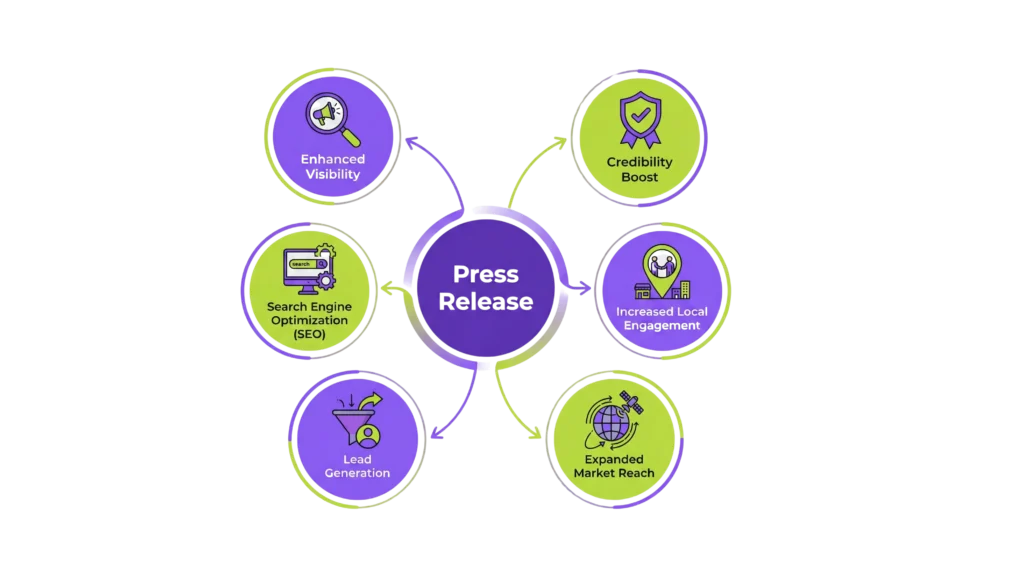
Seen through this lens, press release marketing is not a neutral utility. It is an interpretive signal that shapes how a story is received before it is read.
Editors do not assess distribution tactically. They respond to the patterns distribution creates. Those patterns influence trust, attention, and perceived legitimacy.
Understanding this reframes distribution entirely. It stops being a question of reach and starts being a question of meaning, a signal that quietly informs how the system treats the story that follows.
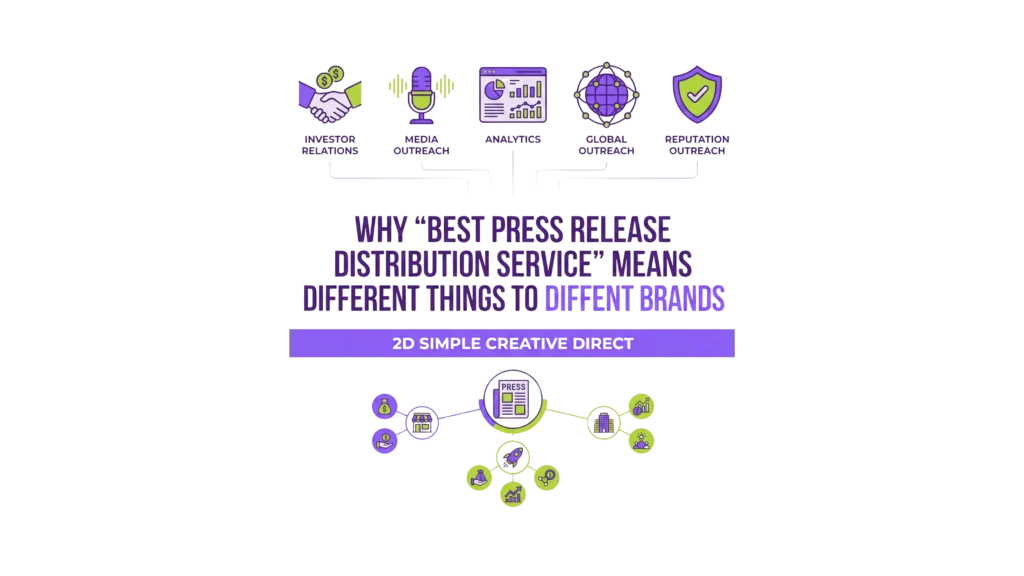
The idea of a single “best press release distribution service” assumes that distribution has one objective. In reality, distribution serves different functions depending on who is using it, what risk they carry, and how their story needs to behave once it enters the media ecosystem. What works for one brand can actively undermine another, even when the service features look identical.
This is why evaluations based on checklists or pricing tiers rarely hold up. Distribution effectiveness is not universal. It is contextual.
Early-stage brands often approach distribution seeking visibility. The goal is recognition, discovery, and initial validation. In this context, broad exposure can feel valuable because the brand is still introducing itself to the ecosystem.
Established brands operate under a different constraint. Visibility already exists. The risk is not being seen, but being seen incorrectly. For these brands, distribution is less about reach and more about credibility, signal control, and editorial alignment. The same distribution path can feel expansive to one and destabilising to the other.
Some brands use distribution to test newsworthiness. They want to see whether a story attracts editorial attention, selective pickup, or contextual reuse. In these cases, distribution functions as a validation layer.
Others treat distribution as reinforcement. The goal is not editorial interest, but visibility consistency across search and aggregation surfaces. Both uses are legitimate, but they interpret success differently. A distribution service that performs well for one lens may feel ineffective through the other.
Optimized press release services operate inside a narrower trust environment. Geographic proximity, recognisable institutions, and community relevance influence how distribution is interpreted. A service that reaches local desks effectively may feel limited at a national level.
National distribution introduces different filters. Competition is higher. Editorial thresholds are stricter. Contextual relevance must travel further. What feels like scale locally can feel like noise nationally. The “best” service depends on which environment the story needs to survive in.
Distribution choices also reflect a trade-off between narrative control and raw pickup volume. Some services prioritise wide replication, allowing stories to travel quickly but with minimal context.
Others create narrower pathways that preserve framing and reduce distortion. Neither approach is inherently superior. The right balance depends on how much interpretive control a brand needs once the story leaves its hands.
There is no universal definition of “best” in press release marketing. Effectiveness depends on intent, risk tolerance, and narrative goals. Distribution services are not interchangeable because brands are not interchangeable.
This section reframes evaluation away from platforms and toward perspective. The next section can now explore how brands align distribution choices with credibility, visibility, and long-term trust, without assuming a single standard applies to everyone.
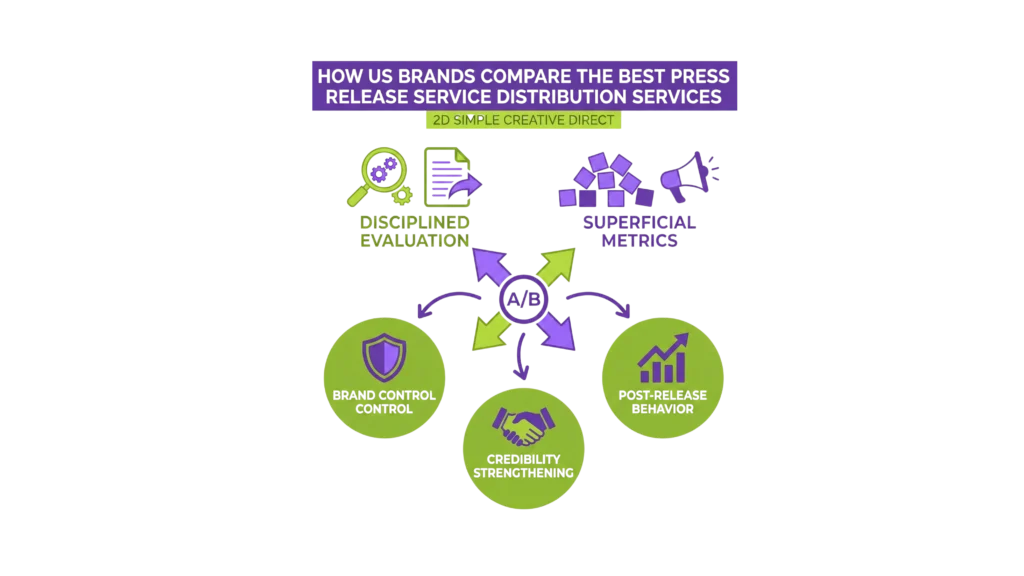
Once distribution signals and evaluation lenses are understood, comparison becomes more disciplined. Mature USA PR brands no longer select optimized press release services based on reach claims or logo walls. They compare providers based on how distribution behaves after release, how much control the brand retains, and whether the service strengthens credibility rather than inflating visibility. This section explains how serious teams evaluate press release marketing without relying on surface metrics.
The first filter is not how many sites picked up the release, but where it was picked up. Brands look closely at source reputation. A pickup from a publication with editorial standards, even if smaller, carries more weight than mass syndication across low-context sites. Editors, analysts, and buyers recognise quality sources, and so do search engines.
USA PR brands also track editorial reuse patterns. They examine whether parts of the release were quoted, summarised, or referenced elsewhere. Reuse signals that the content was considered safe, useful, and credible enough to be republished. A high pickup count with zero reuse often indicates distribution noise rather than influence.
Context matters as much as coverage. Brands evaluate whether placements align with industry relevance. A SaaS announcement appearing in logistics feeds or lifestyle aggregators adds little credibility, even if technically counted as distribution. The question is whether the release appeared in environments where the intended audience already consumes information.
Geographic relevance is another key factor. For region-specific announcements, local press release placement often outperforms national syndication. US brands assess whether a service can place stories in regionally meaningful networks that support local trust signals, regulatory relevance, or market presence. Contextual alignment reduces scepticism and increases perceived legitimacy.
Distribution is not just about reach. It is also about control. Brands examine how much editing freedom they retain once a release enters the distribution network. Services that lock content into rigid templates often limit the ability to refine tone, adjust emphasis, or respond to last-minute compliance needs.
Content positioning flexibility is equally important. Mature teams want the option to tailor headlines, summaries, or angles for different outlets without rewriting the entire release. This flexibility allows brands to maintain narrative integrity across channels, which directly affects press release submission credibility. Loss of control often leads to diluted messaging and increased editorial risk.
Not all networks are equal. USA PR brands look beyond the headline names and assess the actual composition of a distribution service’s network. They review syndication partners, the types of publications included, and how much overlap exists between outlets. Heavy overlap can create the illusion of reach without expanding influence.
Media overlap analysis helps brands understand whether a service truly extends visibility or simply repeats the same placement across mirrored sites. A smaller but diverse network often performs better than a large but redundant one. Network quality is judged by diversity, editorial standards, and audience relevance, not sheer size.
Comparison only works when distribution is matched to intent. Brands evaluate services based on how well they support specific PR objectives. Product news requires speed, clarity, and industry alignment. Thought leadership benefits from placements that allow narrative depth and selective amplification. Regulatory or financial updates demand precision, compliance support, and trusted environments.
The best press release distribution service is not universal. US brands often use different services for different objectives. They compare providers based on scenario fit rather than overall rankings. This approach prevents misalignment between message type and distribution environment, which is a common cause of wasted spend.
The best press release distribution service isn’t defined by how far a release travels. It’s defined by how accurately it lands. In the US media ecosystem, distribution shapes credibility, editorial response, and long-term narrative positioning.
Fastlinko approaches distribution strategically and understands that every placement sends a signal. By evaluating services through pickup quality, contextual alignment, and narrative control, they reduce risk and increase the likelihood that press releases support real visibility rather than short-term exposure.
In modern PR, distribution is no longer a mechanical step. It’s a strategic choice that determines how a story is received, reused, or ignored. Experts a
Syndication alone doesn’t create trust. When releases land on low-engagement sites or irrelevant networks, they don’t reinforce authority. Editors and search systems recognise this quickly, which is why many widely distributed releases generate little lasting value.
Industry norms shape editorial expectations. Tech, finance, healthcare, and local business releases are evaluated differently. The best distribution services understand these nuances and adjust targeting accordingly, rather than applying a single approach across all sectors.
They look for patterns of restraint. Services that limit low-quality pickups and focus on relevant outlets reduce reputational risk. Brands increasingly avoid platforms that trade credibility for volume, even when pricing appears attractive.
It feels measured. Coverage appears where it makes sense. Messaging stays intact. Results are consistent rather than flashy. Over time, teams trust the process because each release reinforces reputation instead of resetting it.
