How US Agencies Use Guest Posting to Build Authority for Clients
January 30, 2026





Press release SEO performance rarely breaks down because of one tactic. It breaks because the local citation building stack is incomplete. Many US businesses invest in links, organic link building, or build citations independently. This is assuming each activity strengthens visibility on its own. In reality, search engines evaluate local presence as a connected system.
When it comes to guest posting services, citations clarify identity, links signal authority & PR reinforces legitimacy. When these signals sync, local search results stabilise. This is why local SEO citation building services like Fastlinko matter beyond listings. They act as the structural layer that connects PR mentions, organic links & location data. Without that layer, other investments struggle to compound.
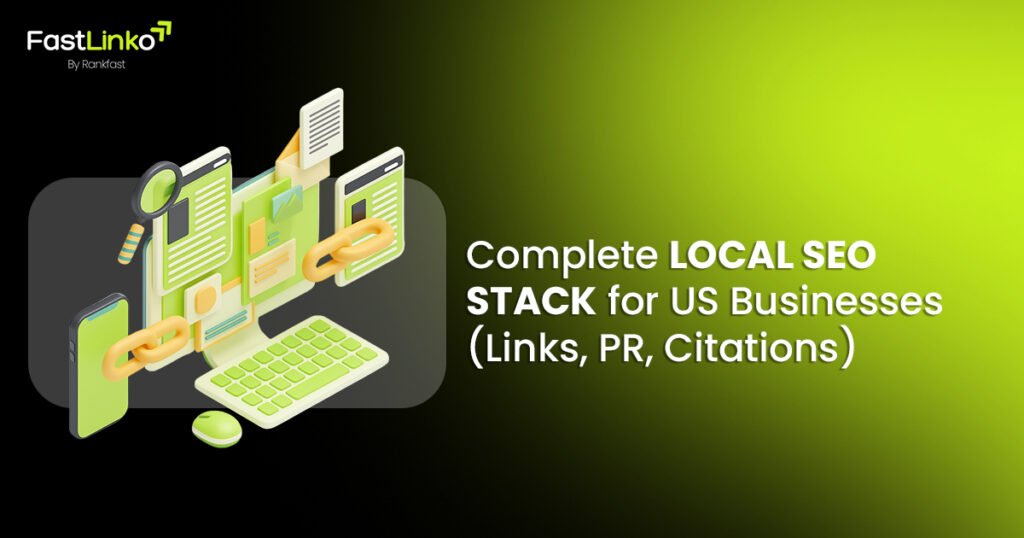
In 2026, strong local SEO stacks will be built intentionally. US brands treat citations, links & press as interdependent trust signals, not interchangeable tactics. This blog explains the complete local SEO stack for US businesses(Links, PR, Citations).
Search engines read Local SEO stacks as a single descriptive system. Their task is to explain who a business is, where it belongs & whether it can be trusted to appear consistently. Before rankings or competition are considered, the system is focused on reducing uncertainty. The local SEO stack exists to help that interpretation settle.
Visibility, here, is not earned through activity volume. It emerges once the system can interpret the business without hesitation. Let’s learn how search engines interpret a local SEO stack.
At a system level, search engines are not impressed by the number of local SEO tactics in play. They are sensitive to whether those signals describe the same reality. Citations, links, mentions, and content are evaluated together to see if they reinforce a coherent business identity.
When signals align, interpretation becomes cheaper. The system no longer has to reconcile contradictions. When signals conflict, even subtly, evaluation slows. Visibility does not drop because something is wrong. It stalls because certainty has not yet formed.
This is why stacks that appear busy but fragmented often underperform quieter, more aligned ones. Alignment reduces interpretive cost. Reduced cost enables reuse.
Identity resolution is the first gate in local search. Before authority or relevance can be applied, the system must be confident that all signals point to the same real-world entity. Business name consistency, citation alignment, and profile verification are not optimisation steps. They are classification requirements.
If identity remains unresolved, other signals lose leverage. Links, guest posting services or organic link building cannot compensate for entity confusion. The system avoids amplifying sources it cannot reliably identify, regardless of how strong individual signals appear.
Authority is not withheld as a penalty. It is deferred until identity stabilises.
Location interpretation is the structural anchor of the local SEO stack. Search engines must understand where a business operates before they can decide when and where to surface it. This is especially critical for service-area brands, where geography is implied rather than explicit.
Links and mentions only reinforce visibility when location certainty already exists. Without it, they introduce noise. A strong backlink pointing to an ambiguously located business does not clarify relevance. It complicates it.
This is why local citation building services play such a foundational role. They do not boost authority directly. They narrow geographic interpretation so other signals can function correctly.
Press release SEO and content-driven mentions are interpreted as legitimacy signals only when they reference a clearly verified entity. Search engines check whether the brand appearing in PR content matches existing citation and profile data.
When that alignment exists, PR reinforces trust. When it does not, PR introduces alternative representations that the system must resolve. Visibility hesitates until reconciliation occurs. PR cannot override unresolved identity or location signals. It amplifies what is already understood. Legitimacy follows verification, not the other way around.

Search engines read the local SEO stack as a unified description, not a collection of tactics. Visibility improves when signals align around identity, location, and legitimacy.
This section explains how the stack is read, not how it is built. With this understanding in place, differences in local SEO outcomes stop feeling arbitrary and start reflecting how clearly a business has been interpreted.
Many US brands invest steadily in SEO and still struggle to achieve lasting local growth. Activity continues, outputs increase, and individual tactics appear to “work” in isolation. Yet visibility plateaus. Rankings fluctuate. Momentum fades. This pattern is not caused by poor execution. It emerges when local SEO inputs are interpreted separately rather than as parts of a unified system.
Local SEO compounds only when signals reinforce the same understanding. Fragmentation breaks that loop.
Guest posting services often succeed at generating authority signals. Links appear in relevant publications. Visibility lifts temporarily. However, when those signals are not grounded in a clearly resolved local entity, their effect dissipates.
Search engines may acknowledge the authority transfer at a page level, but they cannot reliably attach it to a local business identity. The result is short-term movement without long-term retention. Authority floats. It does not anchor. Over time, the system treats these signals as isolated endorsements rather than reinforcing evidence of a trusted local presence.
Authority compounds only when it attaches to something stable.
Press release SEO introduces visibility. Mentions appear across news surfaces and aggregators. For a brief window, brand presence expands. Yet when those mentions are not aligned with verified local identity signals, their interpretive value remains limited.
Search engines check whether visibility confirms an existing entity or introduces ambiguity. When PR mentions do not reinforce the same business profile, location, and category signals already in place, they fail to strengthen trust. The system sees activity but cannot resolve certainty. Visibility occurs, but confidence does not deepen.
Without identity reinforcement, visibility becomes episodic rather than cumulative.
Organic link building is highly effective at amplifying content and improving page-level relevance. In a fragmented stack, however, those gains remain confined to individual URLs. The broader local entity does not benefit proportionally.
Search engines distinguish between pages that perform well and businesses that can be trusted repeatedly. When links point to pages disconnected from a stable local identity framework, the system treats them as isolated successes. Rankings improve, but only where signals converge briefly. Compounding stops once the page-level boost exhausts itself.
Entities compound. Pages peak.
Citations play a different role. They help resolve identity and location. When built independently of authority-building efforts, they succeed at clarification but fail to absorb value. The business becomes easier to interpret, but not more trusted.
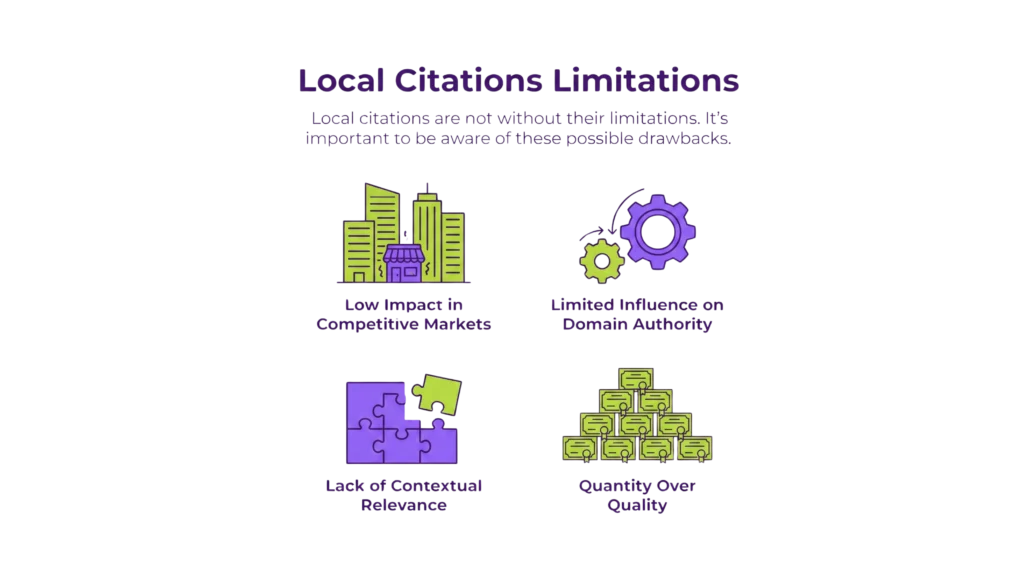
This creates a subtle ceiling. Authority signals arrive from one direction. Identity signals stabilise from another. Because they do not intersect, the system never receives confirmation that authority belongs to the clarified entity. Each input performs its function, but the loop never closes.
Compounding requires convergence, not parallel effort.
Fragmented local SEO does not trigger penalties. It produces diminishing returns. Each tactic performs its role, delivers a short-term effect, then levels off. Search engines are not rejecting the signals. They are failing to integrate them.
Without integration, the system cannot reduce uncertainty further. Interpretation stalls. Visibility hesitates. Growth slows without obvious failure. This is why fragmented execution feels confusing. Nothing is “wrong,” yet nothing compounds.
Local SEO stops compounding when signals describe different realities. Authority without grounding, visibility without identity, and clarity without reinforcement cannot accumulate trust. Search engines require convergence to move from recognition to confidence.
This section exposes why isolated tactics underperform even when executed correctly. Before solutions or services are considered, understanding this structural limitation is essential. Compounding begins only once interpretation gaps close.
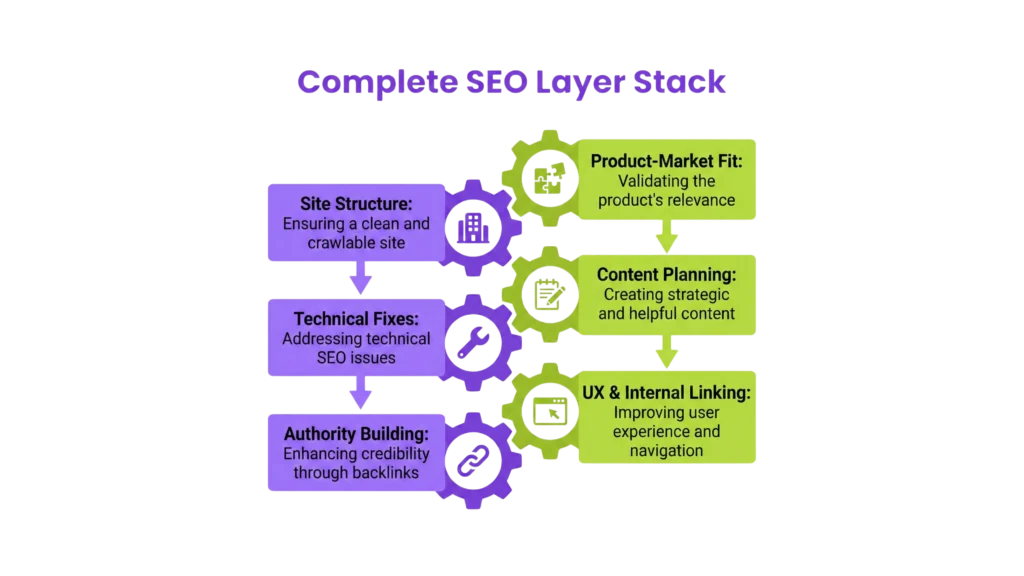
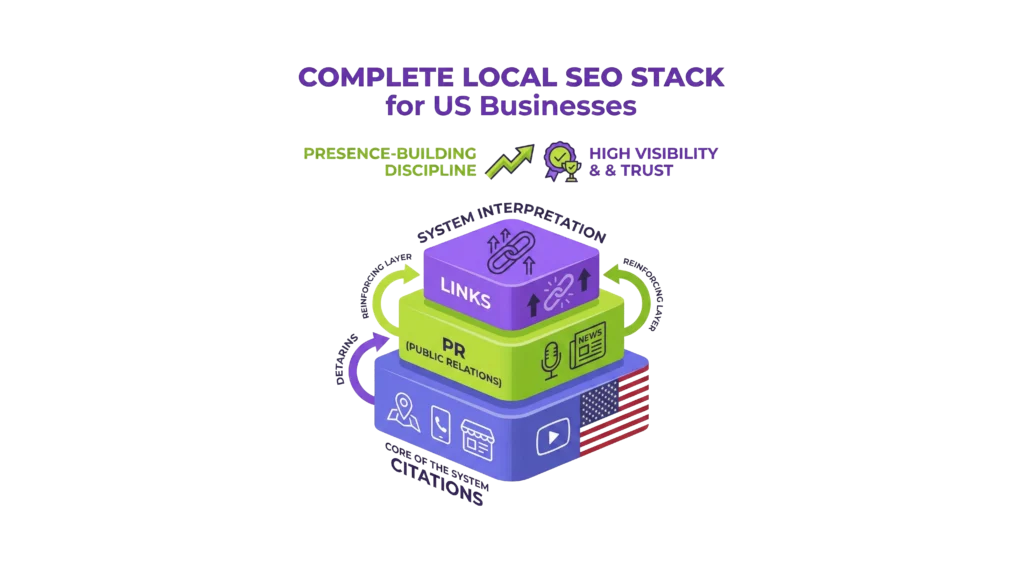
Once system interpretation and fragmentation risks are understood, local SEO stops being a checklist exercise and becomes a presence-building discipline. US businesses that perform consistently in local search do not run citations, links, and PR as separate tactics. They treat them as one reinforcing layer that helps search engines and users reach the same conclusion at the same time.
The local SEO citation building service sits at the core of this system, but it only works when links and PR are sequenced around it correctly.
Every local SEO stack starts with identity, not authority. Before a business can rank, it has to be recognised as real, stable, and consistently represented. Citations do this work quietly. They establish who the business is, where it operates, and how it should be referenced.
NAP consistency is not a hygiene task. It is an interpretation signal. Search engines cross-check business name, address, and phone number across directories, maps, apps, and data aggregators to decide whether an entity is trustworthy enough to surface locally. Even minor variations weaken that confidence.
For US businesses, especially service brands operating across multiple cities or states, entity confirmation matters more than volume. A smaller set of accurate, verified local citation building placements does more than hundreds of loose listings. This is why professional local citation services focus on identity lock-in before expansion. Until the entity is stable, nothing else in the stack holds.
Once identity is confirmed, organic link building begins to add weight to it. The mistake many businesses make is chasing homepage authority too early. In local SEO, links should reinforce verified locations and services, not float above them.
Links pointing to location-relevant pages help search engines connect authority with geography. When a service page, city page, or regional resource earns a contextual link, it strengthens the entity that citations already established. This is how organic link building supports local presence without distorting it.
High authority link building only works here if the destination is clean. If links point to pages with unclear location signals, mismatched services, or thin content, authority disperses instead of compounding. Strong local stacks build authority on top of confirmed entities, not beside them.
Press release SEO is often misunderstood in local contexts. PR does not create presence. It validates the presence that already exists. When press mentions reference businesses with established citations and consistent entities, they act as credibility accelerators.
Local and regional press mentions are especially powerful because they mirror how real users discover businesses. A press release that references a verified business name, location, and service area reinforces trust across search, maps, and AI-driven summaries. This is where PR fits into the stack.
The danger appears when PR is used too early. Press mentions without citation grounding or location clarity create noise. They may generate short-term visibility, but they do not stabilise rankings. In integrated systems, PR arrives after identity and authority are readable, not before.
The order of execution determines whether the stack compounds or collapses. Identity must come first. Citations establish who the business is. Authority follows through organic links tied to verified pages. Amplification arrives last through PR and guest posting.
Reversing this order causes instability. Visibility spikes without grounding often lead to ranking volatility. Search engines test, pull back, and reshuffle when signals arrive out of sequence. Businesses then misinterpret this as algorithm volatility when it is actually structural misalignment.
Strong local SEO citation building service providers manage sequencing as much as execution. They pace expansion so that each layer settles before the next applies pressure.
Local SEO success is rarely loud. It shows consistency. Businesses that integrate citations, links, and PR correctly see fewer ranking swings, steadier local pack presence, and repeat brand recognition across platforms.
Local pack consistency matters more than temporary position jumps. Reduced ranking fluctuation across weeks signals trust. Sustained brand recognition in directories, maps, and press references confirms entity strength.
This is why experienced teams avoid over-reporting activity metrics. They track stability, not expansion. When the stack is working, visibility holds even when competitors push harder.
Local SEO works best when every signal supports the same story. For US businesses, citations establish who they are and links show why they matter. PR confirms legitimacy of your goods/services at scale. When these elements operate together, visibility becomes durable rather than reactive.
A local SEO citation building service isn’t just a listings task. Top names like FASTLINKO are the connective tissue that allows link building and press activity to compound instead of conflict. Brands that treat SEO as a system, not a checklist, experience steadier rankings and fewer setbacks.
In local search, success isn’t about doing more. It’s about building a stack that search engines can trust consistently.
Safety comes from intent alignment. A post feels safe when it adds value to the host site’s audience and fits naturally into existing content. When the article reads like something the publication would have run anyway, the paid element becomes secondary.
Editorial intent shapes interpretation. When a post exists to inform or explain, links feel justified. When intent tilts toward promotion, trust erodes. White hat SEO today depends more on how content is framed than on whether money changed hands.
Context sets expectations. A link placed within analysis, commentary, or explanation carries weight. The same link dropped into unrelated content does not. Google reads this difference through engagement and content relevance rather than disclosure alone.
Yes, when visibility is the primary goal. Paid guest posts can introduce brands to new audiences and shape perception. Their SEO value works best as a secondary benefit, not the main objective. That mindset shift aligns better with how Google evaluates intent.
