
How US Agencies Use Guest Posting to Build Authority for Clients
January 30, 2026





Local press releases often look deceptively simple. They have the same formats, same announcements & same distribution buttons. Yet outcomes vary sharply by city. Some releases surface in search, earn pickup & reinforce local branding. Others disappear without leaving a trace.
The reason is location interpretation. In the US, search engines and local media ecosystems assess press releases through a city-specific lens. Relevance, credibility, & pickup potential change based on many factors. They are geography, publisher context & story alignment with local narratives. A release that performs well in one city may fail entirely in another, even when the business and announcement are identical.
This is why local press release strategy has shifted from broad submission to city-aware placement. Brands like Fastlinko understand how local PR signals are read to gain visibility. They use these insights to support rankings, discovery & trust simultaneously.
This blog explores local press releases in the USA: city level PR that actually ranks. lLearn why placement and context matter more than distribution scale. Also see how city-level PR contributes to rankings when executed with intent.
Before a local press release influences visibility, search engines must first decide what it represents. It is not treated as a ranking asset or a promotional shortcut. It is interpreted as a contextual signal that helps resolve where a brand belongs and how confidently it can be associated with a specific place. Until that interpretation settles, impact remains limited, regardless of distribution or writing quality.
Search engines do not read a local press release as a mechanism to transfer authority through links. They read it as contextual evidence that a business exists, operates, and is recognised within a defined local environment. The presence of a link is secondary to the information surrounding it.
What matters is whether the release reinforces an already understood entity. When a press release aligns with existing citations, profiles, and location signals, it strengthens confidence. When it stands alone, its interpretive value is limited. This is why press release SEO behaves differently at the local level than it does nationally. The system is confirming context, not rewarding promotion.
City references inside local press releases play a specific role. They help search engines anchor the brand to a geographic area, especially when service boundaries are otherwise ambiguous. These mentions are not treated as keywords. They are treated as geographic cues.
Search systems compare city mentions against existing data points. When they align, relevance sharpens. When they conflict or appear inconsistently, ambiguity increases. This is why local branding benefits more from clear, repeated geographic association than from broad distribution. The goal is not reach. It is location certainty.
Not all publishers contribute equally to local interpretation. Search engines assess whether a publisher has genuine ties to the area being referenced. Local or regional outlets that consistently cover a specific city or state carry different trust signals than national platforms.
A local press release appearing on a geographically grounded publisher helps the system understand that the brand is recognised within that community. This does not increase authority directly. It reduces doubt. By contrast, press release submission on platforms without local relevance adds exposure but contributes less to geographic confidence.
Local trust weighting depends on publisher context, not domain scale.
Search engines rely on convergence. When local press releases repeat the same business name, location, and service framing already present across citations and profiles, entity interpretation stabilises. Each aligned signal reduces the need for reassessment.

When signals diverge, even subtly, interpretation slows. Visibility may plateau, not because the press release failed, but because it introduced alternative representations the system must reconcile. Consistency across local signals matters more than frequency. Fewer aligned confirmations outperform many fragmented ones.
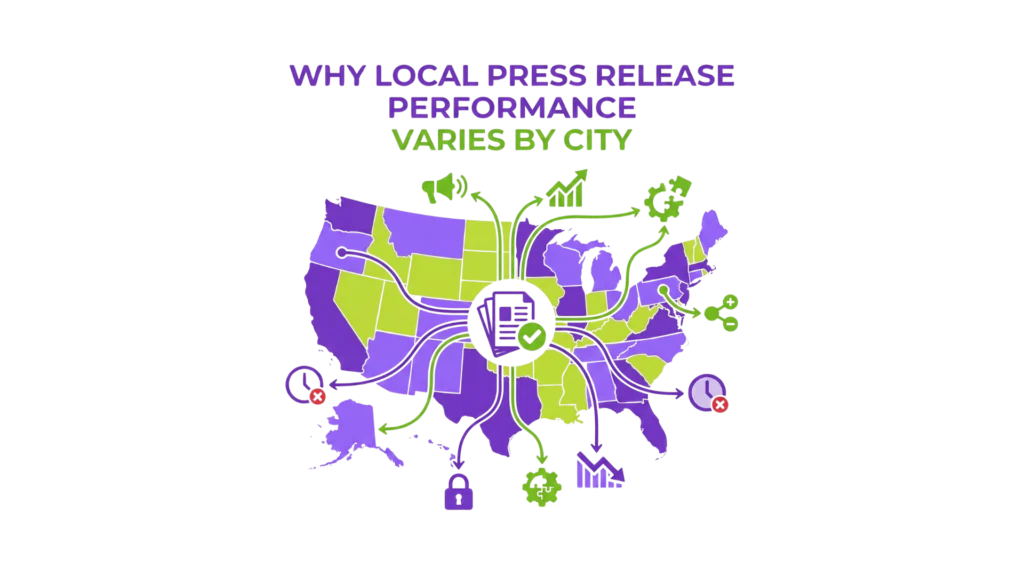
A local press release does not move through every city in the same way. Even when a release is distributed nationally, its performance is shaped by the city it lands in. This variation is not caused by formatting, distribution reach, or writing quality alone.
It comes from how local media ecosystems, search behaviour, and brand familiarity intersect at a city level. Local outcomes differ because cities process information differently. With that being said, let’s understand the reasons why local press release performance varies by city.
In large cities, media density is high. Journalists, publishers, and news desks operate under constant information pressure. Hundreds of stories compete for limited attention every day. As a result, editors filter quickly and aggressively. Only releases that clearly intersect with active narratives survive the first pass.
In smaller cities, the environment is quieter. Fewer competing stories lower the threshold for review. A local press release does not need to fight the same volume of noise to be noticed. This does not mean standards are lower. It means attention is distributed across fewer inputs. Media density quietly determines how much signal strength is required before a release is even processed during press release submission.
Trust does not begin at zero in every city. Where a brand already has visibility, recognition lowers friction. Editors process the release faster. Search engines resolve entity confidence more easily. The release feels like reinforcement rather than introduction.
In cities where local branding is weak, the same release faces a higher trust barrier. Editors assess risk more carefully. Search systems look for supporting signals before granting visibility. This is where press release SEO behaves inconsistently. Performance depends not just on optimisation, but on whether the brand already exists within the city’s information ecosystem.
Search behaviour varies widely by city. In some markets, users actively search for local business updates and community news. In others, search interest skews toward national brands or broader topics. This difference reshapes how a local press release performs after publication.
Even when indexed, visibility depends on whether local users are looking for that type of information. Local branding aligns more naturally with intent in cities where community-focused search behaviour is strong. Where intent is broader, local signals carry less weight, limiting organic reach.
Local press release outcomes diverge because cities impose different interpretation constraints. Media density alters attention thresholds. Market maturity reshapes relevance. Local branding influences trust. Search intent determines visibility potential.
This section explains why identical releases behave differently across cities without attributing outcomes to execution quality. Understanding these structural differences clarifies why local results vary, even when distribution, messaging & timing remain unchanged.

Once interpretation and city-level variation are understood, effective local press release strategy becomes clearer. City-level PR works when it reflects how search engines and readers interpret place, relevance, and credibility together. This section explains how US brands use local press releases to support rankings, visibility, and long-term local branding. The focus is not distribution volume, but signal accuracy.
A local press release only works when the announcement has a clear reason to exist in that city. Generic corporate updates rarely create local relevance, even when distributed through local channels. Search engines and publishers look for signals that explain why a development matters to a specific place, not just that it happened somewhere.
Strong city-level releases anchor the story to local impact. This could be economic contribution, partnerships with local organisations, hiring activity, or service availability tied to the area. When the relevance is explicit, the release becomes easier to index, easier to place, and easier to resurface in local SERPs.
Not all local publishers carry the same weight for rankings or credibility. Many US brands dilute their signals by pushing city releases through generic syndication networks that lack editorial focus. These placements may generate short-term visibility but rarely reinforce local authority.
Effective press release submission at the city level prioritises publishers with clear geographic alignment. City newspapers, regional business journals, and community-driven outlets provide stronger contextual signals than broad networks. These platforms help search engines associate your brand with a specific location, not just a keyword footprint.
Local branding is not achieved by adding a city name to a national press release. Language, framing, and tone must reflect the community context to feel credible. When press release writing services reuse national templates, the disconnect becomes obvious to both editors and readers.
City-level releases perform better when they adopt local language patterns and reference familiar institutions or challenges. This approach signals cultural awareness and intent alignment. Over time, this consistency strengthens brand perception locally and improves how search engines interpret your relevance within that city.
City-level PR works best when sequencing is deliberate. Many brands rush to national amplification before local signals have settled, which weakens both. Search engines often struggle to interpret diluted signals that appear everywhere at once without clear hierarchy.
A local-first approach allows city-level relevance to stabilise before broader distribution. Once local pickup and indexing are established, national amplification can extend reach without erasing context. This sequencing protects local visibility while still supporting broader press release SEO goals.
Press releases do not operate in isolation. Their impact depends on how well they connect to on-site signals that confirm location relevance. When a local press release points to a generic homepage, the authority signal often breaks.
Strong local PR strategies align releases with well-structured location pages. These pages reinforce address consistency, service relevance, and brand references tied to the city. When on-site content supports the same narrative as the release, search engines treat the signal as reliable and sustained.
Local PR success is rarely visible through sudden ranking spikes. More often, it shows up as stability across local SERPs over time. Brands that measure only short-term traffic miss how city-level authority actually compounds.
The right indicators include consistent local presence, repeat pickup by city publishers, and reduced volatility for location-based queries. When a local press release strategy works, visibility holds even when competitors fluctuate. That stability signals trust, not temporary exposure.
City-level PR that ranks is built on restraint, relevance, and repetition done correctly. Local press releases succeed when they reflect how cities function as distinct search environments, not scaled-down national markets. When announcements, publishers, language, and sequencing align, local branding becomes measurable. At that point, local PR stops being a visibility tactic and becomes a durable ranking asset.
Local press releases influence rankings when it’s clear where a brand belongs & why it matters locally. In the US, city-level relevance determines whether PR signals reinforce search presence or fade into noise.
Brands like fastlinko treat local press releases as geographic confirmation, not distribution exercises, to build stronger local branding and steadier visibility. By syncing placement, narrative and city context, local PR becomes a durable ranking support more than a one-off exposure play. City-aware PR doesn’t scale loudly. It scales correctly.
City-level placement anchors the story to a real location. When a release appears on outlets tied to a specific city, it strengthens local relevance signals. Over time, these signals help search engines associate the brand with that area, which improves visibility for location-based searches.
Each city has its own media ecosystem. Some cities rely on regional news hubs, others on niche local publishers. Competition, publisher credibility, and audience behaviour vary widely. As a result, the same press release can rank well in one city and barely surface in another.
Coverage alone isn’t enough. If the publisher’s audience isn’t locally focused or the content lacks geographic clarity, ranking signals weaken. Search systems evaluate whether the story actually serves local intent, not just whether it was published.
Strong writing services adapt tone and structure to local expectations. They highlight regional relevance without forcing keywords. This balance helps releases feel natural to editors and useful to readers, which improves both pickup quality and search interpretation.
