
How US Agencies Use Guest Posting to Build Authority for Clients
January 30, 2026



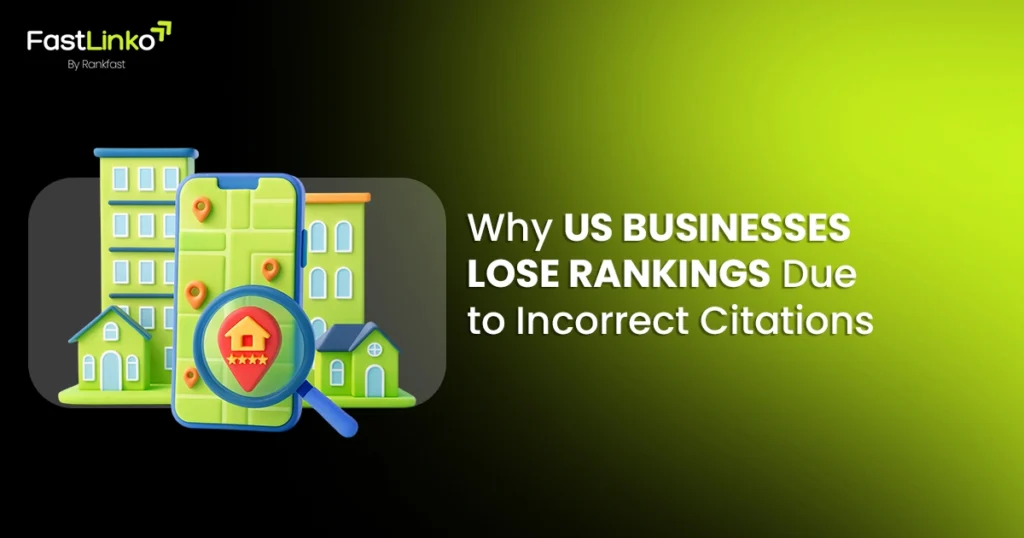



Ranking drops in local search rarely feel logical. Businesses keep consistent services, websites look intact & marketing spend is regular. Yet, visibility quietly erodes. In many US markets, these declines are not caused by missing SEO work, but by fractured identity signals.
Today, local citation services are often treated as a one-time setup task. Listings get created & directories get checked off. The main assumption of citation building services is that the foundation is stable. But local search systems don’t reward presence alone. They reward local citation building consistency over time. When small mismatches appear like an old phone number, a duplicate address or a conflicting category, trust weakens gradually, not immediately.
This is why ranking drops in citations for SEO feel sudden even though the cause is slow-moving. Search engines don’t penalise incorrect citations aggressively. They simply lose confidence.
This blog explains why US businesses lose rankings due to incorrect citations. Explore how local citation services unintentionally introduce instability, and how experts like Fastlinko, avoid it

Local rankings are not driven by activity volume or platform coverage. They are driven by confidence. Before search engines decide where to rank a business, they decide how certain they are about its identity, location, and legitimacy. Incorrect citations interfere with that certainty. The impact is rarely immediate or dramatic. Instead, trust weakens quietly, long before any visible ranking drops occur.
This section explains how that erosion begins at a system level.
Incorrect or mismatched citations do not trigger penalties. Search engines do not “punish” businesses for bad data. What they do instead is lose confidence in how a business should be interpreted. When listings disagree on name variations, addresses, phone numbers, or categories, the system struggles to determine whether they describe the same entity.
This ambiguity forces search engines to slow down their interpretation. Instead of reinforcing trust, each conflicting data point introduces doubt. Over time, the system treats the business as less stable, not less compliant. This distinction matters. Visibility softens because certainty weakens, not because rules were broken. This is why citation building services often focus on correction before expansion.
Search engines prefer to surface businesses they can confidently explain to users. When identity certainty drops, visibility becomes risky. Rather than showing potentially incorrect information, the system reduces exposure. This reduction is subtle. It may affect map visibility, local pack inclusion, or query coverage rather than causing an immediate collapse.
For citations for SEO, this means accuracy outweighs scale. Incorrect data does not negate correct data. It dilutes it. As dilution increases, the system hesitates to reuse the business across local queries. Suppression is a protective response, not a corrective one.
Trust in local search decays gradually. Incorrect citations rarely cause instant damage. Instead, they chip away at confirmation strength over time. Each unresolved inconsistency slightly lowers confidence. As that confidence erodes, the business becomes less competitive in close ranking decisions.
This incremental decay explains why ranking drops often feel unexplained. Nothing obvious changed recently. The cause sits upstream. Over weeks or months, unresolved citation issues accumulate until the system no longer has enough aligned signals to justify prior visibility. Local citation building that ignores maintenance allows this decay to continue unnoticed.
Incorrect citations undermine local trust by increasing ambiguity, reducing certainty, and weakening confirmation signals. The resulting ranking drops are a downstream effect, not the initial problem. Search engines do not react aggressively. They become cautious.
This section explains how trust loss begins before visibility changes are obvious. Understanding this process clarifies why local citation services matter not for growth alone, but for preserving the confidence that local rankings depend on.
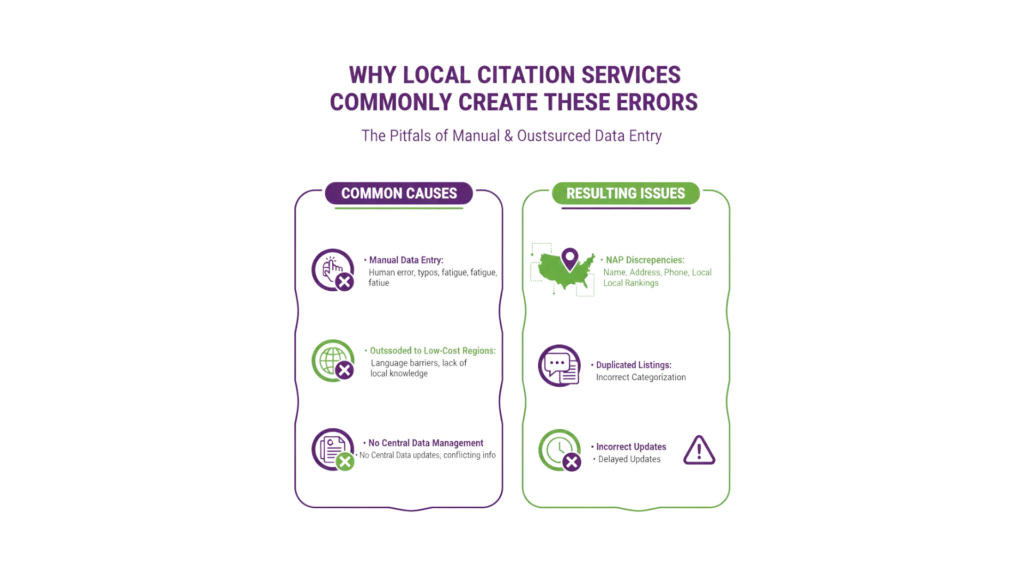
Citation errors rarely appear because someone typed the wrong information once. They accumulate over time due to how citation work is structured, scaled, and maintained. Many businesses using local citation services assume that once listings are “complete,” stability follows.
In practice, completeness and correctness are not the same thing. Search engines read citations as living signals, and systems that build them at scale often struggle to keep pace with that reality. These issues are structural, not accidental.
Most citation building services are designed to maximise coverage quickly. Automation excels at pushing data into many directories, but it struggles with verification depth. Listings may be created successfully without confirming whether existing records already exist under slight variations.
Search engines notice this fragmentation. Multiple near-identical listings reduce clarity instead of increasing trust. From a system perspective, repetition without reconciliation introduces ambiguity. The business appears everywhere, yet remains unresolved. This is why citation volume alone does not protect against ranking drops, even when surface-level completeness looks strong.
Coverage creates presence. Verification creates confidence.
Local businesses evolve. Addresses change. Phone numbers update. Categories shift. Legacy listings created years earlier often persist quietly across directories. Many local citation building workflows do not prioritise resolving these older records once new listings are created.

Search engines encounter conflicting timelines. Older data competes with newer data. The system must decide which representation is current, which increases interpretive cost. When that cost rises, visibility hesitates. Nothing is “wrong” enough to trigger a penalty, but trust does not deepen either.
Unresolved history is one of the most common reasons citations for SEO fail to compound.
Directories do not update in sync. Some refresh daily. Others rely on periodic data pulls. Some prioritise user edits. Others depend on third-party feeds. Local citation services often update primary listings without tracking how, or when, those changes propagate downstream.
This creates staggered accuracy. A business may appear correct on one platform and outdated on another for months. Search engines read these mismatches as uncertainty rather than transition. The system cannot assume intent when data changes unevenly.
Even well-managed listings can drift simply because propagation is uneven by design.
Businesses change faster than citation systems adapt. New service areas, seasonal hours, rebrands, and operational shifts introduce continual updates. Citation maintenance, however, is often treated as a one-time task.
When updates lag, citations fall out of alignment with real-world behaviour. Search engines detect this divergence through user interactions, map behaviour, and cross-platform inconsistencies. Over time, trust softens. Visibility becomes volatile. This is where unexplained ranking drops often begin.
Maintenance is not about fixing mistakes. It is about keeping interpretation current.
Citation errors persist because systems prioritise scale, not continuity. Automation accelerates creation. Legacy data lingers. Updates propagate unevenly. Business reality moves faster than maintenance cycles. Each factor introduces small gaps. Over time, those gaps compound into uncertainty.
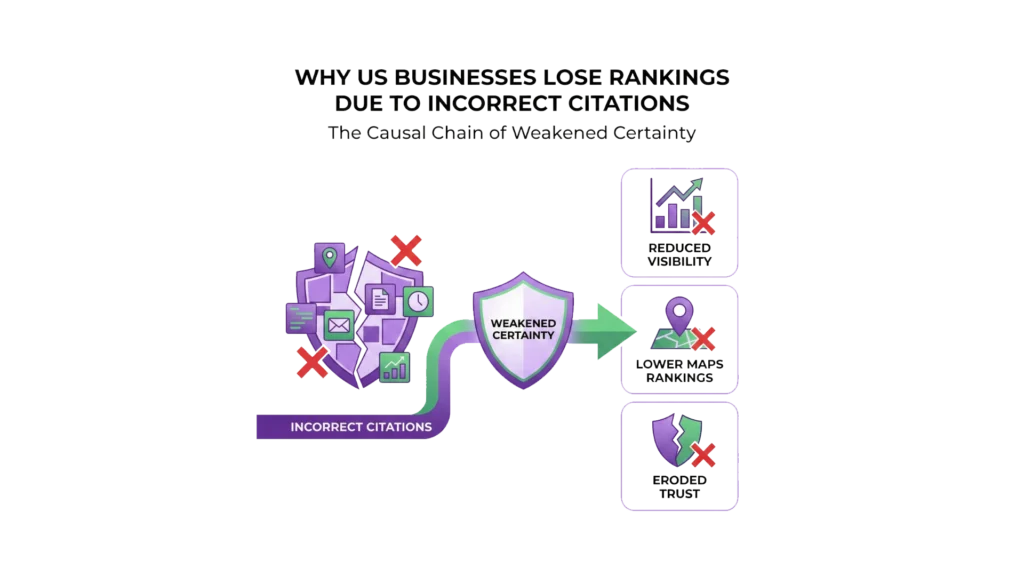
Once trust mechanics and service limitations are understood, ranking drops stop feeling unpredictable. They follow a clear causal chain tied to how search engines validate business entities at scale. Incorrect citations do not trigger penalties; they weaken certainty. When certainty drops below a threshold, visibility is reduced to protect result quality.
Local rankings are built on agreement, not optimisation. Search engines compare hundreds of data points to confirm that a business exists, operates where it claims, and serves the intent it appears for. When those signals diverge, engines respond conservatively. The outcome is not volatility, but quiet exclusion from competitive local results.
Every citation contributes to a single question: is this business consistently identifiable across the web. When multiple versions of the same business name, phone number, or URL exist, that answer becomes unclear. Instead of reinforcing one primary entity, citations begin fragmenting it into partial representations.
Search engines respond by reducing reliance on all conflicting records. This does not surface as an error message or warning. It surfaces as reduced inclusion in local packs and map results. Over time, identity fragmentation erodes the baseline trust required to compete locally.
What insiders notice early is not the drop itself, but the slowdown in discovery impressions. This lag signals that entity confidence is weakening before rankings visibly fall.
Location signals determine where a business is eligible to appear. Address mismatches, outdated service areas, or mixed-use listings introduce uncertainty about geographic relevance. Search engines struggle to assign a stable proximity model when citations disagree on location.
When this happens, visibility does not fluctuate randomly. It contracts. The business appears less frequently because the engine cannot confidently place it within a single search radius. This is a trust-preserving response, not a technical failure.
For US businesses, this issue often emerges after expansions or relocations that are only partially updated. Citation building services matter here because they restore a single, reinforced location narrative across platforms.
Categories signal intent alignment. Naming signals recognition and continuity. When either becomes inconsistent, relevance weakens across local results.
Many ranking drops follow service changes that are never reflected across all citations for SEO. Old categories continue signalling outdated intent, while the website signals something new. Search engines resolve this conflict by reducing exposure rather than guessing.
Naming inconsistencies compound the problem. Variations, abbreviations, or keyword-stuffed titles disrupt entity recognition. Engines prefer businesses that are easy to classify and consistently labelled across the ecosystem.
Duplicate listings dilute authority rather than reinforcing it. Reviews, engagement, and mentions split across records instead of compounding into one strong profile. From the engine’s perspective, this creates multiple weak entities rather than one trusted one.
This fragmentation affects ranking stability. Search engines hesitate to prioritise any listing that competes internally with its duplicates. The result is reduced prominence across maps and local results.
Local citation services resolve this by consolidating records, not by adding new ones. Without consolidation, authority leakage continues quietly, even when other optimisation efforts improve.
Businesses evolve faster than citation networks. Rebrands, relocations, phone changes, or service updates introduce time-based inconsistency into the ecosystem. During this period, search engines detect conflicting information and reduce reliance on the affected entity.
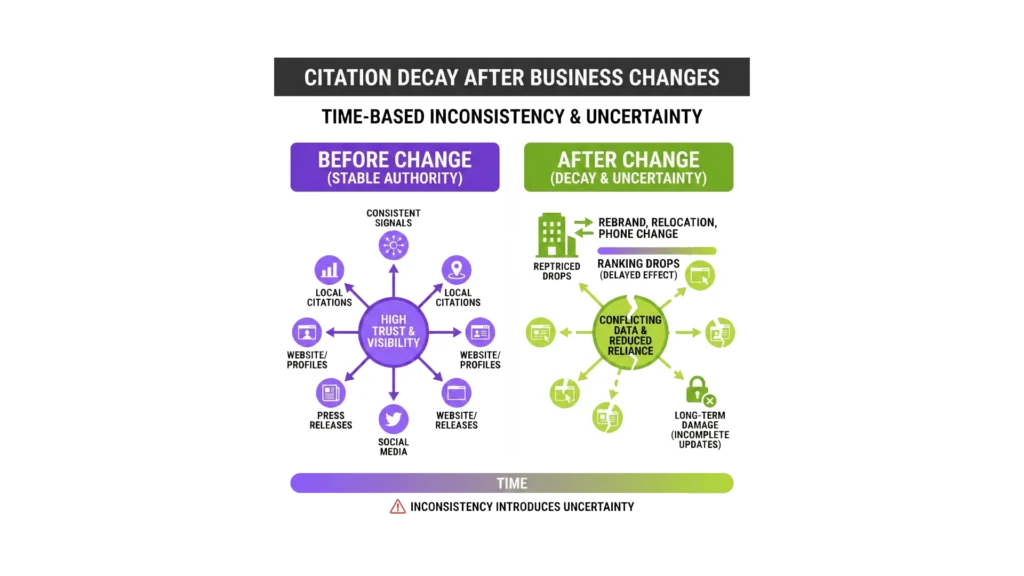
Ranking drops often appear weeks or months after the change, not immediately. This delay leads many teams to misdiagnose the cause. In reality, rankings are reflecting uncertainty rather than decline in relevance.
Citation decay becomes long-term damage when updates remain incomplete. Engines continue trusting older, widely reinforced data over newer but weakly distributed information.
Most US businesses interpret ranking drops as penalties. In practice, they are trust withdrawals. Search engines reduce visibility when identity, location, or relevance signals stop aligning cleanly.
This reduction is stabilising, not reactive. It protects result quality by favouring entities with consistent, verifiable data. Recovery begins only after certainty is restored across citations, not when additional optimization layers are applied. Without correction, rankings plateau at a lower baseline. Trust must be rebuilt before visibility returns.
Local ranking drops don’t usually signal algorithm hostility. They signal uncertainty. When citations stop agreeing, search engines hesitate to surface a business confidently, especially in competitive US markets.
Local citation services fail not because listings are missing, but because they drift out of alignment. Small inconsistencies compound until trust weakens enough to affect visibility.
For US businesses, restoring rankings starts with restoring certainty through citation experts like Fastlinko. Accurate, consistent citation data reinforces identity, stabilises signals, and allows other SEO efforts to work as intended. In local search, rankings don’t fall from absence. They fall from confusion.
The decline often builds quietly. Trust erodes gradually as inconsistencies spread. Rankings drop only when a threshold is crossed, such as during an update or re-crawl. This makes the issue feel abrupt, even though the cause developed over months.
Citations act as the reference layer. When they weaken, reviews, content, and backlinks struggle to compensate. Even strong SEO work loses leverage because foundational identity signals are unstable. Fixing citations often restores balance across all local signals.
Scale magnifies mistakes. One incorrect listing might not matter much. Dozens across locations compound quickly. Variations spread through aggregators, creating internal competition between locations. This is why multi-location brands see uneven ranking drops across cities.
Recovery feels slower than the drop. Corrections must propagate, duplicates must be suppressed, and trust must rebuild. Over time, rankings stabilise rather than spike. That stability is the signal that citations are once again reinforcing, not undermining, visibility.
