
How US Agencies Use Guest Posting to Build Authority for Clients
January 30, 2026







Ever stared at your website traffic and thought, “Why are people visiting but not buying, booking, or even enquiring?” That exact gap is where a content marketing consultant earns their fee. Not by writing random blogs. Not by posting daily for the sake of posting. They fix the connection between what your audience searches, what your brand says, and what your business needs next.
Hiring help for content is easy. Hiring the right help for the US market takes more care, because US buyers get choices everywhere. They compare fast. They bounce fast. They also reward brands that sound clear, helpful, and consistent.
So this guide focuses on how to pick the right person, what to check, what to ask, and what a serious consultant should build for you. It also keeps things plain and direct, so you can use it as a real hiring filter.
Many teams hire a writer when they really need a planner. Or they hire an SEO person when they really need positioning and conversion flow. So start by naming the outcome, then match the consultant to that outcome.
Here are the common “jobs” a consultant gets hired for in the US market:
One line test: if your consultant only talks about “posting more,” they will waste your budget. A serious consultant talks about audience intent, content-to-revenue paths, and distribution.
Also, the US market runs on numbers and proof. That is why the marketing support space is huge: 323,000 businesses and roughly 556,000 employees are counted under U.S. marketing consulting (which includes content and strategy consultants). Use this as a reminder. You are not hiring in a tiny niche. You have options. So filter hard.
Add these internal reads for your team while you shortlist:
In the US, buyers do quick research, then quick comparison, then quick action. Your content has to match that rhythm. A consultant must plan for:
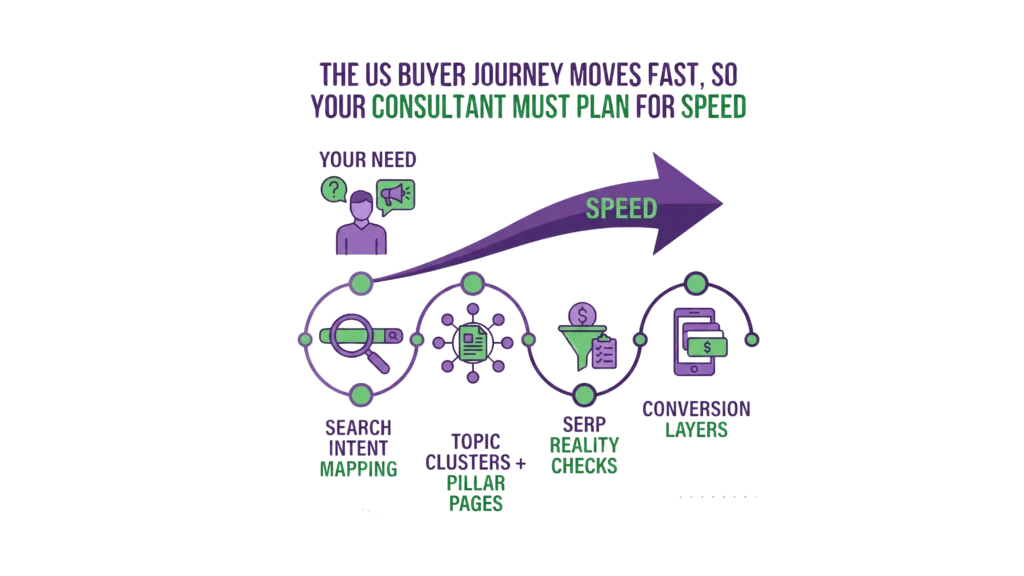
1) Search intent mapping
They should map keywords to buyer stages. Not just “high volume terms.” They should cover:
2) Topic clusters + pillar pages
This is where many teams slip. They publish 40 posts, each one isolated. A consultant should connect pieces into clusters, so Google sees authority and users keep clicking deeper. Ask them how they build:
3) SERP reality checks
The US SERP is competitive. Your consultant should review the top results and tell you:
4) Conversion layers
Traffic without conversion becomes noise. A consultant should add:
This is also why brands hire experts instead of guessing. Over 41 % measure content marketing success via sales, indicating businesses increasingly seek measurable outcomes, a key reason for professional consulting engagement. A consultant must talk about sales tracking without getting lost in fancy dashboards.
A strong writer helps. But a consultant should do more than writing. A consultant builds a system that gets results even when the next writer changes.
Here is what revenue content looks like in real life:
Ask the consultant how they handle “content that sells” without turning the page into an ad. If they only say, “Add a CTA,” that is surface-level.
Also, check if they can work with or guide content marketing companies when needed. Some businesses want one consultant to lead, while a production team writes at scale. A capable consultant knows how to lead that mix without ego, and they know when to outsource design, video, or tech SEO.
Another reality check: Content marketing delivers three times more leads than outbound marketing and reduces costs by 62 %, underlining why businesses outsource expertise to consultants.
So you are not paying for “words.” You are paying for lower cost per lead over time.
This is the quick scoring sheet I use when teams evaluate a content marketing consultant. Keep it simple. Score each item from 1 to 5. If someone refuses to answer, that is your answer.
| What to Check | What a Strong Consultant Shows | What a Weak One Does |
| Proof | case studies, before/after metrics, clear scope | vague results, “trust me” talk |
| Process | audit → plan → publish → measure → improve | random topics, inconsistent cadence |
| SEO skill | topic clusters, intent maps, update plan | only keyword stuffing |
| Conversion skill | offers, CTAs, funnel steps, email flow | traffic focus only |
| US market fit | examples in US niches, buyer behavior awareness | generic global advice |
| Communication | clean updates, simple reporting, fast feedback loop | ghosting, unclear promises |
| Team fit | works with your team, gives systems | blames team, keeps everything hidden |
Use this in interviews. It keeps emotion out.
Also, if they promise “page 1 in 7 days,” walk away.

A content marketing consultant should not start by writing 20 blogs. They should start by checking what exists, what works, and what blocks growth. Good consultants follow an early sprint plan that looks like this:
They review:
They check:
This phase is quiet but powerful. It improves every future page.
They create:
This is where your internal team stops feeling lost.
US growth needs distribution. A consultant should plan:
This is also where you decide if you need seo content marketing services support beyond the consultant. Some consultants do it themselves. Some manage a specialist. Both can work, but clarity is required.
Here is a useful budget reality: 50 % of marketers plan to increase investment in content marketing signaling budget expansion where consultants can be engaged.
So your consultant should help you spend smarter, not just spend more.
Ask these in your first call. A strong answer sounds structured and clear. A weak answer sounds like filler.
Also ask this one, it catches bluffing:
If they cannot answer, pause the process.
This is where many founders get stuck. They ask, “Should I hire a consultant or an agency?” The honest reply: it depends on speed, budget, and internal team strength.
A senior consultant leads, and production comes from a small team or agency. This can beat both options, if managed well.
Just keep one thing clear: if you hire the best content marketing agencies, ask who your day-to-day lead is. Many agencies sell senior talent, then assign juniors. That can still work, but only if the process stays strong.
Also keep market adoption in mind. Around 29 % of marketers actively use content marketing as part of their strategy.
That number shows plenty of brands still do it poorly. Your consultant should help you win by doing it clean.
You may also talk to content marketing companies for specialised pieces like video or interactive tools, while your consultant owns the plan.
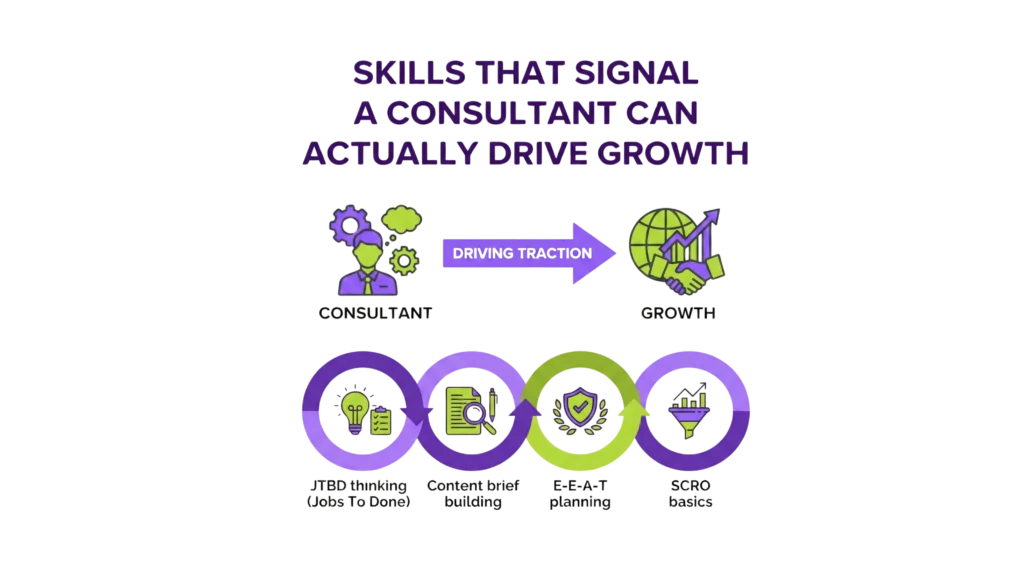
Look for these skills. Not all have to be perfect. But if most are missing, the engagement turns shaky.
This is where the US market pushes hard. Teams want results. They want pipeline. They want fewer “maybe later” leads.
And yes, lead generation stays a major reason. 87 % of B2B marketers report successful lead generation with content marketing.
So your consultant should have a lead path plan, not only an SEO plan.
One more check: can they guide SEO content marketing services if your site has technical problems? If they ignore technical SEO fully, you will hit a ceiling.
The US market rewards clarity, proof, and steady publishing. It also punishes scattered content and weak positioning. So hire a content marketing consultant who builds a repeatable engine, who tracks business outcomes, and who can lead writers, designers, and stakeholders without drama.
If you want help setting up the plan, the scorecard, and the first 60-day pipeline, contact Fastlinko today and we will map the content plan with you.
You may see quick wins from page refreshes and better internal links in weeks. Bigger changes like rankings, pipeline, and inbound lead quality often need a few months. Ask for a 30–60 day plan with milestones so you can track progress without guesswork.
Both options can work. If the consultant writes, you get tighter execution and fewer handoffs. If they only guide, you can scale faster with writers. The key is clear briefs and strong edits. Ask who owns quality control, every week.
Tools vary, but the process matters more. Still, a serious consultant usually uses a keyword tool, Google Search Console, analytics, and a content planner. Ask them to show how a tool decision changes a content choice, not just a list of logos.
Give them one sample page and one product pitch. Then ask them to write a short rewrite plus a page outline. You will see if they catch your tone, your buyer language, and your offer shape. This small test reduces hiring risk and avoids long cycles.
