
How US Agencies Use Guest Posting to Build Authority for Clients
January 30, 2026








In B2B markets, most teams produce more content than they can actually use.
Sometimes, a single strong article carries the insight, depth and narrative clarity needed to fuel multiple discovery paths. Yet most of that potential is left unused. Modern content marketing companies no longer focus on output volume. They focus on asset longevity.
One well-written piece becomes a tool for traffic growth when content reuse is practiced. Affordable content marketing services divide assets into formats that match how real users validate information today.
Buyers skim in short windows, search engines reward structured context, and social platforms surface clarity over creativity. That means the smartest teams anchor their strategy on one flagship article and then expand it into multiple distribution loops. They carry it from SEO to partnerships, guest posting, topical clusters and format-driven reach.
This blog explores the content repurposing tips
that shape 10x visibility, strengthen brand authority, and help B2B teams grow without overproducing.
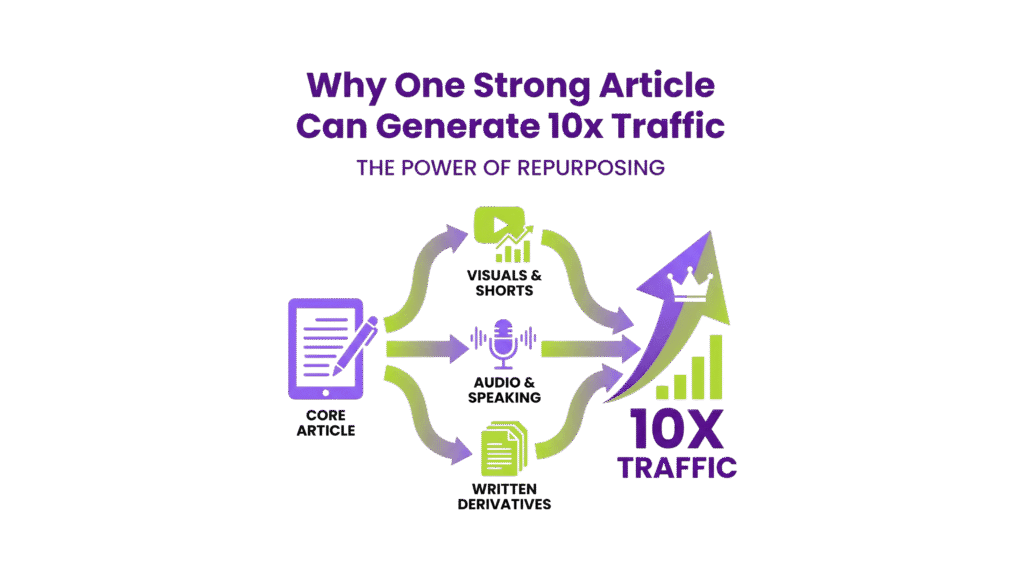
A single flagship article performs well when it mirrors many factors.
Your content must reflect how people research, filter noise, and validate solutions. Then, buyers can lean on it as a support anchor. Such assets turn into a reliable reference point that answers a problem with clarity and authority.
When that anchor is repurposed into formats synced with real search behaviour, comparison workflows, and cross-channel consumption, its reach compounds. One article becomes a system and its influence stretches across the entire discovery journey.
In high-intent environments, readers aren’t browsing. They’re filtering. They want clarity fast.
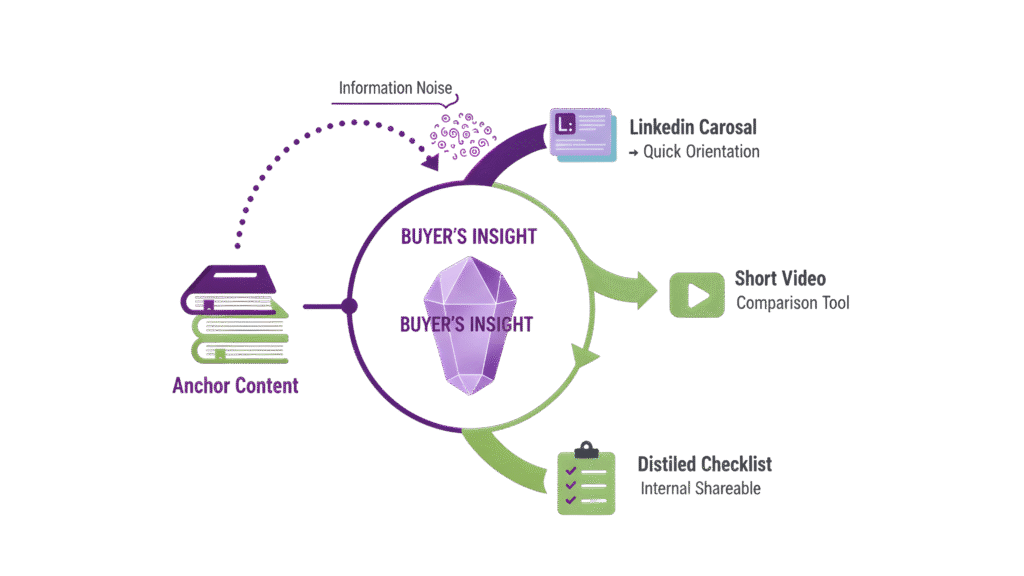
An anchor piece works when it helps them understand the landscape before they commit to depth. That’s why buyers often scan an article, cross-reference it with other tabs and gravitate toward condensed versions of the same idea. This is usually summaries, visuals or quick checklists. Repurposing meets them in this natural motion.
When the same insight is reframed into lighter formats, buyers don’t experience repetition, they experience reinforcement.
A LinkedIn carousel becomes a quick orientation. A short video becomes a comparison tool. A distilled checklist becomes an internal shareable for team discussions.
Each derivative format reduces the cognitive load of understanding which is exactly what discovery-stage users rely on when trying to avoid risk.
Search engines respond to signals that make understanding, categorising, and trusting content easier.
Repurposed content clarifies its meaning across touchpoints and gives search systems a richer semantic map of your topic. They also help engines understand intent boundaries, sub-topics and real user patterns.
This is why one strong article often outperforms a dozen disconnected posts. The ecosystem produces stronger topical authority. It shows consistency, depth, and relevance. These are 3 traits that modern algorithms correlate with expertise.
Distributed versions of assets on owned and partner platforms also create proof loops. These are signals that multiple sources trust your narrative enough to reference it.
That validation lifts the anchor article further, increasing its ranking stability and its ability to attract new audiences.

The shift from volume to velocity changed how brands scale content.
Repurposing is not a shortcut; it’s a redistribution of the same intelligence where buyers are already present. It trims production cost, sharpens message clarity and reduces operational drag for content teams.
More importantly, it builds credibility. When ideas appear consistently across channels like newsletters, niche communities, podcasts and partner sites, buyers receive repeated context without feeling sold to.
Distributed formats also help brands tap into borrowed audiences from ecosystems that already command trust. This is where affordable content marketing services deliver value for companies that need traffic but can’t sustain high-volume production.
Content repurposing tips show a discovery strategy that matches how people learn, compare and form early impressions. When readers encounter the same idea multiple times in different formats each touchpoint lowers friction and deepens authority.
That is why one strong article, repurposed intelligently, can generate 10x the traffic with half the effort.
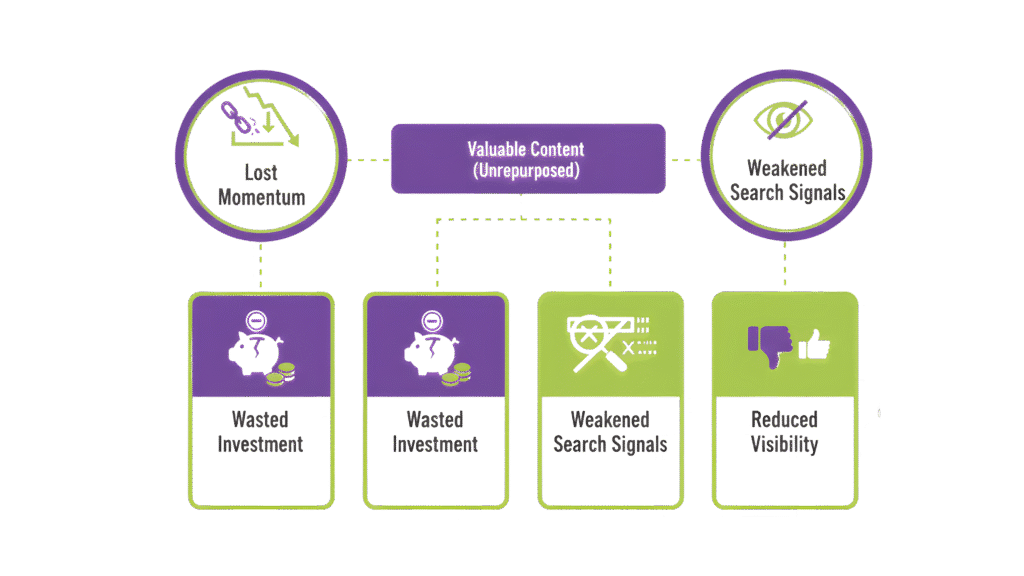
Most brands assume that publishing more will solve their traffic issues.
But the real loss happens quietly when strong content is created once and never reused. Under-used assets weaken search signals, reduce visibility in competitive categories and force teams to overspend. All just to maintain baseline performance.
Ultimately utilisation, not velocity, drives growth.
When B2B buyers begin researching, they don’t interact with content linearly. If your strongest assets exist only as static articles, they lose momentum in the active moments that buyers spend evaluating, validating, and shortlisting vendors.
This is the silent cost most companies never measure, the revenue impact of unused expertise.

Search engines reward signals that accumulate over time, the kind repurposed assets create naturally.
When an article sits untouched, it loses ranking power, even if the insights are relevant. This decay becomes sharper when no supporting formats surround the piece. Without summaries, comparisons, visuals, FAQs, or cluster spokes reinforcing its theme, the page carries all ranking responsibility alone.
Competitors who repurpose aggressively build multi-angle relevance, creating a semantic wall your single asset cannot break.
This is how a strong page slips from top-five visibility to page two without any direct error. It simply wasn’t supported with derivative formats that continually refresh authority and strengthen topical breadth.
B2B viewers move through multiple information environments across platforms. A single article cannot reach all of them.
When content stays locked in one format, you unintentionally narrow your own surface area. High-value insights that could have become LinkedIn posts, email sequences, short-form explainers, sales enablement assets, or third-party guest contributions instead remain confined to a single URL.
As a result:
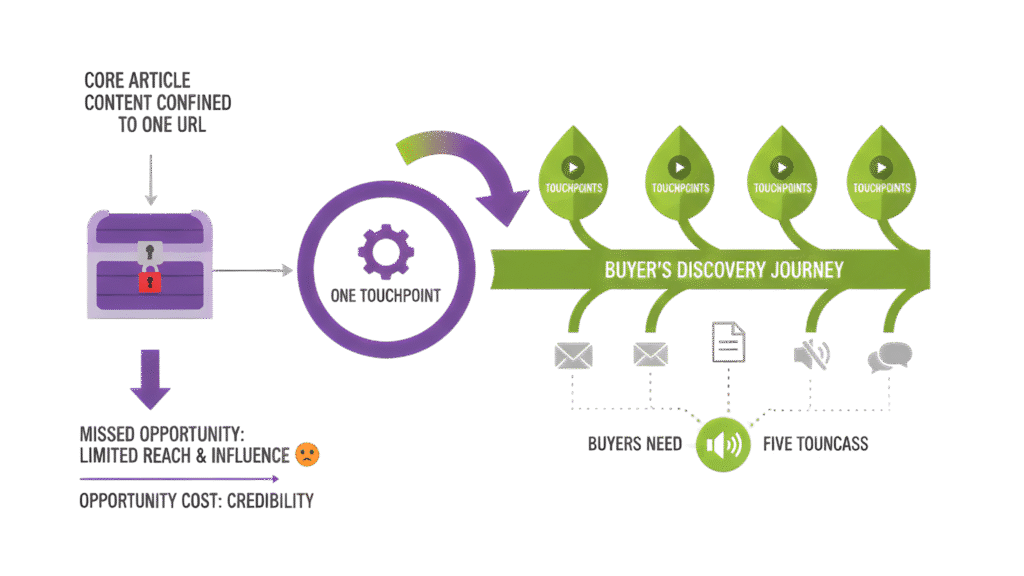
The opportunity cost isn’t just reach. It’s credibility. Without repurposing, you limit your presence to one touchpoint when buyers need five.
Every article, video, or whitepaper is a financial asset.
Similarly, production time, research depth, and subject-matter expertise all carry real cost. When content is used once and forgotten, the return never compounds.
Teams then feel pressured to produce more just to maintain visibility. This accelerates:
Meanwhile, competitors who repurpose effectively extract months of additional visibility from each piece. Thus reducing their cost per lead without increasing output.
Repurposing extends the life of every investment. Instead of creating ten new assets, one strong asset becomes ten formats that collectively perform better. It protects your budget, strengthens authority, and converts expertise into sustained visibility.
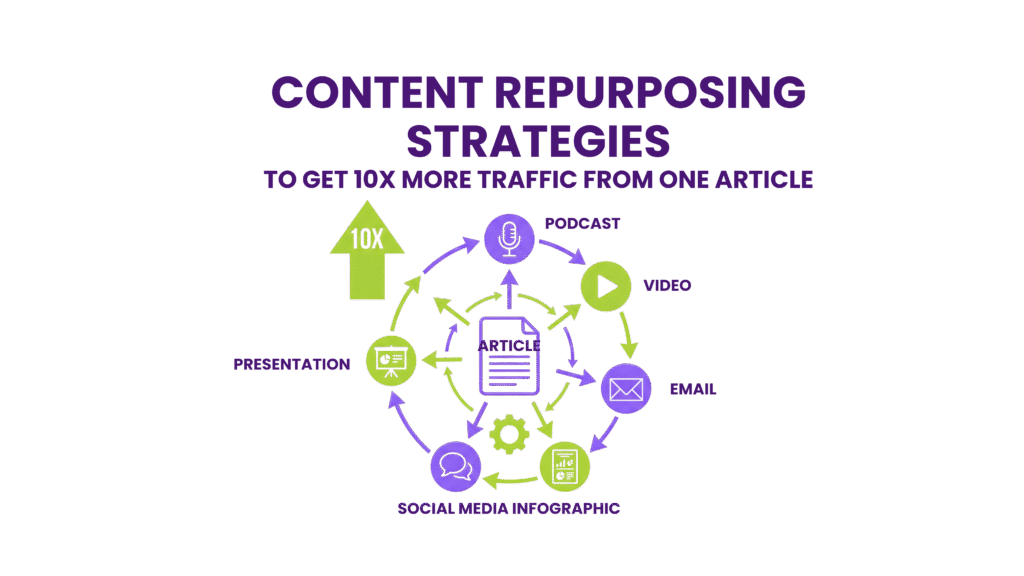
Teams usually underestimate the value locked inside a single high-performing article.
When an idea already resonates with readers, search engines, or internal stakeholders, it carries natural momentum. Repurposing simply amplifies that momentum into new formats, new surfaces, and new intent pathways.
Now that we know about content reuse in detail, let’s explore content repurposing tips to get 10x more traffic from one article.
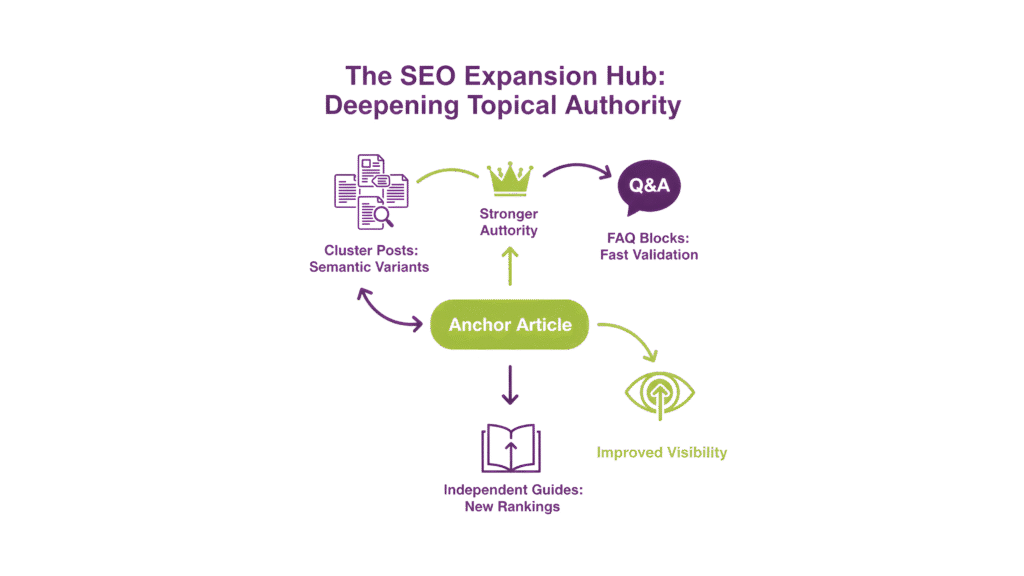
At the search level, repurposing works best when it deepens a page’s semantic footprint.
Strong repurposing begins by identifying the article’s primary decision pathways, then expanding them into formats optimised for discovery, clarity, and supporting intent.
A foundational approach builds supporting cluster posts around its core theme. These clusters target semantic variants, long-tail refinements and related conceptual bridges. It gives search engines a clearer understanding of your expertise and strengthens the parent page through contextual reinforcement.
You can also convert high-impact sections into FAQ blocks. These short, direct answers capture users who want fast validation rather than full articles. They guide engines toward recognizing your page as a relevance hub.
Some ideas deserve standalone treatment. Turning dense paragraphs into independent guides or category explainers allows you to carve out new rankings while keeping the narrative cohesive.
The result is predictable. Brands fetch stronger topical authority, better internal linking logic and improved visibility for the anchor page.

For content marketing companies and high-growth teams, authority distribution matters as much as on-site optimisation.
Repurposing into offsite placements pushes your reach and traffic growth into ecosystems where buyers already consume expert insights. One of the simplest, most effective routes is using the article’s key insights to create thought-leadership guest posts on high-quality guest post sites.
B2B businesses can also try content reuse with industry blogs and newsletters that align with your domain. These outlets value operator observations and practical frameworks. Both of which come naturally when repurposing strong content.
For deeper reach, affordable content marketing services collaborate with partners or influencers to create co-authored versions. These hybrid pieces borrow from your original narrative but gain additional trust signals through shared authority.
Repurposing isn’t only about spreading reach. It’s just as powerful for improving conversion readiness and supporting internal decision cycles.
Content reuse turns core ideas into checklists, quick-start frameworks, or validation guides that give prospects a faster way to evaluate your insights. These formats fit early sales conversations and help reduce friction for buyers who want clarity, not length.
A well-constructed article can also feed a comparison table that presents options through neutral criteria. It is ideal for mid-funnel users mapping tradeoffs.
For teams that need tight messaging, a shortened sales version boils down the key points into a concise, shareable narrative. It can support demos, email follow-ups, and procurement discussions.
All these assets work together as decision boosters for users in different ecosystems. All without any sales-driven impressions or tactics.
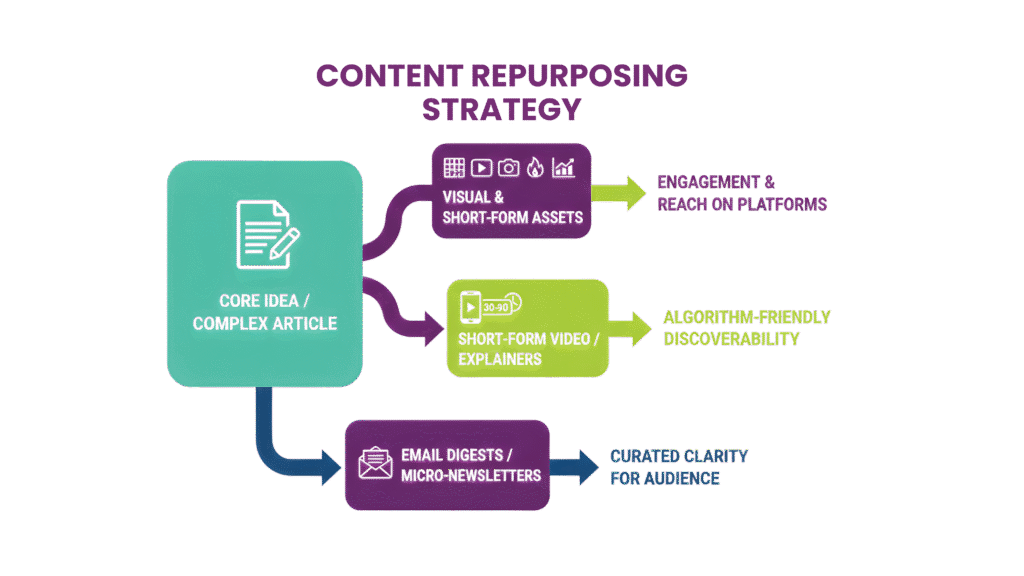
Traffic growth now depends on formats that perform beyond traditional search.
Repurposing into visual and snackable assets expands your total addressable surface area without diluting message integrity.
Infographics, carousels, slide posts, and micro-diagrams recraft complex ideas into scannable, platform-native visuals. These formats win big on LinkedIn, X and niche communities where clarity drives engagement.
Short-form videos of 30 to 60 seconds offer a second pathway. They summarise key insights in a way that fits modern consumption patterns and lift the reach of your article through algorithm-friendly engagement.
Email digests and micro-newsletters remain underrated. Adapting the article into a digestible email narrative taps into an audience that values curated clarity over long-form reading.
Sustainable traffic growth is a result of treating repurposing as an ongoing ecosystem, not a one-time conversion. High-performing articles naturally become seed assets for broader content cycles.
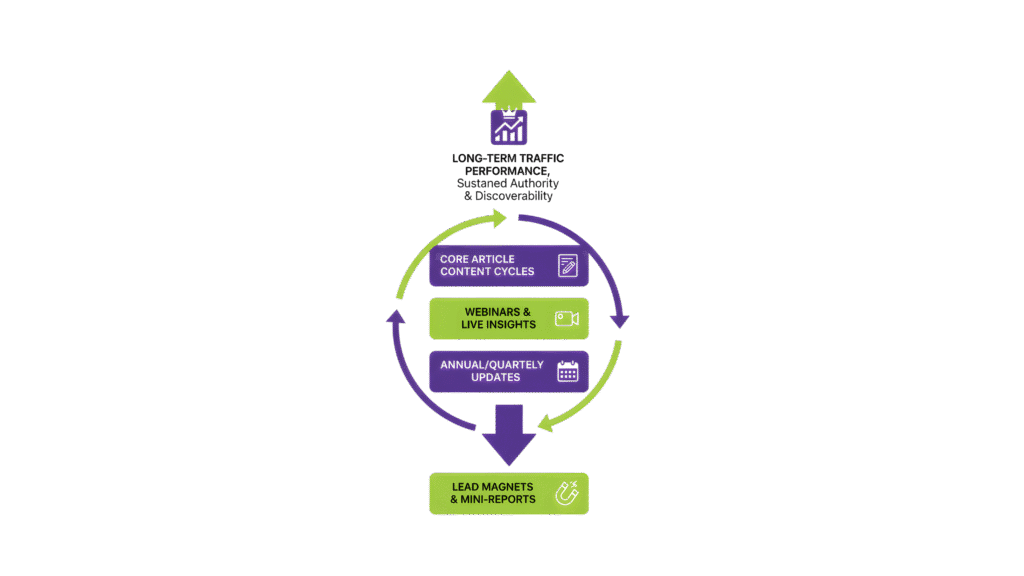
Brands can also use it to power webinars, turn the written analysis into live insights, audience Q&A and post-event content reuse. Likewise, deeper research sections can become lead magnets or mini-reports to support list-building and authority positioning.
The most forward-looking brands maintain an annual or quarterly update cycle, treating the article like a living resource. This preserves search momentum, keeps the asset aligned with industry shifts, and strengthens long-term traffic performance.
Content repurposing isn’t about recycling, it’s about expanding influence.
With strategic clarity, a single article becomes an interconnected system powering search, social, partnerships, and buyer enablement. The message stays consistent, the reach compounds.
By collaborating with industry leaders like Fastlinko, the traffic growth becomes both scalable and sustainable across every channel that matters.
Short posts, comparison explainers, answer snippets, and modular frameworks work well because they match how people search. Search engines reward structured reuse that aligns with real user intent. Repurposing into these formats strengthens authority and keeps your original idea active across topics, queries, and new traffic paths.
If an article ranks but hits a ceiling, has unused subtopics, or attracts mixed-intent traffic, it’s ready for repurposing. These signals show the idea is strong but under-distributed. Reuse gives it new reach without restarting creation, helping businesses grow traffic without scaling cost.
Yes. Repurposing creates organic demand loops — especially when placed across guest post sites, partner blogs, newsletters, and search-friendly formats. This reduces the need to amplify visibility through ads. Over time, the article becomes a self-sustaining traffic engine rather than a one-off cost centre.
The best repurposing starts with isolating the article’s strongest insight, then placing it where intent naturally forms. B2B brands grow faster when one narrative becomes search posts, partner articles, and outreach assets. This builds recurring visibility without needing constant creation, which is exactly what content marketing companies optimise for.
