
How US Agencies Use Guest Posting to Build Authority for Clients
January 30, 2026





Organic link building is often discussed as a growth lever. In practice, it’s a risk surface. Every backlink pointing at a commercial site influences not just rankings, but how search engines interpret intent, trust, and transactional credibility.
What many ecommerce teams miss is that Google evaluates ecommerce backlinks differently from informational ones. Links to product-driven sites are scrutinised for why they exist, not just where they come from. This is why forced placements, generic guest posts, and high-DA shortcuts often fail quietly, they introduce authority signals without narrative justification.
US ecommerce brands that scale without volatility don’t treat high authority link building as outreach. Experts at Fastlinko treat it as commercial context management. They ask where product narratives belong, which environments naturally validate buying intent, and how authority should accumulate across categories rather than spike on isolated URLs.
This blog breaks down how high-authority backlinks are actually earned in ecommerce, why traditional link models underperform for product-led businesses, and how US brands build authority that compounds without triggering risk.
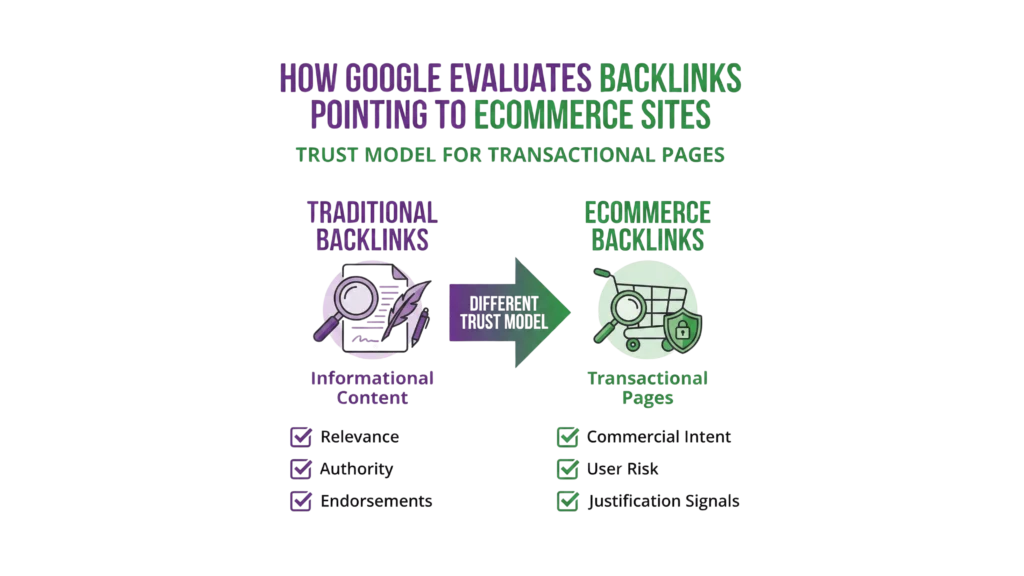
Backlinks pointing to ecommerce sites are not interpreted through the same lens as links to informational content. When commercial intent is present, search systems apply a different trust model. Google is not just evaluating relevance or authority. It is evaluating whether a transactional page deserves visibility without increasing user risk. This distinction shapes how ecommerce links are read, weighted, and reused over time.
In ecommerce SEO, backlinks function less as endorsements and more as justification signals.
Ecommerce pages introduce financial outcomes. A ranking decision can directly influence purchasing behaviour, refunds, complaints, or user dissatisfaction. Because of this, Google applies higher credibility thresholds to pages that sell, price, or transact.
Backlinks to these pages are examined more carefully. The system looks for signals that explain why the page should be trusted, not just who is linked to it. A strong domain linking in isolation does not resolve that question. Trust must be inferred through surrounding context, historical behaviour, and alignment with user expectations.
This is why ecommerce visibility often lags behind informational content, even with comparable link profiles. The system is solving a harder problem.
For ecommerce links, context matters more than raw authority. Google evaluates the environment in which a link appears to understand intent transfer. A backlink embedded within relevant editorial content helps explain the role of the product or category. It answers the question of why this item belongs in the conversation.
Links that appear without explanatory context force the system to infer intent. In commercial settings, inference increases risk. As a result, context-rich links reduce uncertainty more effectively than high-metric but disconnected placements.
This is why contextual link building services behave differently for ecommerce SEO. The surrounding narrative does interpretive work that metrics alone cannot.
Ecommerce backlinks are evaluated based on the editorial environment, not just domain strength. Google distinguishes between links that emerge naturally from content-driven contexts and those that appear in transactional or templated placements.
Editorial environments signal deliberation. They suggest that a human decision connected the product or category to a broader topic. That signal matters more than domain-level metrics because it reduces ambiguity around intent.
A link from a lower-metric but editorially aligned page can therefore carry more interpretive weight than a link from a high-metric domain placed without narrative relevance.
Ecommerce authority is rarely assigned at the product level alone. Google evaluates how authority distributes across category, subcategory, and product layers. Backlinks pointing to supporting category pages help the system understand breadth, structure, and topical ownership.
Direct product links are interpreted narrowly. Category and collection links provide context about range, expertise, and consistency. This hierarchy allows Google to assess whether the ecommerce site behaves like a coherent retail entity rather than a collection of isolated offers.
Authority, in this sense, is structural.
Ecommerce backlinks behave differently because the system is optimising for transactional safety. Google is not just ranking relevance. It is protecting users from low-confidence commercial outcomes.
This section explains how ecommerce links are interpreted, not how they are acquired. With this understanding in place, the uneven behaviour of ecommerce link building strategies becomes easier to interpret and less mysterious, before any discussion of execution or optimisation begins.
Organic link building models were designed in environments where intent is informational and outcomes are indirect. Publishers and SaaS brands benefit from visibility that educates, persuades, or nurtures. Ecommerce operates differently. Every ranking decision carries transactional consequences. When generic link models are applied to ecommerce without structural adjustment, the system does not penalise them, it simply fails to translate them into commercial trust.
This breakdown happens because the model optimises for visibility, while ecommerce requires justification.
The first structural failure appears in how generic models rely on editorial guest posts and informational content. These placements work well for discovery-stage education, but ecommerce pages sit much closer to purchase intent. When links originate from content that does not explain a buying decision, the system struggles to connect relevance.
Google is not asking whether the link is natural. It is asking whether the surrounding context explains why a product or category deserves visibility. Informational narratives without commercial logic force the system to infer intent transfer. In ecommerce, inference introduces risk. As a result, link impact is dampened rather than amplified.
This is why ecommerce brands often “have links” but see little category movement. The context does not resolve the transaction.
Generic frameworks assume authority is global. Build enough high-authority links, and pages will rise. Ecommerce authority is not interpreted that way. Google evaluates trust at multiple layers: domain, category, and product.
When links reinforce the domain but do not clarify category relevance, authority remains abstract. The system sees a strong site, but cannot confidently extend that strength to specific buying queries. Categories remain weak not because they lack links, but because they lack explanatory reinforcement.
This is a structural mismatch. High-DA links are doing what the model expects, but the system requires category-level confirmation before it reallocates trust downward. Without that logic, growth stalls despite apparent strength.
Generic models lean heavily on blogs because they attract links safely and predictably. Over time, ecommerce sites begin to resemble publishers with attached stores. Authority accumulates in informational sections, while revenue-driving pages remain under-supported.
From Google’s perspective, this creates a disconnect. The site signals expertise through content, but its transactional pages lack external confirmation. Authority does not automatically flow from blogs to products. The system evaluates behaviour, not internal assumptions.
This is why ecommerce brands often rank well for guides but struggle on collections. The link model reinforces the wrong layer of the site.
These outcomes persist even with clean, white hat execution. The links are compliant. The placements are safe. The teams are capable. The failure lies in the model’s assumptions about how intent moves.
Generic link building models explain information well. Ecommerce requires explanation of commerce. When that distinction is missed, effort compounds in the wrong places.
With this clarified, the need for a structurally different ecommerce link logic becomes unavoidable, not as a tactic shift, but as a system requirement.
Once ecommerce-specific link interpretation and model limits are clear, authority building stops feeling unpredictable. High-authority backlinks for ecommerce do not come from aggressive outreach or isolated placements. They emerge from how clearly a brand defines its categories, how consistently it appears inside commercial conversations, and how patiently it lets authority settle before pushing for scale. US ecommerce brands that do this well are not chasing links. They are shaping how search engines understand where trust should live.
In ecommerce, categories do the explanatory work that products cannot. Categories define scope. They explain choice boundaries. They show how products relate to each other. Search engines treat them as structural trust holders because they reflect how buyers think before they commit.
High-performing ecommerce brands concentrate early authority at the category level, not because products are unimportant, but because products inherit trust only after categories are understood. When a category page becomes a reliable reference point, product URLs gain ranking resilience through internal proximity. This is why ecommerce link building strategies that target products first often stall. They apply pressure where interpretation is weakest instead of where clarity already exists.
Authority grows faster when links live inside narratives that buyers already follow. Contextual link building services work in ecommerce because it mirrors the research phase. Buyers do not land on products cold. They move through guides, comparisons, and use-case explanations that help them reduce uncertainty.
US ecommerce teams place links inside buying guides, editorial product mentions, and use-case discussions where products are referenced as part of a decision process, not as endpoints. These links carry commercial meaning without forcing conversion. Contextual link building services succeed here because relevance does the convincing. Search engines read these placements as evidence of market participation, not promotional intent.
One of the most important discipline points in ecommerce SEO is separating authority building from conversion optimisation. Authority needs stability. Conversion pages change. Prices shift. Inventory updates. Seasonal variants rotate. Forcing links into product pages ties authority to volatility.
High-authority link building for ecommerce is staged deliberately. Categories and supporting content absorb authority first. Product pages remain protected, optimised for clarity and purchase readiness rather than external pressure. Internal linking then distributes trust in controlled ways. This separation prevents the oscillation many ecommerce sites experience after link pushes, where rankings spike briefly and then collapse.
Ecommerce authority does not come from generic publishers. It comes from environments where products are discussed seriously. Industry publications frame categories. Review ecosystems influence comparison logic. Specialist media speak to niche buyer groups with specific intent.
US ecommerce brands invest in these commerce-adjacent spaces because links there reinforce legitimacy. A mention inside a category analysis, a review breakdown, or an industry trend piece carries interpretive weight. These placements signal that products belong in the market conversation. Organic link building in these environments builds authority quietly, without relying on volume or repetition.
Authority accumulation works best when organic signals lead and high-authority links reinforce. Organic growth establishes baseline trust through consistent mentions, contextual references, and category-level reinforcement. Only after stability appears do brands introduce selective authority anchors.
This sequencing matters. High-authority links introduced too early look like acceleration without adoption. Introduced later, they act as confirmation. US ecommerce teams avoid velocity spikes by letting categories settle before layering reinforcement. This blend creates a natural authority curve that survives updates and avoids saturation.
High-authority backlinks in ecommerce aren’t earned by chasing metrics. They’re earned by professionals like Fastlinko by placing products and categories into environments where their presence makes commercial sense. Google rewards this alignment quietly, through stability, not spikes.
US ecommerce brands that build authority without risk understand that backlinks are not endorsements in isolation. They are contextual signals that explain why a product deserves visibility among competitors.
When ecommerce link building strategies reflect buying logic instead of SEO mechanics, authority compounds naturally. And in ecommerce, that difference determines whether growth scales — or stalls.
High authority links usually appear near context that explains why a product or brand matters. That might be within comparisons, buying guides, or industry commentary. These placements help search engines and users connect relevance with credibility, which is harder to fake in ecommerce than in content-only sites.
Volume creates noise in ecommerce. Too many mismatched links confuse search engines about what the site actually represents. Relevance keeps signals aligned. When links reinforce the same product themes and audiences repeatedly, authority becomes clearer and more defensible.
They look beyond the homepage. Category pages, brand stories, and evergreen guides often carry more link value than individual products. These pages provide context that supports many SKUs at once, making link equity easier to distribute internally.
A common mistake is chasing metrics instead of intent. Links are placed based on domain strength rather than audience fit. Another issue is linking only to transactional pages without supporting content. Both choices limit how effectively authority flows through the site.
