
How US Agencies Use Guest Posting to Build Authority for Clients
January 30, 2026







Guest posting is usually talked about as a way to get links. But in local search guest posting services behave differently. When a business is mentioned on another site, search engines don’t just notice the link. They observe where that mention appears & which environment surrounds it.
For US local seo businesses, this matters most at the city and state level. A marketing guest post mentioned on a regional blog, a state-focused publisher or a city-based outlet carries location data. That helps search engines understand where a business belongs, not just what it offers.
When seen this way, SEO guest posts aren’t really about outreach or volume. It’s part of how local presence is interpreted over time. Understanding that interpretation is more useful than trying to optimise placements blindly.
For businesses using a guest post blogging service like Fastlinko, these placements sit alongside SEO guest post, marketing guest post & local SEO efforts, affecting how geographic relevance is inferred rather than how links are counted. This blog looks at guest posting for US local businesses with city- and state-level signals. Not as a tactic to apply, but as a signal to understand.

When a business is mentioned off-site, search engines are not simply recording a reference. They are interpreting geography. Location meaning is inferred indirectly, through patterns that explain where a business belongs and how confidently it can be associated with a place.
This process happens quietly, before visibility, rankings and outcomes are measured. External mentions exist to help the system resolve geographic understanding, not to force movement. Let’s see how search engine’s interpretation of geography from external mentions forms:
Search engines do not derive location meaning from the link itself. They derive it from the environment surrounding the mention. The publisher’s audience, topical focus, and regional relevance all contribute context. A mention on a regionally grounded publication carries different geographic implications than the same mention on a general site.
This is why mentions arising through a guest post blogging service behave differently depending on where they appear. The system asks where the publisher operates, who it serves, and what local signals surround its content. Geography is borrowed from the host, not declared by the brand.
Single mentions introduce possibilities. Repeated mentions create confidence. Search engines look for recurring associations between a business and specific geographic contexts across independent sources. Over time, these repetitions reduce ambiguity around where the business operates or is relevant.

This is also why volume alone does not accelerate clarity. Multiple mentions from similar environments collapse into one signal. What matters is consistency across varied but aligned sources. Whether mentions come from guest posting services or editorial references, repetition across trusted contexts strengthens entity–location understanding.
Beyond the host environment, the language surrounding a mention plays a critical role. Search engines analyse how a business is described in relation to place. Phrases that imply service areas, local relevance, or regional activity help shape geographic interpretation.
This context matters more than explicit location tags. A seo guest post that situates a business within regional discussion contributes more geographic meaning than a generic mention with a city name attached. Language explains how a business relates to a place, not just which place is referenced.
External mentions do not act as direct ranking levers for location. They act as confirmation signals. Search engines use them to validate existing geographic understanding rather than to override it. When mentions align with known location data, confidence increases. When they conflict, interpretation slows.
This explains why marketing guest post placements or local seo discussions sometimes appear to “do nothing.” They are not meant to move positions. They are meant to stabilise interpretation. Stability allows other systems to operate without hesitation.
Search engines read geography from off-site mentions by analysing publisher context, repetition patterns, and surrounding language. These mentions confirm where a business belongs rather than forcing visibility outcomes.
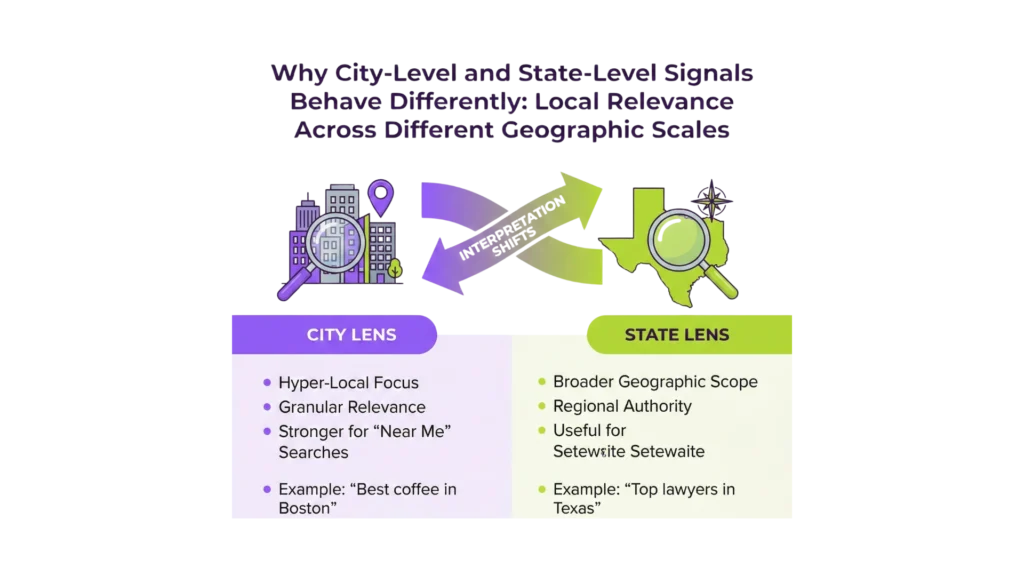
Guest posts do not carry a single, fixed local meaning. The same placement can be interpreted very differently depending on whether search engines read it through a city lens or a state lens. This difference is not accidental. It reflects how local relevance is resolved at different geographic scales. Understanding this distinction explains why a guest post blogging service may appear highly effective in one market and muted in another, even when execution looks identical.
Local interpretation changes as geographic scope changes.
At the city level, search engines operate under tight proximity constraints. They assume that users want results anchored close to where they live or search. As a result, city-level interpretation depends heavily on how densely signals cluster around a specific location.
A seo guest post that references a city but sits within a publication that lacks strong local readership or engagement does little to reduce uncertainty. The system looks for multiple, nearby confirmations that a business belongs to that urban context. In dense cities, this threshold is higher because many businesses compete for the same geographic relevance. One placement rarely settles interpretation on its own.
City-level relevance is therefore sensitive, narrow, and confirmation-heavy.
At the state level, proximity loosens and scope expands. Search engines shift from neighbourhood validation to regional credibility. Here, the publisher’s audience breadth matters more than physical closeness.
A marketing guest post placed on a regional publication with statewide readership helps the system understand broader service legitimacy. The question is no longer “is this business near the user,” but “does this business belong within this regional ecosystem.” Publications that consistently cover statewide issues, industries, or communities carry interpretive weight even if they are not city-specific.
State-level signals stabilise around reach, not immediacy.
Market size quietly alters interpretation thresholds. In smaller cities or less competitive states, fewer signals are needed to establish relevance. The system encounters less conflicting data, so confidence forms faster.

In large metropolitan areas or highly competitive states, confirmation requirements increase. Multiple guest posting services placements may still struggle to compound if they do not reinforce the same geographic understanding. This is not a penalty. It is a risk-management response. The system demands more evidence before committing to visibility in noisy environments.
The same signal behaves differently because the surrounding data landscape is different.
National publications provide authority, but they rarely resolve local ambiguity on their own. Regional publishers operate closer to the geographic layer search engines are trying to interpret.
For local seo, a regional publisher helps bridge city-level specificity and state-level legitimacy. It signals that the business is recognised within a defined area, not just broadly online. National sites validate expertise. Regional sites validate belonging. The system treats these validations as complementary, not interchangeable.
City-level and state-level signals behave differently because search engines solve different problems at each layer. Cities require proximity confirmation. States require regional legitimacy. Market size adjusts confidence thresholds. Publisher scope shapes how relevance is inferred.
Once local visibility fundamentals are in place, guest posting becomes less about promotion and more about confirmation. For US local businesses, the role of a guest post blogging service is to help search engines and users agree on one thing: where the business actually operates.
At the local level, visibility is earned before persuasion begins. Engines look for consistent signals across locations, publishers, and entities. Guest posts work when they reinforce geography, not when they try to convince readers of expertise.
A. Treat guest posts as geographic confirmation, not promotion
For local brands, guest posting works best when it confirms existence rather than announces capability. Search systems already assume competence once a business is indexed. What they continue to test is location certainty. The environment in which a brand appears matters more than the message inside the article.
A mention in a city-based publication quietly reinforces that the business operates within that market. Here presence precedes persuasion in local search. Before users trust claims, engines need to trust placement. This is why many guest posting services fail local businesses. They optimise for generic reach instead of geographic relevance. The result is content that reads well but does not strengthen local signals.
B. Align publisher geography with service coverage
City and state publishers play different validation roles. A feature on a city-focused platform reinforces hyperlocal intent. It supports queries that include neighbourhoods, ZIP codes, or “near me” modifiers. These placements help engines associate the brand with a specific operating area, not just an industry.
State-level outlets serve a broader function. They reinforce regional legitimacy, especially for businesses serving multiple cities within one state. This matters for services where buyers compare providers across districts rather than streets. A well-placed seo guest post on a state publication helps stabilise rankings across multiple local SERPs without forcing repeated city-level outreach.
The key is alignment. Publishing outside your actual coverage area creates noise. Publishing within it creates confirmation.
C. Frame content around local decision context
Local guest posts should mirror how decisions are made on the ground. City-level content works best when it addresses immediate, practical problems. These could include service availability, compliance nuances, or operational constraints specific to that city. State-level content, on the other hand, should speak to broader considerations such as regulation, scalability, or cost differences across regions.
What does not work is generic marketing guest post content repackaged with a city name. Engines and readers recognise this instantly. Local relevance comes from context, not labels. The strongest guest posts read like local insight, not repurposed brand messaging.
D. Position guest posts alongside other local signals
Guest posting does not operate in isolation for local SEO. Its real value appears when it supports existing signals. City-specific guest posts reinforce on-site location pages. They help validate NAP consistency already established through citations. When aligned correctly, they strengthen entity understanding rather than introducing new variables.
This is why local seo outcomes improve when guest posting is sequenced after foundational work. Once citations, location pages, and service-area clarity are in place, guest posts act as external confirmation. They tell engines that other local entities recognise and reference the business within the same geographic frame.
E. Adjust expectations by market structure
Market size changes how quickly guest posting influence appears. In large metros, reinforcement is slower. Competition is higher, and engines require repeated confirmation before adjusting trust levels. Guest posts here act as stabilisers rather than accelerators.
In smaller regions, association happens faster. Fewer competing signals mean each placement carries more relative weight. A single, well-aligned guest post can noticeably improve city-level clarity over time. Understanding this difference helps businesses set realistic expectations and avoid over-investing too early.
Guest posting services for US local businesses work quietly. Professionals like Fastlinko do not push rankings directly. It shapes interpretation. At the city and state level, where search engines must resolve location confidence, off-site mentions provide environmental context that links alone cannot.
When guest posts align with geography, publisher environment, and market structure, they reinforce local presence over time. When they don’t, they remain neutral, regardless of effort or quality.
Understanding this distinction turns guest posting from a tactic to optimise into a signal to read correctly.
State-level targeting builds broader relevance. City-level targeting builds precision. A state-focused placement helps establish regional authority, while city placements help confirm proximity and service coverage. Strong strategies usually combine both, rather than choosing one over the other.
The publisher’s location shapes how search engines interpret relevance. When a site regularly covers a specific region, its mentions carry geographic meaning. A link from that environment reinforces local association more clearly than a generic placement with no regional focus.
Effective services look beyond metrics. They evaluate who the publisher writes for, what locations they cover, and how local their audience actually is. A smaller, region-specific site often delivers stronger local SEO signals than a large but location-neutral platform.
In smaller markets, a few strong local placements can move visibility quickly. In larger cities or competitive states, guest posts work more as reinforcement than drivers. They help stabilise rankings while reviews, proximity, and citations handle differentiation.
