
How US Agencies Use Guest Posting to Build Authority for Clients
January 30, 2026







For US service businesses, local SEO success often depends less on rankings and more on interpretation. Search engines first need to understand who a business is, where it operates & whether its information can be trusted across the local ecosystem. Citation building for local SEO sits at the centre of this process.
What creates confusion is that citations feel simple. Business listings. Directory mentions. Name, address, phone number. Yet small inconsistencies quietly shape how confidently a service brand is surfaced in local results. Visibility gaps are rarely caused by missing optimisation. They’re caused by unclear identity signals.
In modern local search, citation building for local SEO is not about directory volume. It’s about consistency, confirmation & coverage. Service brands that appear stable across trusted sources are easier for search engines to validate, categorise, and rank locally.
This blog explains how local citation building service actually works for US service businesses, how search engines read citation signals today & why disciplined NAP consistency and presence still influence local visibility, even as algorithms evolve.
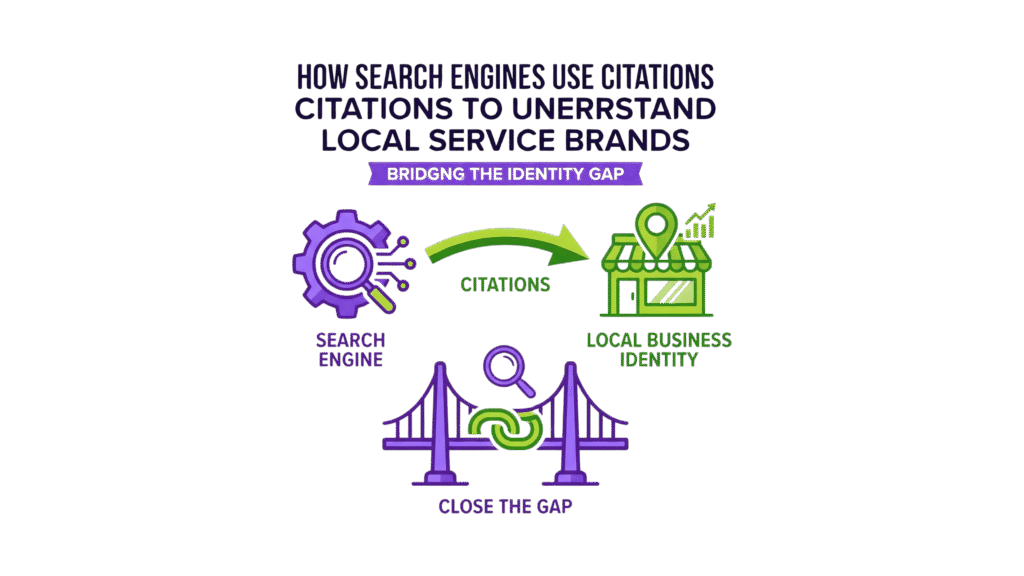
Before search engines decide where a local business should rank, they must first understand who the business is and where it operates. This sounds basic, but at scale it is one of the hardest problems local search systems solve. Citations exist to close this gap. They act as interpretation signals that help search engines stabilise identity, location, and intent for local service brands.
Local search systems struggle with identity resolution at scale. Similar business names, rebrands, duplicate listings & inconsistent data make it difficult to determine whether references point to the same real-world entity. Citations reduce this ambiguity through repetition across independent sources.
When a business appears consistently across directories, data aggregators, and local platforms with matching core details, the system can cross-verify identity rather than infer it. Local seo citation building service reduces uncertainty. Over time, the business transitions from being questioned to being recognised. This recognition is critical for service brands, especially those without strong offline signals or long-standing digital histories.
Identity must be settled before visibility can stabilise. Citations help the system reach that settlement.
For service-area businesses, location interpretation is rarely straightforward. Many do not operate from a single customer-facing address. Instead, they serve defined regions, cities, or neighbourhood clusters. Search engines rely on citations to understand these geographic boundaries.

What matters is not how many places a business claims to serve, but how consistently location is described across platforms. Repeated alignment around cities, service areas & regional descriptors allows the system to place the business confidently within proximity-based results. When location data conflicts or remains vague, the system limits exposure to avoid misplacement.
This is why citations play a central role in Maps and local pack behaviour. Clear, repeated geographic signals reduce placement risk. Reduced risk allows more stable visibility.
Citations also inform how search engines interpret what a business actually does. Category labels and service descriptors across local citation building service sources help map the business to specific local intent queries. When these categories align consistently, intent matching becomes more precise.
Misaligned categories introduce friction. They force the system to reconcile competing interpretations, which delays confidence. Clear, repeated categorisation sharpens how the business is understood within its service niche. That clarity improves relevance matching without requiring additional authority signals.
Over time, consistent categorisation contributes to trust. The system learns that the business behaves predictably within a defined service category. Predictability reduces evaluation cost, making the business safer to surface across similar queries.
Citations are not signals of popularity or strength. They are signals of clarity. They help search engines resolve identity, geography & service classification with lower risk. Once those elements are settled, other systems, relevance, competition, authority, can operate effectively.
This section explains how citations are read, not how they are created. With interpretation clarified, it becomes easier to understand why citation consistency underpins long-term local SEO stability rather than short-lived ranking movement.
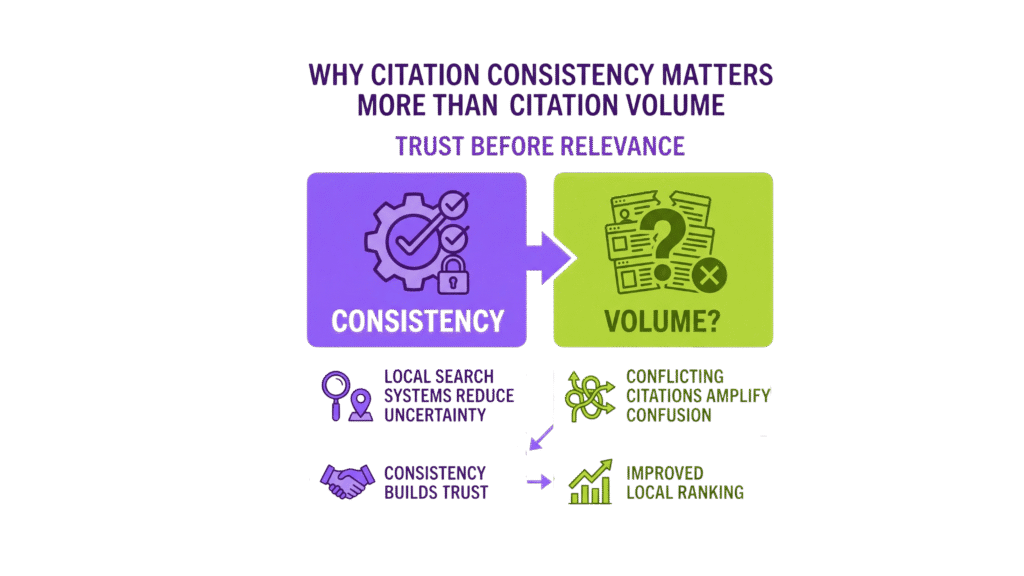
Local search systems are designed to reduce uncertainty, not reward abundance. While many citation strategies still emphasise scale, volume alone does not help a system interpret a business more confidently. In fact, when citations conflict, increased coverage can amplify confusion rather than resolve it. Consistency matters because local search depends on trust before relevance or competition is evaluated.
Citation volume only helps when interpretation is already stable.
Name, address & phone number data form the core of local identity resolution. When this information conflicts across platforms, search engines are forced to reconcile competing versions of the same business. That reconciliation introduces friction. The system must decide which data points are reliable and which are outdated or incorrect.
As friction increases, confidence decreases. Even small inconsistencies like abbreviations, formatting differences, or outdated contact details can compound when repeated across multiple listings. Instead of reinforcing legitimacy, conflicting NAP consistency data signals instability. The system responds cautiously, limiting reuse until identity can be resolved with lower risk.
Duplicate listings create a different but equally damaging problem. Rather than conflicting signals, they produce fragmented ones. Search engines may interpret duplicates as separate entities or as unresolved variations of the same business.

This fragmentation weakens confidence because signals that should reinforce each other are split across profiles. Engagement, references, and validation no longer accumulate cleanly. The system sees partial evidence in multiple places instead of complete evidence in one. Over time, this slows trust formation and destabilises local visibility, even when overall citation count appears strong.
Category data tells search engines what type of demand a business satisfies. When categories vary across local seo citation building service, intent interpretation becomes unstable. A business may appear relevant to multiple query types without clearly satisfying any one of them.
This inconsistency forces the system to hedge. Rather than committing to a clear interpretation, it limits exposure to reduce misclassification risk. Even extensive citation coverage cannot compensate for unclear categorisation. Intent matching weakens because the system cannot confidently place the business within a defined service cluster.
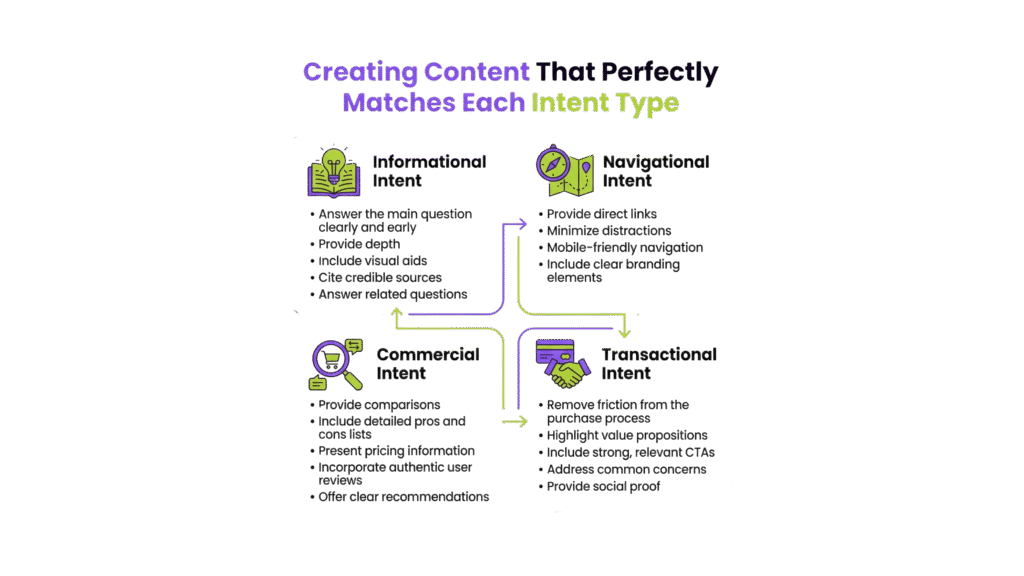
Citation consistency matters more than volume because local search systems value clarity over coverage. Conflicting data, fragmented entities, and unstable categorisation increase uncertainty. Increased uncertainty suppresses visibility quietly, without penalties or explicit signals.
This section explains why local SEO citation building often underperforms despite apparent scale. The issue is not effort or reach. It is an unresolved interpretation.

Once citation interpretation and consistency risks are understood, citation building becomes a controlled positioning exercise. For US service businesses, citations are not just directory listings. They are how search engines verify operational reality over time. This section explains how mature service brands structure citation building to support long-term local SEO without introducing instability or dilution.
Citation building starts long before submissions begin. The first step is locking a single business identity that will not change across platforms. Search engines do not tolerate ambiguity well. Even small inconsistencies in name formatting or contact details create uncertainty around legitimacy.
US service brands standardise their business name down to punctuation and spacing. They also lock a primary phone number and website URL early, before any expansion. This creates a clean reference point that aggregators, maps & directories can trust. Once this identity is stable, every future citation reinforces the same entity instead of fragmenting it.
Brands that skip this step often spend months fixing duplicates later. Those corrections rarely recover full trust. Stability at the start saves authority over the long term.
Many US service businesses operate as service-area businesses rather than walk-in locations. Citation building for local SEO must reflect this reality accurately. Listing a physical address where customers are never served creates friction and invites edits from third-party platforms.
Experienced teams focus on coverage descriptions instead of overstating physical presence. They clearly define service areas, cities served & regional boundaries. This helps search engines understand where the business is relevant without forcing a storefront narrative.
For service-area businesses, accuracy here directly affects local pack eligibility. When citations reflect how the business actually operates, ranking behaviour becomes more stable. When they do not, volatility increases even if link and content signals are strong.
Not all citations carry equal weight. US service brands prioritise platforms that search engines already trust for local validation. This includes industry-specific directories, professional associations & regional business sources tied to chambers, trade groups, or verified local databases.

Authoritative platforms act as reference anchors. When these listings are accurate and consistent, smaller directories inherit trust through association. This layered effect is far more effective than submitting to dozens of low-quality sites early.
Brands that focus on authority-first local citation building service see fewer corrections, fewer merges, and stronger map consistency over time. The goal is not coverage everywhere, but confidence in the places that matter most.
Citation building services are tools, not strategies. US brands use them selectively, not blindly. Automation without verification often introduces more errors than it resolves. Mature teams prioritise accuracy checks before scale.
Verification comes before expansion. Listings are confirmed, corrected, and stabilised on core platforms first. Only then do brands widen their footprint. This prevents error propagation, where incorrect data spreads across dozens of networks.
When used correctly, citation building services reduce manual workload while preserving control. When used aggressively without oversight, they create cleanup cycles that weaken trust signals.
Citation work does not end once listings are live. US service brands treat citation hygiene as ongoing maintenance. Over time, duplicates appear, platforms update formats & legacy data resurfaces through aggregators.
Teams monitor for duplicate listings, mismatched addresses & outdated phone numbers. They also review older citations created during early business stages that no longer reflect current operations. Updating this legacy data prevents authority leakage.
Consistent hygiene is what turns citation building from a one-time task into a stabilising system. Brands that ignore maintenance often see gradual ranking decay without obvious causes.
Citation impact is rarely visible through sudden rank jumps. US brands measure success through stability rather than spikes. Local pack consistency is a primary indicator. When citations are clean, businesses appear reliably for the same queries across time and locations.
Reduced ranking volatility is another signal. Fluctuations caused by data conflicts begin to smooth out as trust accumulates. Search engines become more confident about where and how the business should surface.
These outcomes matter more than raw listing counts. Stable visibility indicates that citations are doing their job as trust infrastructure, not just presence markers.
For US service businesses, citation building works when it is treated as identity management, not directory submission. A single stable entity, aligned service-area signals, authoritative platforms, controlled use of services & ongoing hygiene together create a trust layer search engines rely on.
This execution model only makes sense once foundational mechanics are understood, because citations amplify clarity, not confusion. When built and maintained correctly, they become one of the quietest yet most powerful supports for long-term local SEO performance.
Citation building for local SEO works because it helps search engines trust what they see. For US service businesses, clarity around identity, location, and consistency determines whether visibility grows steadily or stalls unpredictably.
Strong citation strategies don’t chase directory counts. They reinforce the same signals repeatedly, across credible platforms, over time. This creates a stable local presence that supports rankings, maps inclusion & long-term discoverability.
In local SEO, authority begins with accuracy. Citation building remains one of the quietest and most durable ways service brands earn that trust.
Citations act as foundational signals. When content, backlinks, and reviews point to the same consistent business identity, authority compounds. Without citation alignment, even strong content and links struggle to fully lift local rankings.
The most common mistake is ignoring legacy data. Old addresses, outdated phone numbers, or duplicate listings dilute trust. Another issue is rushing submissions without fixing existing errors, which spreads inconsistency instead of resolving it.
Reviews should follow business changes, not fixed schedules. Any update to address, phone, or service area should trigger a citation audit. Periodic checks also help catch silent changes made by aggregators that can disrupt consistency over time.
It feels steady and predictable. Listings match everywhere. Local rankings fluctuate less. Leads become more geographically relevant. When citation building works, it quietly supports growth without constant intervention or repeated fixes.
