How US Agencies Use Guest Posting to Build Authority for Clients
January 30, 2026






Press release SEO is often misunderstood as a formatting upgrade. In 2026, it works more like a visibility qualifier. Google does not treat press release writing as marketing assets by default. It evaluates them as informational inputs. Further google updates filter which releases contribute to search understanding and which are ignored entirely.
This difference explains why many US businesses still issue press releases but see no lasting search impact. The release exists, it’s distributed & it may even get indexed. Yet it fails to reinforce brand authority, topical relevance or long-term discovery.
What has changed is not the need for press releases, but the conditions under which they carry SEO value. Optimized press release services like Fastlinko are experts in the SEO & PR space. They work with brands for lasting reach and relevance. This blog explains why US businesses need SEO-optimized press releases in 2026.

Google no longer treats press release marketing as neutral content that exists outside the main search ecosystem. They are now interpreted as part of a broader information graph that connects entities, topics & trust signals over time. This change explains why press release SEO behaves differently after recent Google updates, even when distribution volume or writing quality appears unchanged.
At a system level, Google is not asking whether press release writing is optimised. It is asking what role the release plays in reinforcing, duplicating or confusing existing understanding.
Press releases are no longer read primarily as standalone pages competing for rankings. Google interprets them as signals that feed into how entities and topics are understood across the web. Their value depends on whether they reinforce existing knowledge about a brand, organisation or subject area.
When a release aligns with consistent entity details, stable topical focus & clear intent, it contributes marginal confidence. Then it introduces conflicting representations or stretches beyond established context, its influence diminishes. This is why optimized press release services can still produce uneven outcomes. The system is not rewarding optimisation, it is evaluating coherence.
Recent Google updates tighten how redundancy is handled across press releases. Repeated promotional language, similar framing or near-identical narratives distributed multiple times are now filtered more strictly. The system treats repetition without informational progression as low-value duplication.
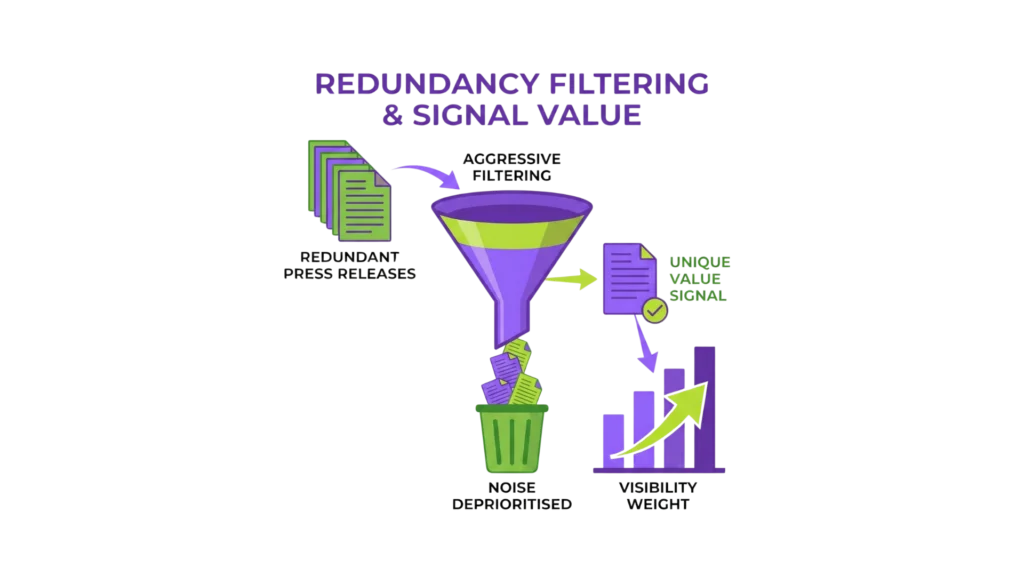
This does not mean press release marketing is ignored. It means that visibility weight declines when releases fail to add new interpretive value. Each release is assessed relative to prior ones. When nothing meaningfully changes, the signal contribution weakens. Redundancy increases noise, and noise is deprioritised.
Google now applies credibility checks earlier in the evaluation process. Before a press release contributes to search understanding, the system assesses source clarity, verifiable context, and intent alignment. These thresholds determine whether the release is processed as informational input or sidelined as promotional material.
This is why press release writing alone cannot guarantee impact. Writing quality matters only after credibility is established. If the system cannot confidently place the source within an existing entity framework, the release struggles to influence downstream signals.
The SEO impact of press releases is no longer immediate or keyword-driven. Press releases influence authority and relevance layers indirectly, rather than producing direct ranking movement. Their effect is cumulative and contextual.
A release may reinforce entity trust, clarify topical association, or support broader organic link building signals over time. These contributions are subtle and delayed. Expecting instant keyword gains misunderstands how press releases are interpreted post-update. Google reads them as supporting infrastructure, not ranking assets.

Press release SEO evolved during a period when search systems were more permissive about repetition, distribution scale, and surface-level optimisation. In that environment, releases could perform simply by matching keywords, pushing volume, and mirroring on-site content. That environment no longer exists. Modern search systems interpret press releases as signals within a broader entity and content ecosystem, not as standalone SEO assets.
What appears “optimized” today often fails quietly because the underlying logic no longer aligns with how value is inferred.
Traditional press release SEO often begins with keywords and works outward. The release is shaped to mirror landing pages, blogs, or category copy, assuming consistency will reinforce rankings. Modern systems interpret this differently. When a press release closely mirrors existing content, it adds little new information.
Search engines now discount releases that repeat what is already known. Redundancy signals low incremental value. Even when keywords are placed correctly, repetition without added context reduces interpretive usefulness. Press release writing that prioritises keywords over contribution often looks complete but fails to advance understanding.
Optimization without informational gain no longer compounds.
Press release marketing once relied on distribution volume to amplify impact. The assumption was that broader syndication increased authority through exposure. After recent Google updates, distribution without differentiation behaves very differently.
When identical or near-identical releases appear across multiple platforms, search systems recognise broadcast patterns. These patterns dilute signal strength rather than concentrating it. Volume cannot compensate for unclear intent. Without a distinct informational role, wide distribution accelerates discounting instead of visibility.
Optimized press release services that still prioritise scale over intent often see diminishing returns, even when reach increases.
Marketing language has become a liability in press release SEO. Search systems now evaluate tone as part of intent inference. Over-promotional framing signals that the release exists primarily to influence, not inform.
This does not mean brands must remove positioning entirely. It means marketing-forward language reduces interpretive value when it dominates. Releases written as promotional assets struggle to function as credible information inputs. Trust suppression happens quietly. The release is indexed, but its ability to transfer value weakens.
This is why press releases that feel polished yet sales-oriented often fail to support long-term SEO outcomes.
Press release SEO used to function independently. Releases were published, indexed, and expected to deliver value on their own. Today, search systems interpret releases in relation to broader entity signals, content history, and behavioural patterns.
When press releases are written in isolation, without alignment to existing content and entity understanding, their SEO value plateaus. They may generate short-term visibility, but they fail to reinforce long-term trust. Organic link building and entity consistency now determine whether press releases add value or remain episodic.
Compounding requires integration. Isolated optimization produces isolated results.
Traditional press release SEO models have not failed because execution worsened. They have failed because the system changed. Search engines no longer reward optimisation that does not reduce uncertainty or add new information.
This section exposes why familiar approaches underperform despite appearing correct. Understanding this decay is necessary before rethinking how press release writing, press release marketing, and optimization fit into modern search behaviour shaped by ongoing Google updates.
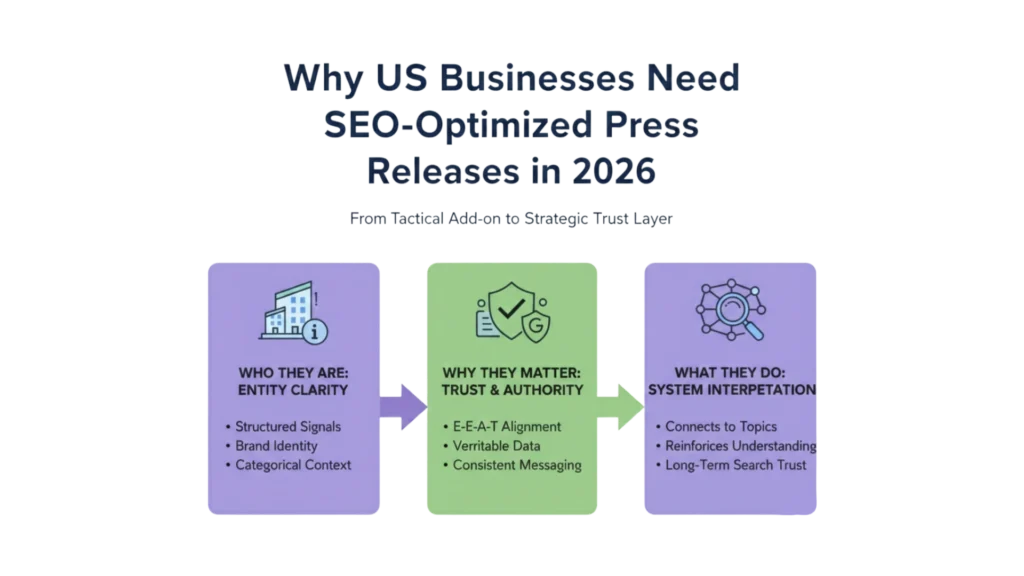
Once system interpretation and legacy limitations are clear, SEO-optimized press releases take on a very different role. They are no longer issued to “rank” or to chase temporary visibility. In 2026, US businesses use press releases as structured signals that help Google understand who they are, what they operate in, and why they matter within a category.
This shift is a direct response to how search evaluation now works. Google updates increasingly reward clarity, consistency, and contextual authority over volume or repetition. Within that environment, press release SEO has moved from a tactical add-on to a strategic layer that supports long-term search trust.
Modern press releases are not written to push individual pages up the SERP. They are written to reinforce entity understanding. For US businesses, this means clarifying the business itself rather than optimising around isolated keywords.
A well-structured release helps search systems connect the brand to its industry, operating scope, and relevance. It explains what the business does, where it operates, and how it fits into a broader market conversation. Over time, repeated clarity across releases builds a stable entity profile that survives algorithm shifts.
This is why SEO-aligned press release writing now focuses on definition and context. When releases consistently describe the business in the same terms, across the same topical boundaries, Google becomes more confident in associating the brand with specific queries and categories.
In 2026, keyword density is a liability. Press releases perform better when they communicate one clear narrative instead of attempting to cover multiple angles in a single asset.
Intent clarity means deciding what the release exists to explain before a word is written. Is it reinforcing expertise, announcing expansion, supporting a campaign, or clarifying positioning after a market shift? When a release answers one intent cleanly, it becomes easier for search systems and publishers to interpret.
This approach also avoids duplication across assets. Many US businesses dilute their signals by reusing the same language across blogs, landing pages, and press releases. SEO-optimised releases deliberately avoid that overlap. They support discovery by adding new context, not repeating existing copy.
This is where press release SEO quietly outperforms traditional content. Instead of competing with owned pages, it complements them.
Press releases work best when they are treated as part of a broader press release marketing strategy, not as isolated announcements. In 2026, high-performing businesses align releases with campaigns, launches, and narrative arcs that already exist across content and search.
This alignment allows releases to support discovery over time. Instead of creating a short spike in attention, they reinforce the same themes that blogs, case studies, and category pages are already establishing. Search systems reward this consistency because it reduces ambiguity.
For US brands, this means releases are planned alongside SEO and content calendars. Each release adds a layer of explanation or validation, rather than standing alone. The result is cumulative visibility instead of fragmented exposure.
Search interpretation increasingly mirrors editorial judgment. Releases written in an informational tone perform better than those written as promotional copy. This is not about style preference. It is about trust signals.
Informational press release writing explains what changed, why it matters, and who it affects, without overstating outcomes. This makes the release safer to reuse, cite, and summarise, which increases its lifespan across publishers and search surfaces.
Structure also matters. Clear headers, logical progression, and quotable sections make releases easier to extract and reference. As Google relies more on summarisation and reuse, releases that are structured for citation gain an advantage.
US businesses that understand this write press releases that behave like reference material, not marketing collateral.
Optimized press release services are most effective when they prioritise credibility over automation. Distribution alone does not create SEO value. Placement, sourcing, and editorial alignment do.
The best services focus on where the release appears and how it is contextualised. They favour environments where credibility already exists, and where the release can contribute meaningfully to an ongoing topic. This approach reduces risk during Google updates, which increasingly penalise mass-produced or low-context content.
SEO-optimized press releases in 2026 are not about visibility hacks. They are about qualifying a brand’s presence within search systems that increasingly reward clarity, credibility, and intent alignment.
For US businesses, press releases still matter, but only when they reinforce authority rather than repeat marketing claims. When optimized correctly by experts like Fastlinko, they support broader SEO efforts by strengthening entity understanding and topical relevance across updates.
Press releases no longer win on volume or distribution alone. They earn value by fitting precisely into how Google evaluates information today.
Search behaviour has shifted toward entity-based understanding. Press releases help define who a brand is, what it does, and why it matters. When releases are written clearly and distributed thoughtfully, they support brand visibility across search, news, and discovery surfaces at the same time.
Recent updates reward clarity and credibility. Releases that read like genuine news are indexed differently from promotional content. Google observes how releases are reused, cited, and engaged with. That behaviour influences whether a release contributes to search presence or fades quickly.
Balance is key. SEO-friendly releases use natural language, clear structure, and relevant context without forcing keywords. When a release answers real questions and explains impact, optimisation becomes invisible. That subtlety is what allows the content to perform without triggering quality concerns.
They start with interpretation, not templates. Services now shape releases around how stories are indexed, cited, and contextualised. Distribution follows strategy, not the other way around. This approach aligns better with how search systems evaluate credibility today.
