
How US Agencies Use Guest Posting to Build Authority for Clients
January 30, 2026






Most brands assume guest posting automatically brings traffic.
But in 2025, the guest posts that once performed well now feel misaligned. Audiences skim past them, search engines discount them, and referral clicks stagnate.
The problem isn’t the format. It’s the strategy behind it. Nowadays, traffic emerges when a guest post reflects audience demand, platform intent, and clean link logic. Contrarily, it dies when guest posts read like filler content, appear on irrelevant websites or carry links that don’t match user motivations.
Experienced content editors and strong guest post blogging services treat offsite articles as strategic acquisition assets, not writing assignments. They consider narrative framing, platform authority, link placement, and behavioural signals before publishing.
This blog breaks down why most guest posts don’t drive traffic and, more importantly, how to fix them with modern, buyer and search-aligned approaches.
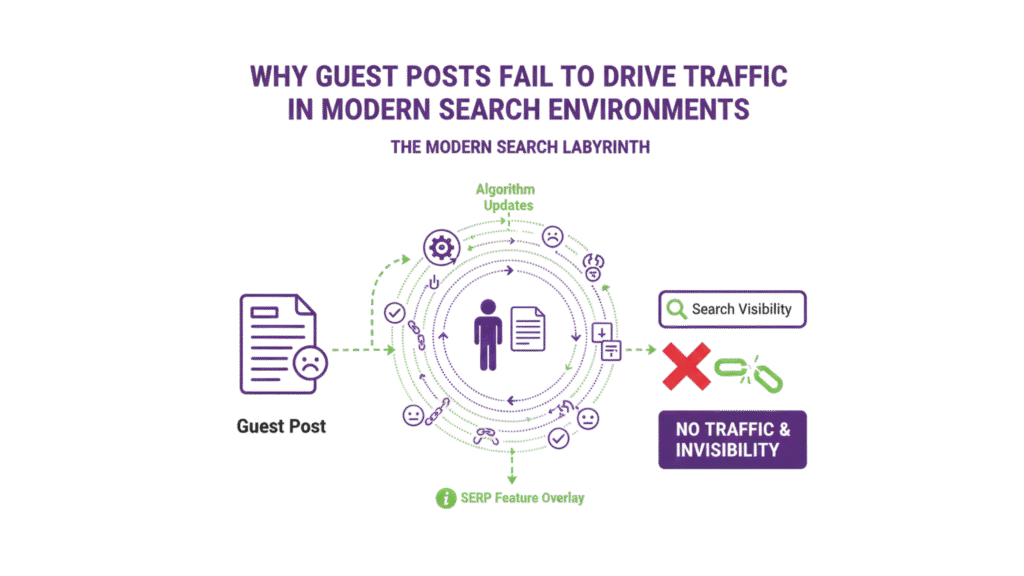
Traffic failures aren’t accidental.
They happen when guest posts ignore platform intent, audience priorities, or link behavior. Many brands assume placements guarantee attention. Today’s search environments reward relevance, trust, and user value.
This section breaks down why guest posts underperform and why volume-based outreach no longer produces real visibility.
Most traffic failures begin at the platform-selection stage. Publishing on websites that attract the wrong audience, weak engagement, or surface-level content ecosystems makes even a well-written marketing guest post invisible.
Many sites used by a typical guest post blogging service have the appearance of authority but lack active readership. Low repeat visits, minimal comments, and thin editorial oversight weaken distribution.
When the platform’s reader base doesn’t match your buyer persona, the content earns impressions, not action. Traffic dies at the source.
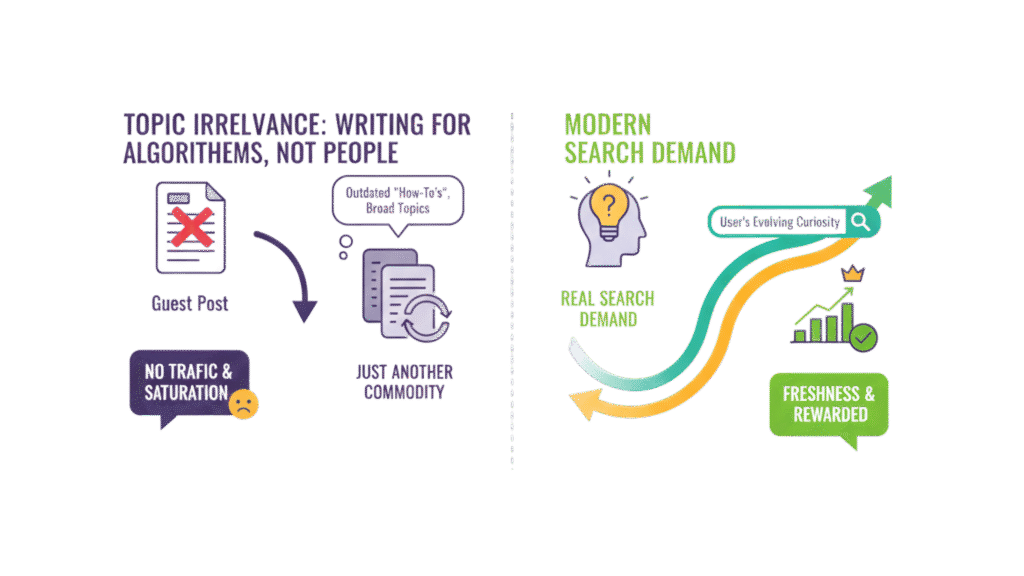
A common mistake is choosing topics that don’t intersect with real search demand or evolving buyer curiosity. If the headline doesn’t match what users are actively exploring, no amount of SEO formatting will generate traffic.
Many guest posts rely on outdated “how-to” themes or broad concepts that already exist in thousands of variations. Without specificity or insight, your article becomes just another commodity. Search engines recognise saturation — and reward freshness, not repetition.
One of the biggest reasons guest posts not driving traffic becomes a recurring issue is link misuse. Most links are placed to satisfy SEO checkboxes rather than user intent.
Links shoved into irrelevant anchors, unrelated subheads, or promotional paragraphs receive no clicks. Users ignore them because they add no value to their journey.
Low click-through rates teach search engines that the link is unhelpful. Thus weakening both referral traffic and long-term authority signals.
Good links guide readers toward an answer. Bad links sit there unnoticed.
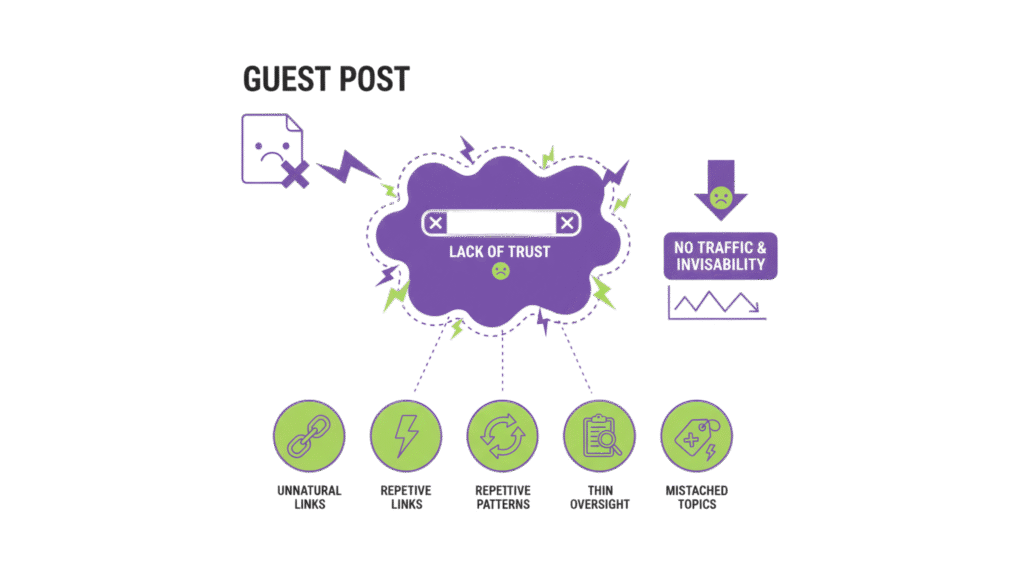
Search engines evaluate guest posts differently now. Articles that seem artificial, overly promotional, or disconnected from the site’s topical expertise are either down-ranked or ignored.
Signals that trigger suppression include:
• unnaturally inserted links
• repetitive content patterns across multiple sites
• thin editorial oversight
• mismatched topical categories
If the post looks engineered rather than editorial, traffic evaporates before it begins.
A high Domain Rating or Domain Authority doesn’t guarantee active readership. Many paid guest posting sites inflate their metrics through backlinks but lack real communities, search visibility, or repeat visitors.
Brands confuse strong metrics with strong readership, leading to traffic expectations that never materialise. DR may open doors, but real readers drive performance.
Readers now understand the core reasons why traffic fails. Before fixing the issue through better targeting, smarter platforms, and strategic link optimisation, they have clarity on the root causes.
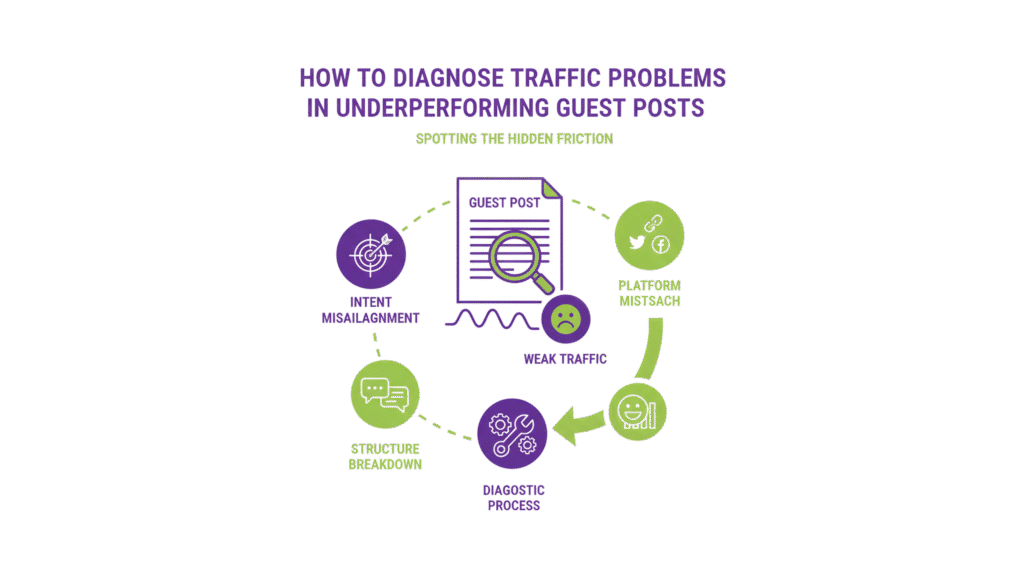
Traffic failures follow a pattern.
Guest posts break when intent, structure, and platform behaviour fall out of alignment. Strong teams study these failures with patience and precision. This helps them spot the hidden friction behind weak performance.
Let’s learn how to diagnose traffic problems in underperforming guest posts:
A guest post collapses the moment its story misfires.
Many posts focus on internal agendas instead of user problems. They explain features instead of tensions. This breaks trust before the reader even settles.
Readers respond to clarity and honesty. They want content that reflects their challenges. They expect insight that feels earned, not recycled. Posts that ignore this truth always lose the room.
Weak narratives also drift from search behaviour. They chase vague topics without demand. They repeat generic tips seen everywhere. This mismatch drains momentum instantly.
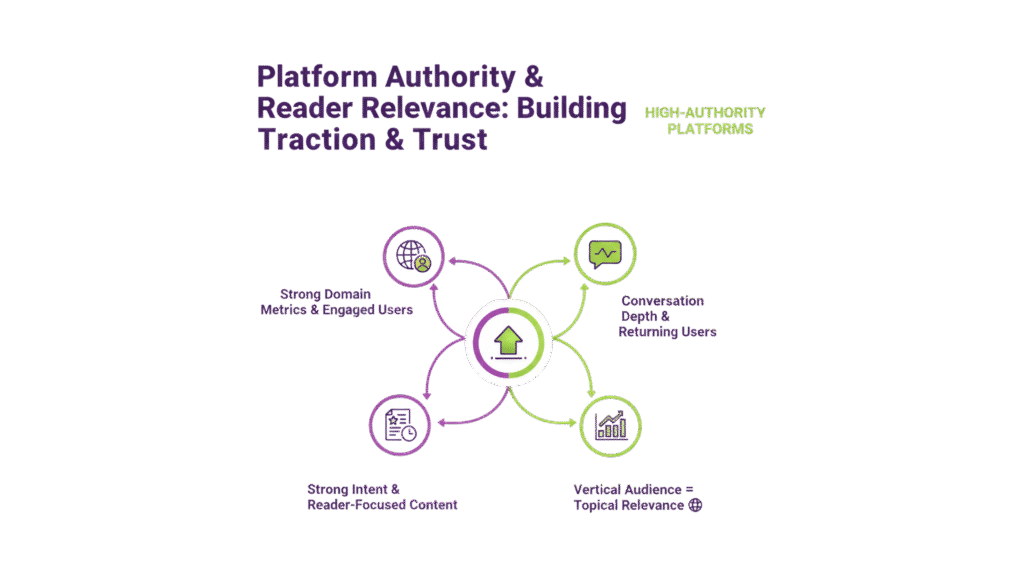
Platform quality dictates traffic potential.
Some sites display strong domain metrics yet hold no real users. They publish content without a community. They attract writers, not readers.
These environments produce impressions without movement. They host posts that never circulate. They weaken every narrative placed inside them. A platform without a vertical audience cannot create traction.
Relevance emerges from lived readership. Good platforms carry conversation depth. They bring returning users and strong intent. They respect content that respects the reader.
Links reveal the heart of a guest post.
Weak link placement signals a weak understanding of reader flow. Many links sit in paragraphs no one reaches. Others attach to anchors that create no curiosity.
Links must earn attention through relevance. They need narrative timing and emotional logic. They should guide readers where questions naturally arise. Forced links only break trust.
Destination alignment matters too. A mismatched page disrupts the journey. Readers click, feel lost, then exit fast. Behaviour patterns make this failure obvious.
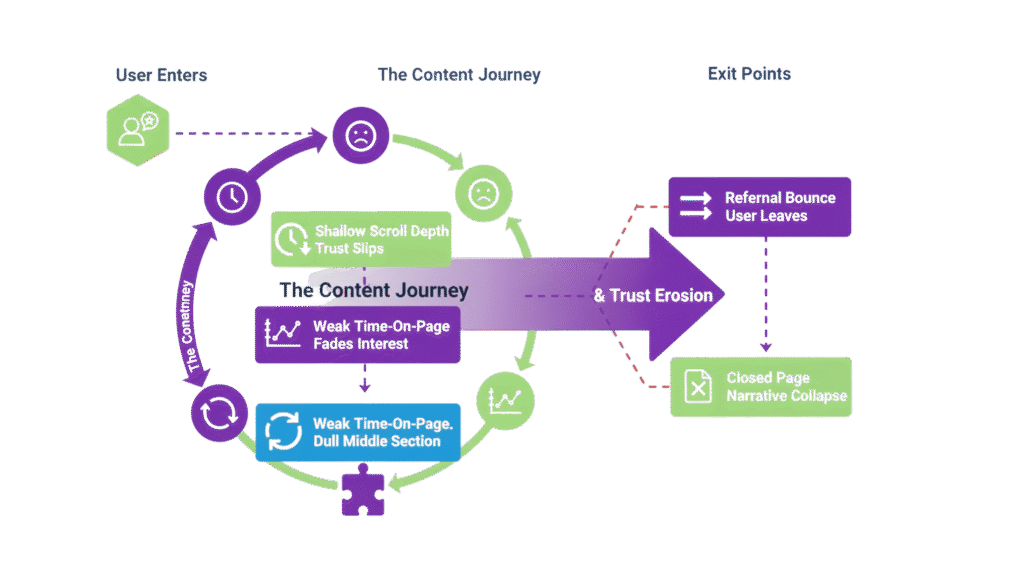
Behaviour metrics show the truth behind each visit.
Shallow scroll depth reveals early disappointment. Weak time-on-page shows a dull middle section. Referral bounces reveal broken continuity.
These patterns show where trust slipped. They expose unclear hooks or slow pacing. They highlight missing context or weak transitions. They give teams the emotional map behind each collapse.
Good analysts study these signals with patience. They treat metrics as human reactions. They use them to rebuild narrative strength.
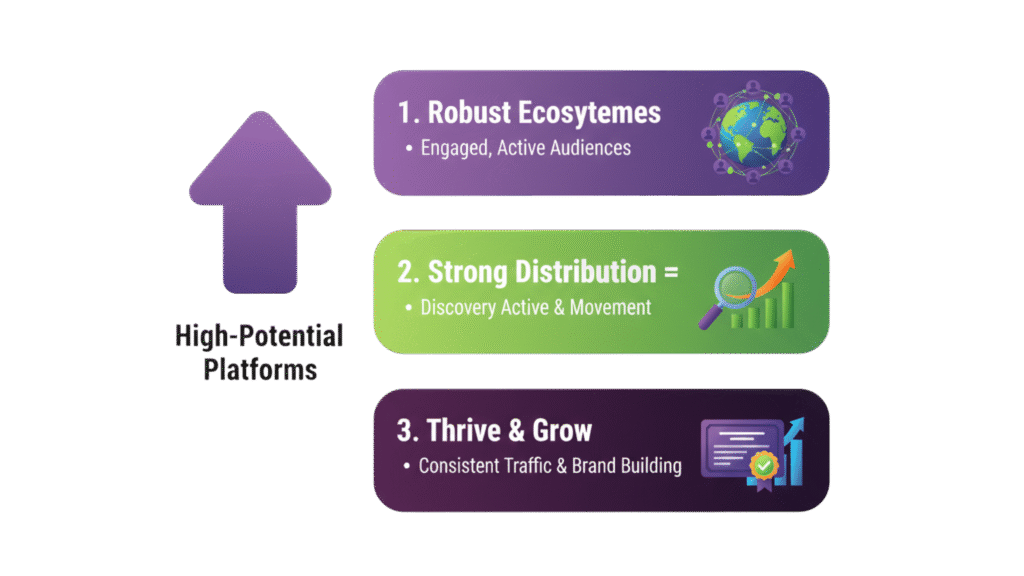
Some platforms cannot deliver traffic regardless of content strength.
Their ecosystems lack distribution. Either their audiences remain passive or absent. Ultimately, their visibility decays in silence.
These limits belong to the platform, not the brand. Good content cannot thrive in stagnant environments. No distribution means no discovery. No discovery means no traffic.
Teams must recognise these constraints early. It protects the strategy from false blame. It keeps focus on environments that can support movement.
This diagnosis sharpens every decision. It explains why guest posts not driving traffic becomes a repeated issue. It shows where friction forms and why it persists.
Now, let’s find out why most guest posts don’t drive any traffic and how to fix it.
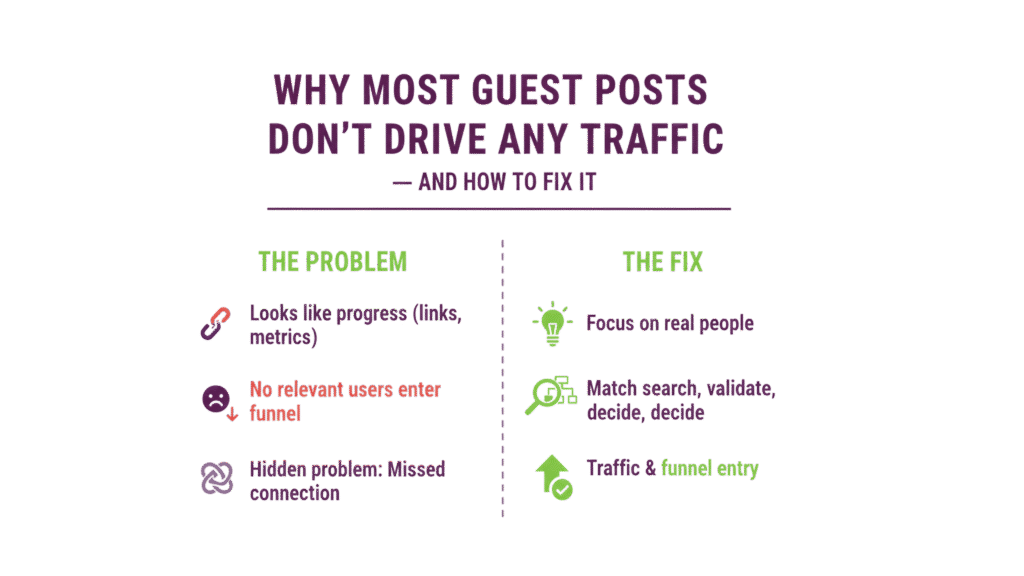
Guest posting often looks like progress. Traffic solutions involve new placements, backlinks, and logos for reporting.
Yet many brands discover later that their guest posts not driving traffic was the hidden problem all along. Links exist, metrics rise, but not a single relevant user enters the funnel.
Traffic comes only when a guest post blogging service or internal editorial team designs content around how real people search, validate, and decide. Here’s a guide on fixing your traffic from guest posts.
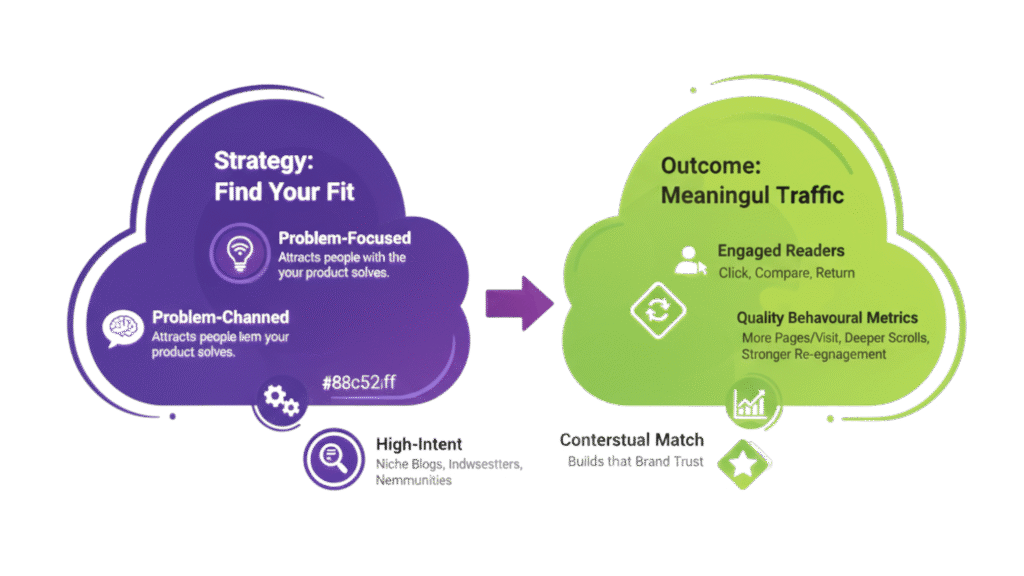
Traffic begins with fit.
When brands prioritise DA or price, they land on platforms that readers scroll past. Relevance means the platform attracts people already facing the problem your product solves.
For high-intent discovery, niche blogs, industry newsletters, and focused communities deliver far better outcomes than generic paid guest posting sites. That difference is visible in behaviour. Engaged readers click, compare, and return.
Disengaged audiences bounce in seconds.
Relevant placement puts your idea inside someone’s decision path. They arrive looking for solutions. They click because your link sits at the exact point where curiosity peaks.
A strong contextual match also strengthens how Google interprets the link, supporting both authority and topical alignment. When platforms focus on quality, the referral sessions they generate become meaningful.
More pages per visit, deeper scrolls, stronger re-engagement. This is traffic that matters.
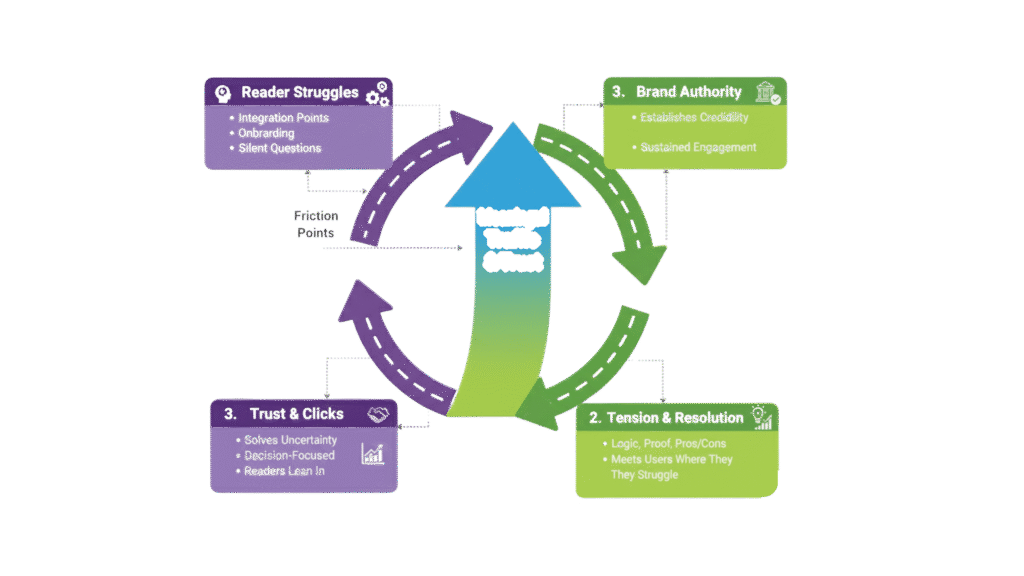
The biggest reason for guest posts not driving traffic still being common is that the content speaks about your brand, while the readers want help with their constraints.
Insight-based angles outperform generic tips and tricks because they meet users where they struggle. They address integrations that break, onboarding steps that stall, and procurement objections that kill deals. When a post enters these friction points with clarity, readers lean in.
Narratives built around tension, benchmarks, and hidden inefficiencies work well now because they surface the questions that people already ask silently. A marketing guest post should not compete for attention; it should resolve uncertainty.
True guest post blogging services share grounded logic, proof from the field, or choices with pros and cons. When readers feel understood, the brand becomes worth clicking. When content lacks stakes, readers skim and leave.
Traffic improves when storytelling respects the practical decision environment buyers operate within.
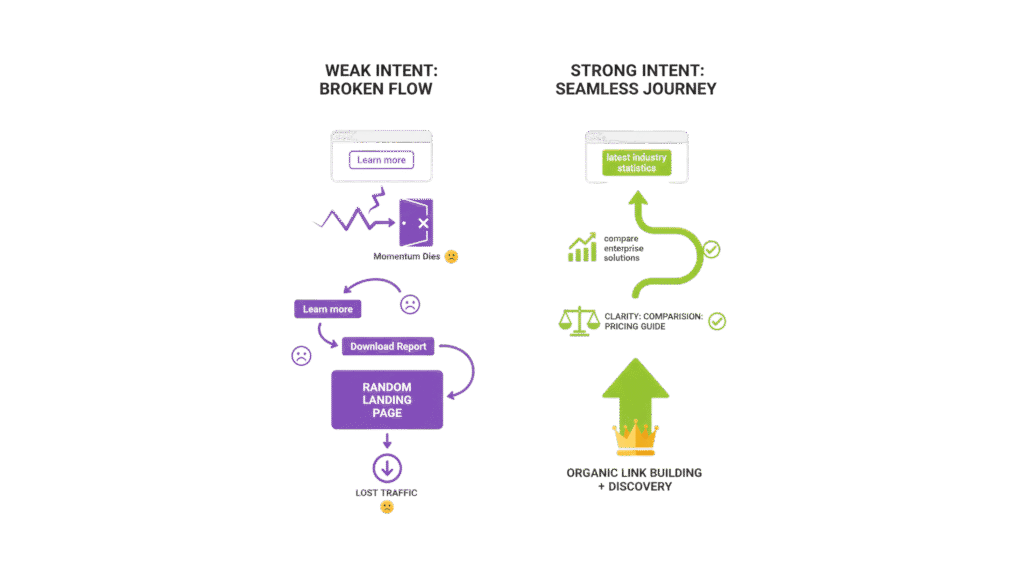
A link fails when it interrupts the flow. It performs when it extends the thought.
On websites, clicks happen where user curiosity spikes. Be it after a claim, after a stat, or a solution framework. Then, anchor text should promise what the reader wants next. They decide whether the asset will deliver comparison, clarity, ora deeper explanation.
Even the small things matter. If your “Learn more” section leads to a random landing page, the user’s momentum dies. If “See cost differences for enterprise workflows” leads to a page that answers exactly that, traffic carries value.
This approach also supports organic link building because it reinforces that the brand understands buyer logic. Search engines reward coherence, pushing pages deeper into discovery journeys.
Readers trust content that improves their understanding. Search engines do too.
Surface-level guest posts struggle to rank or attract visitors because they add nothing to existing conversations. Depth signals change that. Examples from the field, short comparison matrices, topic definitions, and small data points show real expertise.
These improve dwell time and scroll depth, the two key signals in behavioural SEO.
Topical authority grows when ideas are linked across a cluster, and guest posts become supporting nodes. Link-building outsourcing services often fail because traffic doesn’t follow links that reinforce meaning.
Publish content that changes how a reader thinks about the problem, and they’ll click willingly.
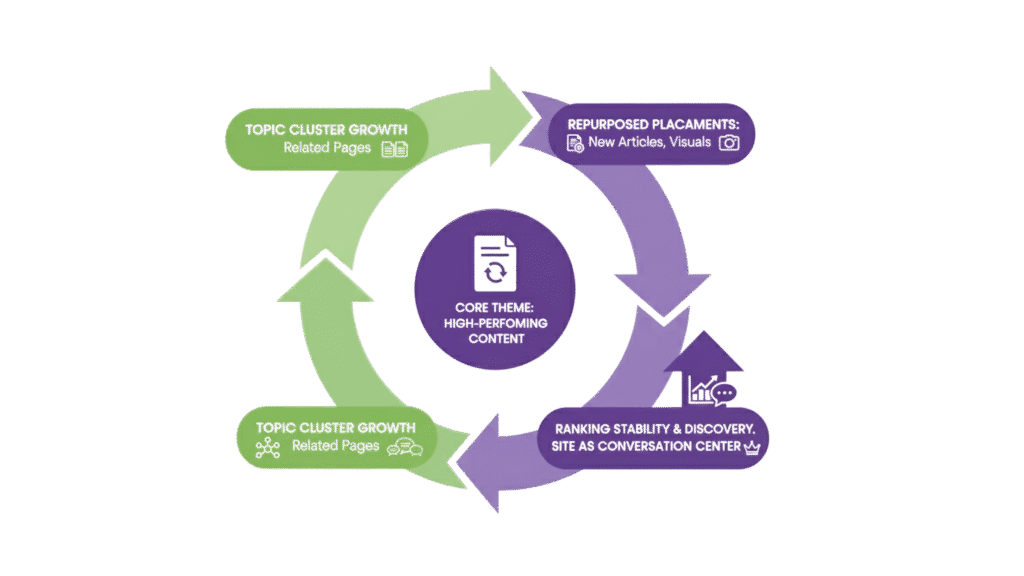
Traffic becomes predictable when you publish around the same themes repeatedly.
Strong guest posts generate follow-up curiosity. Repurposing high-performing segments into future placements compounds authority across the same cluster. Each new link reinforces the interpretation of your brand as a specialist, not a visitor. Over time, that leads to ranking stability and quicker SERP climbs for related pages.
This is where the link strategy shifts from tactical to strategic. Instead of counting links, you connect stories, proofs, and explanations across the web. When this loop forms, search engines treat your site as the centre of the conversation.
When guest posting aligns with how buyers learn, it becomes an active engine of discovery, not a passive SEO checkbox.
Guest posts fail for predictable reasons.
They can be misaligned topics, weak platforms, poor link logic, and unstructured distribution. But when executed expertly, the same content format becomes one of the strongest multipliers of authority, search visibility, and referral traffic.
The fix isn’t publishing more, it’s publishing smarter. By choosing the right platforms, with Fastlinko, your brand can refine its narrative quality, align link intent, and shape content around real-time patterns. Thus, brands can rebuild traction.
Traffic comes from platforms where your audience already spends time. Many brands post on sites that look strong but hold no real readership. Good placements anchor your message around genuine interest, not generic authority scores. The right audience makes the link feel natural and worth clicking.
Absolutely. Readers move when the story speaks to their problem. Even strong domains lose impact if the content feels generic. A marketing guest post works when it builds momentum through simplicity and clarity. Traffic follows narratives that help people understand their options faster.
Links get ignored when they interrupt the flow or feel forced. Readers sense when the link is the goal rather than the guide. Effective link optimization respects reading rhythm. It points to the next natural step in the conversation.
Paid placements help only when the site has real influence. Many paid guest posting sites attract no genuine users, which means even good content fails. Paying for reach works when the platform has active readers and editorial quality. Otherwise, traffic rarely moves.
