
How US Agencies Use Guest Posting to Build Authority for Clients
January 30, 2026





SEO content marketing for professional services operates under different rules. Unlike ecommerce or SaaS, visibility alone doesn’t create trust. Prospective clients for b2b content marketing services evaluate judgement and expertise long before they assess offers. This means content marketing consultants should focus less about promotion and more about signal quality.
In the USA SEO professional services landscape, be it legal, consulting, financial or advisory, search engines & buyers often look for the same thing: evidence of informed thinking. Content that ranks but feels sales-driven quietly erodes confidence. Meanwhile, content made by experts like Fastlinko that demonstrates clarity, restraint & domain understanding compounds authority.
This is why SEO content marketing services vary sharply by profession. The challenge isn’t generating content. It’s aligning search intent with professional credibility without diluting trust.
This guide explores how SEO content marketing actually works for US professional firms. Learn how search engines interpret authority-driven content & how leading B2B advisors structure content strategies that support both visibility and client confidence.
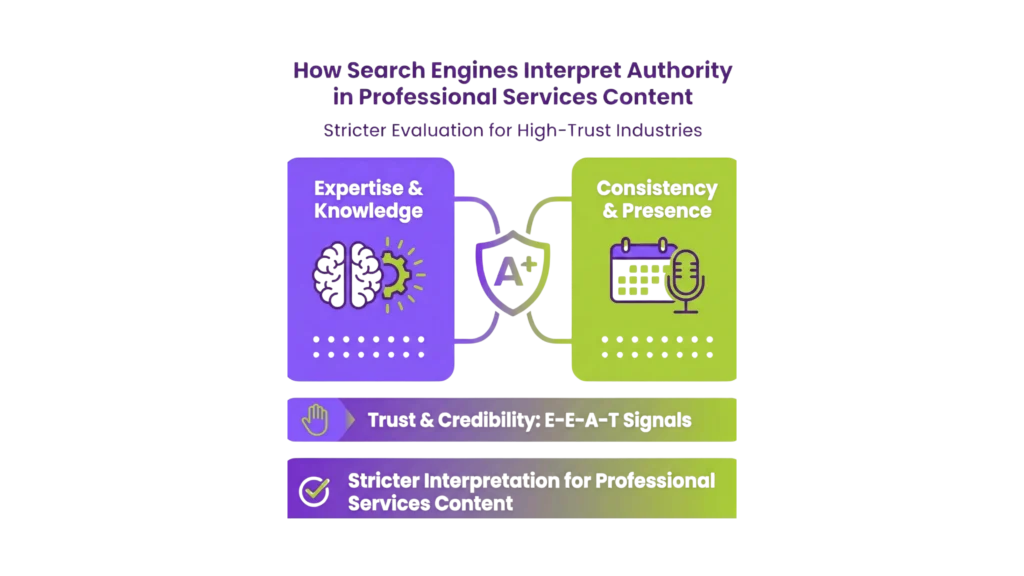
Professional services content is evaluated inside a stricter trust framework than most commercial material. Search engines apply this lens because the consequences of misinformation are higher in advisory, legal, financial, and consulting contexts. Before relevance or rankings are considered, the system assesses whether a source demonstrates stable judgment, clear boundaries, and intellectual reliability over time. This is why authority in seo content marketing services behaves differently for professional firms.
Here, authority is inferred slowly, through coherence rather than scale.
Search engines observe how consistently a professional services brand reasons across related topics. They track whether recommendations align over time, whether conclusions contradict earlier positions, and whether viewpoints shift opportunistically. Inconsistency introduces uncertainty, even when individual pieces perform well.
This is why effective b2b content marketing services often publish less but think more deeply. When judgment remains stable, the system learns how the source evaluates trade-offs. That predictability makes the content safer to reuse across similar queries, which is how authority compounds in high-trust categories.
In professional services, authority is not inferred from how many keywords a site covers. It is inferred from how thoroughly a source understands a subject. Search engines look for topic ownership, not topical reach. Ownership emerges when a source revisits the same core ideas from multiple angles while applying the same logic each time.
Strong content marketing for professional services feels cohesive rather than expansive. Each piece reinforces the previous one, not by repetition, but by deepening context. This allows the system to associate the brand with a defined intellectual space instead of scattered keyword intent.
Professional services content is also evaluated by how it handles persuasion. Overconfident language, absolute claims, or outcome-driven framing raise skepticism. Search engines associate restraint with expertise because experienced professionals tend to explain limits, not exaggerate certainty.
This is why seasoned content marketing consultants often produce content that feels measured and deliberate. Clear definitions, acknowledged trade-offs, and careful language reduce interpretive risk. The system reads this restraint as confidence grounded in experience, not as hesitation.
User behaviour is interpreted differently for professional services searches. Long dwell times driven by confusion or repeated comparison do not necessarily indicate quality. Search engines look instead for signs that the content resolved the user’s need efficiently.
In USA SEO environments, authority is reinforced when users engage, absorb information, and do not immediately search for alternative explanations. This behaviour suggests confidence rather than curiosity. Reduced follow-up searching lowers uncertainty, which strengthens trust signals for the source.Authority in professional services content is inferred through consistent judgment, topic ownership, and restrained clarity. Search engines favour sources that behave predictably and reduce uncertainty across time, not those that maximise output or persuasion.
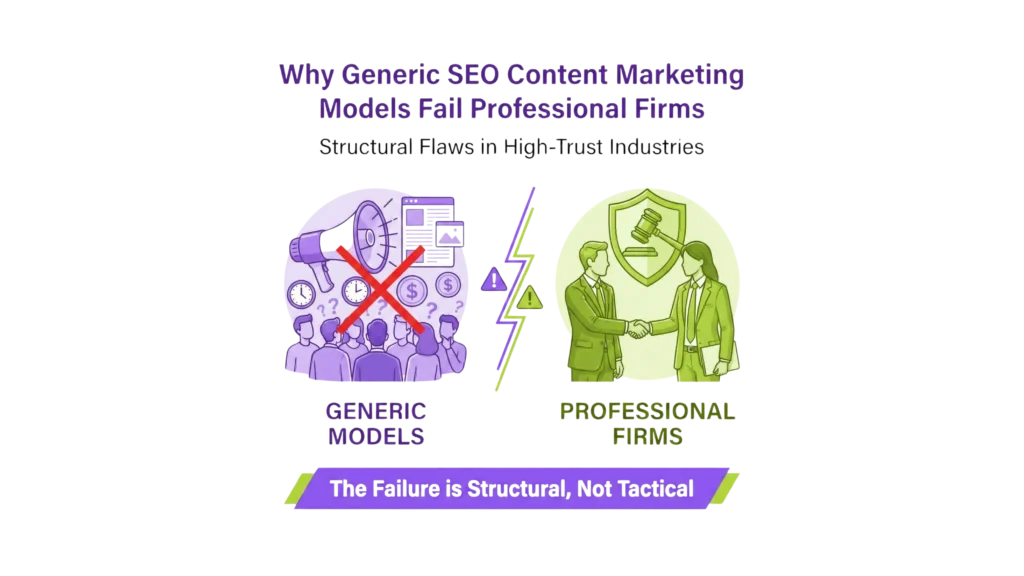
Many widely used SEO content frameworks were designed for transactional industries where speed, volume, and persuasion drive results. Professional services operate under different constraints. Here, trust precedes conversion, and judgment matters more than visibility.
When generic models are applied to advisory, legal, financial, or consulting firms, performance often plateaus or credibility quietly erodes. This is why seo content marketing services that work elsewhere frequently underperform for professional brands. The failure is structural, not tactical.
Generic SEO models rely heavily on persuasive framing. Calls to action, benefit stacking, and confident promises are treated as engagement drivers. In professional services, this language introduces friction. Search engines associate excessive promotion with uncertainty, especially in high-trust categories.
In content marketing for professional services, credibility is inferred through restraint. When content pushes outcomes instead of explaining reasoning, both users and systems hesitate. The result is not rejection, but reduced reuse. Authority weakens because confidence appears manufactured rather than earned.
Many SEO frameworks prioritise publishing frequency. The assumption is that more content increases surface area and ranking potential. For professional firms, this approach fragments authority. Each additional piece introduces another judgment point the system must reconcile.
Effective b2b content marketing services behave differently. They build depth around fewer topics rather than spreading attention across many. When volume increases without conceptual cohesion, search engines struggle to infer a stable point of view. Authority becomes diffuse, and topical strength erodes over time.
Keyword-first models encourage content creation based on search terms rather than subject logic. While this improves coverage, it disrupts how expertise is perceived. Professional authority depends on coherence like how ideas connect, evolve, and reinforce each other.
A content marketing consultant working in professional services understands that keywords support discovery, not credibility. When content is organised around isolated queries, the system sees scattered relevance instead of owned expertise. Over time, this fragmentation limits how confidently the source can be reused across related searches.
Generic SEO frameworks often push optimisation aggressively. Exact-match keywords, internal linking density, and structural repetition are treated as levers. In professional services, these signals can backfire. They draw attention to mechanics rather than meaning.
In USA SEO environments, search engines are particularly sensitive to credibility cues in regulated or advisory industries. Over-optimised content reads as engineered rather than reasoned. Even when rankings hold temporarily, trust signals weaken, and long-term stability suffers.

Generic SEO content marketing models fail professional firms because they optimise for visibility before trust. Promotional tone, high volume, keyword fragmentation, and mechanical optimisation all increase interpretive risk. Search engines respond by limiting reuse rather than issuing penalties.
This part explains why these models break, not how to replace them. Understanding the structural mismatch is essential before approaching seo content marketing services for professional brands.
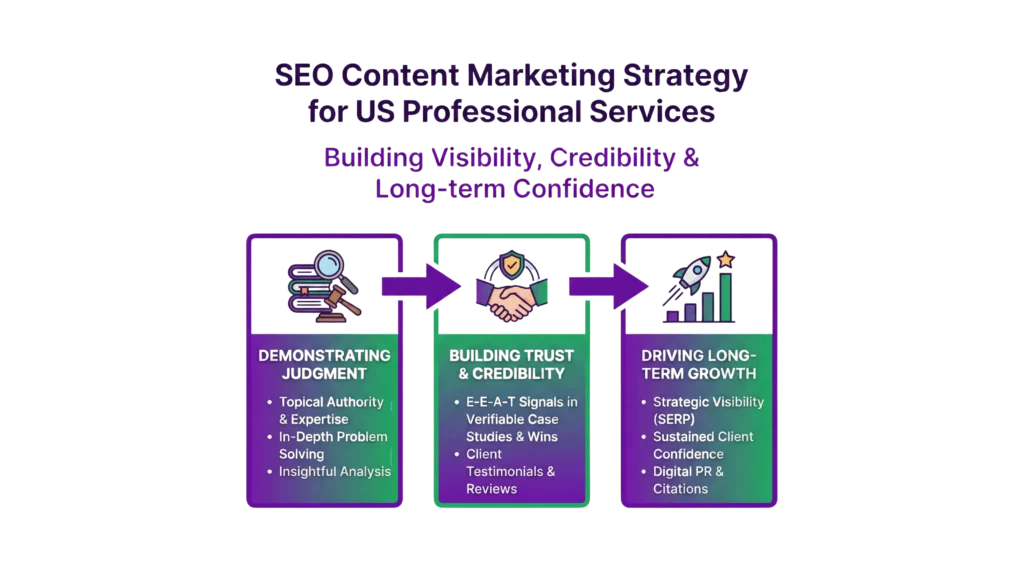
Once authority interpretation and model limitations are understood, an effective strategy becomes clearer. For professional firms, SEO content is not about traffic capture alone. It is about demonstrating judgement at the exact moment a prospective client is deciding who to trust. This section explains how US professional services firms structure SEO content marketing to support visibility, credibility, and long-term confidence.
In professional services, clients are not searching for definitions. They are searching for reassurance that your thinking matches the complexity of their problem. This is why high-performing SEO content marketing services anchor content around judgement rather than explanation. Instead of repeating what a regulation, process, or framework is, effective content shows how decisions are made when trade-offs exist.
This often takes the form of interpretive insights. For example, explaining how a firm approaches risk assessment differently across client sizes, or how priorities shift based on regulatory exposure. These are the kinds of decision frameworks clients already use internally. When content mirrors that reasoning, it signals competence without having to state it explicitly.
For content marketing for professional services, this approach matters because trust is built before contact. A reader who recognises their own decision logic in your content is already halfway to shortlisting you.
Most professional services content fails because it applies conversion pressure too early. Advisory buyers move through research, validation, and comparison stages slowly. They are not looking to be sold to while they are still forming opinions.
Strong b2b content marketing services align content with these advisory-stage moments. Early content focuses on problem framing and boundary conditions. Validation-stage content explores options, constraints, and consequences. Comparison-stage content helps readers understand what differentiates approaches, not vendors.
This sequencing reduces friction. It allows readers to progress naturally, without feeling pushed. For a content marketing consultant working in the US market, recognising these intent layers is essential. The goal is not to force action, but to remain present and credible as the buyer’s understanding deepens.
Professional services firms often dilute authority by trying to cover too many themes. Topical authority is not established by publishing broadly. It is established by owning a narrow set of ideas deeply and consistently.
Effective SEO content marketing services focus on fewer themes but reinforce them from multiple angles. A core concept might be explored through regulatory interpretation, client scenarios, operational implications, and long-term risk considerations. Each piece strengthens the others.
Over time, search engines recognise this depth. More importantly, human readers do too. When multiple pages reflect the same underlying expertise, confidence builds. This is how firms in competitive USA SEO landscapes differentiate without chasing volume.
Content alone rarely carries full credibility in professional services. Authority is reinforced through association. Mentions in industry publications, citations in professional directories, and references from recognised bodies all support the content’s claims.
The key is integration, not accumulation. Authority signals should align with the content’s topic and audience. A tax advisory article reinforced by a citation from a recognised accounting body carries more weight than a generic backlink from an unrelated site.
This is where SEO content marketing services differ from pure production vendors. The strategy considers how off-page signals support on-page judgement. Credibility is built beyond the page, but always in service of the content’s message.
Traditional SEO metrics only tell part of the story. In professional services, success is better measured through trust indicators. Engagement quality matters more than raw traffic. Time spent reading, return visits, and progression across related content signal confidence building.
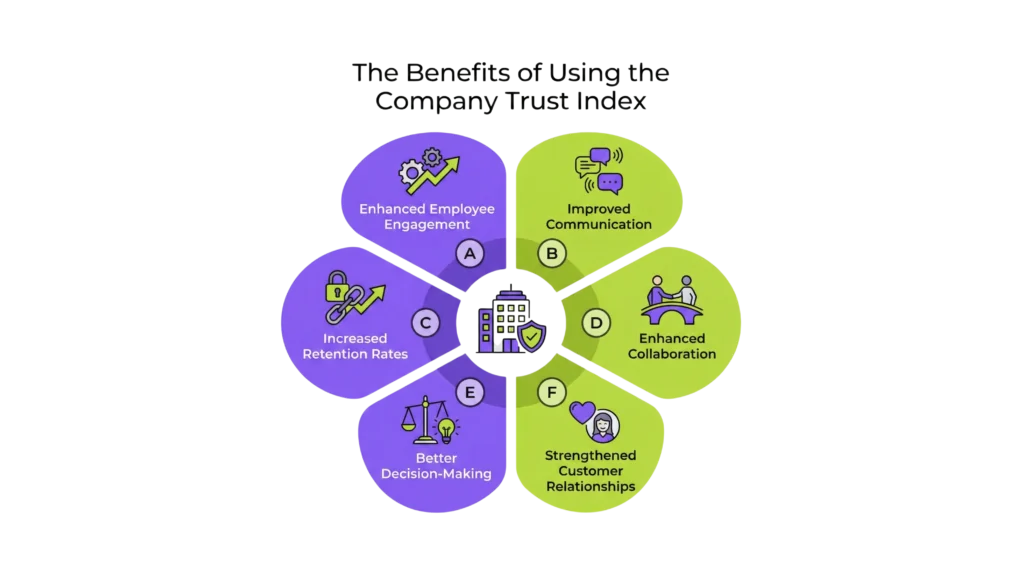
Ranking stability is another indicator. Content that holds position through algorithm changes suggests authority recognition. Finally, client confidence signals, such as references to content during consultations or longer consideration cycles, reflect real-world impact.
For firms using b2b content marketing services, these signals matter more than lead volume alone. They indicate that content is doing its real job, shaping perception before conversation.
SEO content marketing for US professional services succeeds when it respects how trust is formed. Visibility without authority creates attention, not confidence. Authority without clarity creates confusion, not demand.
Professional firms like Fastlinko, that grow sustainably treat content as an extension of judgement. They prioritise depth, restraint, and consistency by aligning search visibility with the expectations of sophisticated buyers.
The strongest SEO content strategies don’t sound optimised. They sound informed. This is the best SEO content marketing strategy for US professional services in 2026.
Keywords attract discovery, but thought leadership sustains attention. Clients look for signs of experience and reasoning before engaging. When content explains complex decisions clearly, search engines reward it through engagement signals that generic optimisation alone cannot create.
They answer questions the way advisors speak, not advertisers. Content is framed around decision-making, risks, and trade-offs. This approach matches how clients search while preserving tone. Search engines recognise this alignment because users stay, read, and return.
They support long consideration periods. Professional clients research extensively before contacting a firm. SEO content keeps the firm visible throughout that process. By the time outreach happens, trust is already established, which shortens sales friction significantly.
Most fail because they avoid specificity. Content stays high-level to remain “safe,” but that limits usefulness. Readers sense when insight is missing. When content doesn’t help clients think more clearly, search visibility fades regardless of publishing frequency.
