How US Agencies Use Guest Posting to Build Authority for Clients
January 30, 2026




High authority link building is often discussed as a tactic. In reality, US brands that sustain rankings treat it as a trust architecture decision. The confusion begins when authority is equated with domain metrics, rather than with how consistently a brand appears in credible, contextually aligned environments.
In 2026, Google evaluates authority through pattern stability. It looks at where a brand is referenced, how often it appears alongside trusted entities, and whether those signals remain consistent over time. This is why some brands grow steadily without aggressive link acquisition, while others plateau despite heavy investment.
The risk isn’t building links. The risk is building the wrong kind of authority signals too early or too aggressively. High authority link building now overlaps with content positioning, local validation, and citation hygiene, not just outreach.
This blog explains how US brands approach white hat link building without risking volatility, why sustainable SEO depends on alignment rather than scale, and how authority is built quietly through consistent, defensible signals.
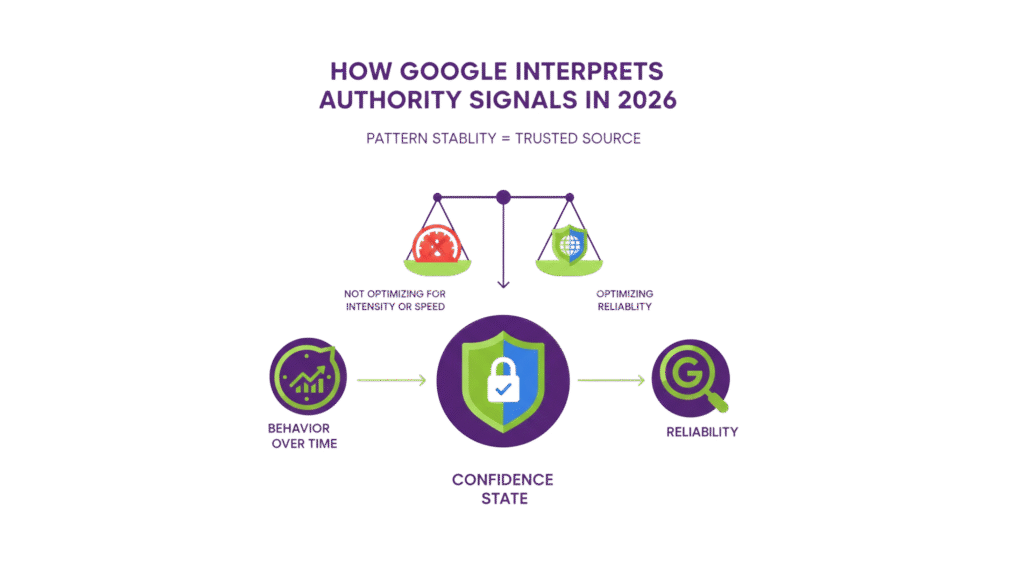
Authority in 2026 is interpreted as stability. Search systems are no longer trying to identify which sites have accumulated the strongest individual signals. Their primary concern is determining which sources can be reused repeatedly without increasing uncertainty. Authority, from this perspective, is not a score. It is a confidence state that forms as behaviour becomes predictable over time.
This explains why authority now develops more slowly but holds its ground more firmly once established. Google is not optimising for intensity or speed. It is optimising for reliability across millions of queries.
At a system level, authority is inferred through patterns that repeat without contradiction. Search engines observe where a source appears, how frequently it appears, and whether those appearances align with a consistent topical identity. A single strong backlink or mention can qualify a source for consideration, but qualification alone does not establish trust.
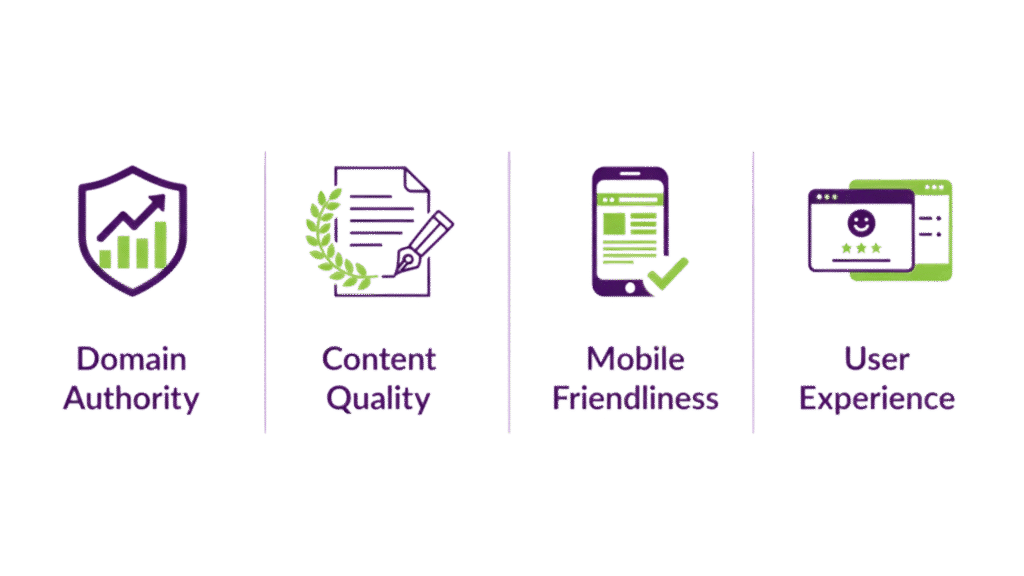
Trust begins forming only when similar signals recur across time and context. Each aligned appearance reduces uncertainty about classification. Over time, the system learns what the source represents and where it belongs. That clarity makes reuse safer, and reuse is the foundation of authority.
This is why isolated high-authority links no longer stabilise rankings. They introduce data points, not behavioural evidence..
Consistency is favoured because it reduces system risk. Sudden spikes in links, mentions, or visibility force reevaluation. Reevaluation introduces ambiguity. Ambiguity increases the likelihood of error.
From Google’s perspective, a steady signal profile is easier to trust than an erratic one. Sources that grow gradually, remain within defined topical boundaries, and avoid abrupt shifts are more reusable. Volatility, even when it appears as momentum externally, is interpreted cautiously because it breaks behavioural expectations.
This explains why aggressive activity often fails to translate into lasting authority. The system waits for behaviour to settle before assigning confidence.
Authority is not global by default. It is resolved within context first. A source may be trusted locally but not nationally, or within one topic but not another. Local validation helps anchor geographic relevance. Topical validation anchors subject-matter trust.
When context is narrow and consistent, classification becomes sharper. Sharper classification reduces misinterpretation risk. This is why authority often appears uneven across different query spaces. The system is not contradicting itself. It is evaluating trust relative to context.

In 2026, authority is not accumulated through effort, volume, or intensity. It is inferred through behaviour the system learns to expect. Google is not measuring how aggressively a site pursues visibility. It is observing how safely that site can be reused as an answer.
This section explains how authority is read, not how it is produced. Once this logic is understood, ranking stability, slow growth, and resistance to disruption stop feeling arbitrary. They become the natural outcome of a system designed to reward predictability over force.
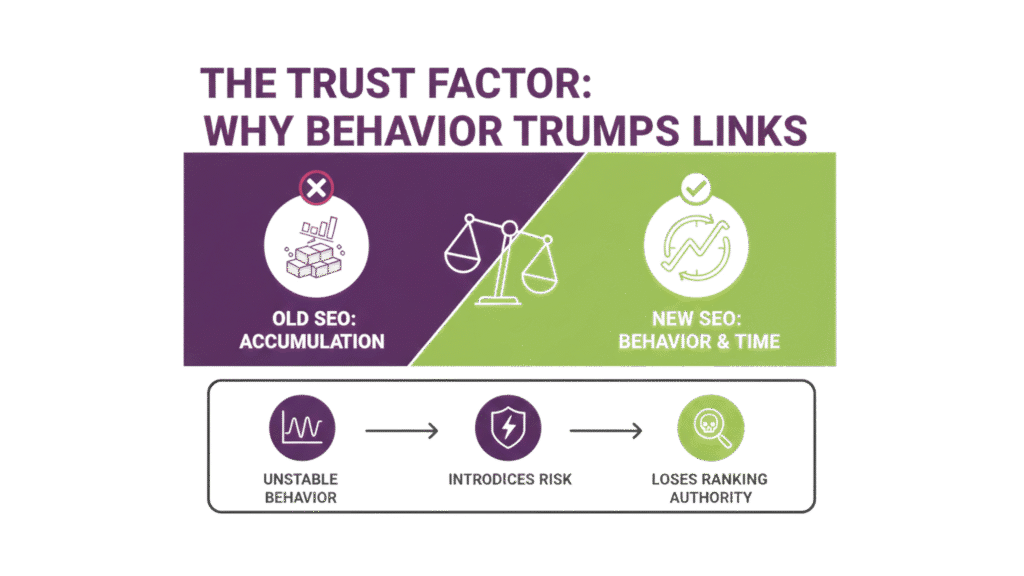
High authority link building models were built for a time when search systems evaluated strength through accumulation. Authority could be approximated through visible signals, and risk was largely external. In today’s search environment, that logic no longer holds. Authority is now interpreted through behaviour, and behaviour is judged over time. As a result, many traditional models introduce instability even when executed carefully.
The risk does not come from shortcuts or manipulation. It comes from frameworks that no longer match how trust is inferred.
Traditional link building often prioritises domain authority as a proxy for trust. While DA can indicate overall strength, it says little about contextual fit. When links are acquired primarily because a site scores highly, relevance becomes secondary.
Search systems now interpret relevance as alignment, not prestige. A high-DA link that sits outside a site’s natural topical or regional ecosystem introduces ambiguity. Enough of these mismatches distort classification, making it harder for the system to understand where a source belongs. What once looked like strength begins to resemble noise.
Guest posts remain a legitimate channel, but overreliance introduces fragility. When a site’s authority profile becomes dominated by similar editorial formats, similar anchor behaviour, or similar publication types, diversity collapses.
From the system’s perspective, this creates a narrow signal footprint. Authority appears manufactured rather than emergent. Over time, the site becomes harder to trust outside that single mechanism, limiting its stability across query spaces.
Local citation building is often treated as a separate discipline, disconnected from link strategy. When citation data is inconsistent or outdated, it introduces contradictions that undermine trust.
Search systems reconcile link signals with entity data. When those layers conflict, confidence weakens. Even strong links struggle to compensate for uncertainty around identity, location, or legitimacy. The risk here is not a penalty. It is erosion of clarity.
Execution quality alone does not determine safety. Even white hat link building can generate risky patterns if the underlying framework is outdated. Ethical placement does not guarantee interpretive clarity.
Search systems do not judge intent. They judge behaviour. If that behaviour produces volatility, misalignment, or overconcentration, risk increases regardless of compliance.
Traditional high authority link building models fail not because they are unethical or careless, but because they were designed for a different interpretive logic. They optimise for visible strength rather than systemic trust.
This section exposes framework decay, not execution failure. Once this distinction is understood, instability stops being mysterious. It becomes a predictable outcome of models that no longer align with how authority is read.
The next section can now examine what sustainable authority frameworks prioritise instead, without revisiting these risks again.
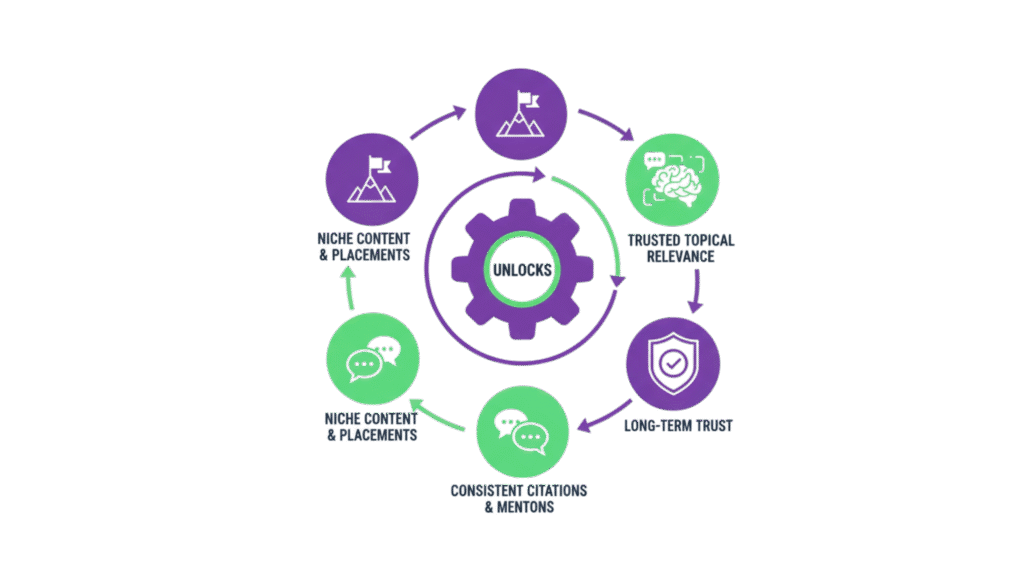
Once authority mechanics and risk factors are understood, safe growth becomes predictable. US brands that maintain search visibility through multiple algorithm cycles do not treat white hat link building as a tactical add-on. They treat it as a controlled credibility system. Every placement, mention, and citation is evaluated for how it affects long-term trust, not short-term lift. This section explains how brands build authority that compounds without creating exposure.
Mature teams stop asking how strong a domain looks and start asking how closely it aligns with their category reality. A link only strengthens authority when it reinforces what the brand is already trying to be understood for. Industry relevance consistently outweighs raw DA because search systems interpret meaning before they interpret power.
Editorial alignment plays a bigger role than placement count. Brands assess whether the host publication speaks to the same audience, uses the same language, and addresses the same decision paths. When context aligns, even a modest publication can reinforce authority. When it does not, high-DA placements often add noise instead of clarity. Sustainable SEO begins where meaning is reinforced, not where metrics look impressive.
High authority links are rarely the result of aggressive outreach. They emerge from content that explains something better than existing resources. US brands rely on SEO content marketing services to develop assets that publishers want to reference because they clarify complexity, introduce usable frameworks, or surface original insight.
These mentions sit inside editorial narratives rather than alongside promotional copy. The difference matters. When links exist because the content helped someone explain a point, they signal authority naturally. When they exist because space was bought or negotiated, they signal intent. Over time, only the first category compounds. Authority built through explanation survives scrutiny because it mirrors how trust forms in real editorial environments.
Before scaling link acquisition, brands stabilise their foundational trust signals. Local citation building plays a quiet but essential role here. Consistent business data across directories, maps, and industry listings removes ambiguity about who the brand is and where it operates.
Conflicting information creates friction for search systems. Even strong links struggle to reinforce authority when underlying signals are unstable. By cleaning and maintaining citation consistency, brands ensure that high authority links reinforce clarity instead of compensating for confusion. This step does not increase rankings on its own, but it prevents erosion when authority signals are layered later.
Authority is not layered onto unfinished structures. Brands allow content to settle before reinforcing it. Pages are indexed, behavioural signals stabilise, and internal linking patterns mature before outreach begins. This sequencing ensures that links amplify clarity instead of masking gaps.

Rapid link velocity often signals pressure rather than adoption. US brands avoid this by introducing authority in deliberate intervals. They watch how rankings behave between signals, allowing search systems to interpret changes incrementally. Stability comes first. Expansion follows. This pacing is one of the most reliable ways to avoid future volatility.
The final test of high authority link building is not how high a page climbs, but how well it holds. Brands track ranking consistency across updates, not momentary gains. Reduced volatility indicates that authority has been integrated into the site’s trust profile rather than sitting on top of it.
Long-term visibility retention is the real metric. Brands observe whether key pages recover quickly after updates, continue attracting qualified traffic, and remain visible without constant reinforcement. These patterns confirm that authority is structural, not superficial. Sustainable SEO shows up as resilience, not reaction.
White hat link building without risk is not achieved through restraint alone. It is achieved through coherence. US brands that succeed align context, content, citations, outreach, pacing, and measurement into a single system. Each element supports the others. When authority is built this way, it does not spike and collapse. It settles, compounds, and continues to support visibility long after tactics fade.
High authority link building works when it reflects how brands earn trust in the real world. Not through aggressive acquisition, but through consistent presence in credible, relevant environments. In 2026, sustainable SEO is built on alignment — between content, citations, mentions, and links.
US brands that avoid risk don’t chase authority. They demonstrate it repeatedly. By focusing on context, consistency, and controlled growth, they build SEO foundations that withstand algorithm shifts and competitive pressure.
Authority that lasts is rarely loud. It’s recognisable, stable, and earned.
White hat link building aligns with how links form naturally. It focuses on relevance, editorial judgment, and genuine contribution. When links are earned through value rather than placement, they age better. That durability is what reduces risk as algorithms continue to evolve.
Mentions help establish recognition. Citations reinforce legitimacy. Together, they shape how a brand is understood across the web. Even without a link, consistent mentions signal trust. Over time, this visibility supports link authority by making backlinks feel expected rather than forced.
Slow growth mirrors natural discovery. When links appear gradually, they reflect real interest rather than coordinated effort. This pacing protects brands from sudden drops and manual scrutiny. Sustainable SEO values compounding trust over rapid accumulation.
The most common mistake is separating links from context. When links don’t match content, audience, or brand narrative, they feel artificial. Over time, these mismatches weaken trust signals. Risk increases when volume replaces relevance as the primary goal.
