
How US Agencies Use Guest Posting to Build Authority for Clients
January 30, 2026







High quality content 2026 has become one of the most repeated phrases in SEO.
It is also one of the least clearly defined. In 2026, the confusion isn’t caused by lack of guidance. It’s caused by too much outdated interpretation. Content marketing services still associate quality with optimisation effort, while Google has started to link it with user resolution.
Search systems no longer ask whether content is well written or keyword-aligned. They ask whether it settles intent. Their top priority is finding whether users stop searching as a page reduces friction & follow-up queries. These outcomes are inferred through behaviour, not claims.
This paradigm shift is reframing how white hat link building and authority strategies work together. High quality content is no longer a standalone asset. It’s a performance signal that integrates clarity, user signals and real engagement.
This guide explains what Google considers “High Quality Content” in 2026 (Explained Simply). Explore how quality is now interpreted through user signals and system-level consistency.
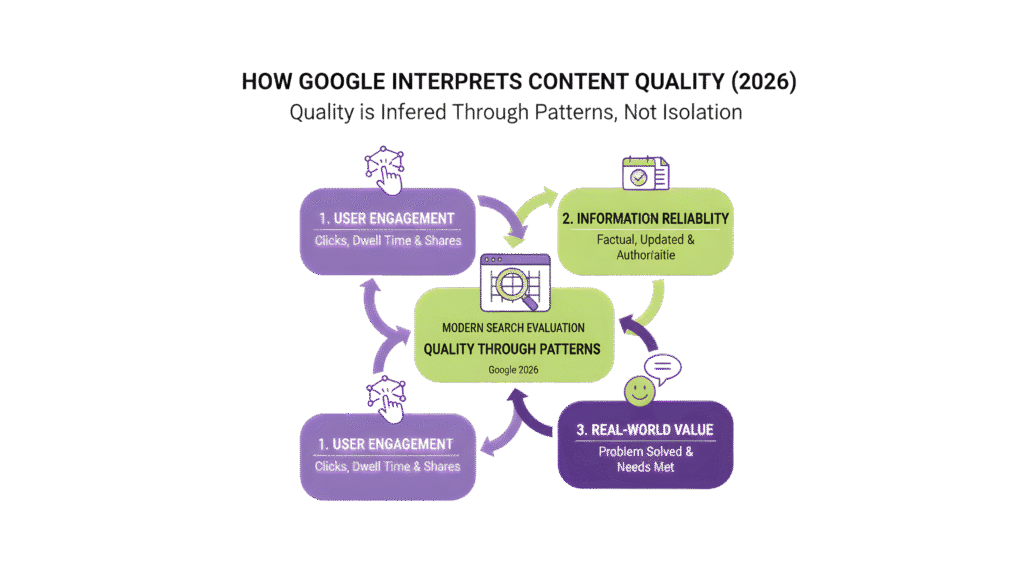
In 2026, Google no longer treats content quality as a static property. Quality today emerges gradually, through how content behaves once real users encounter it.
Most modern content already meets the user signals and baseline standards. Their writing is competent, structure is clean & SEO fundamentals are present. The only difference lies in how content performs after the basics of google quality factors become redundant.
This is why quality feels harder to manufacture today. It is no longer attached to the amount of effort or intent you put in once. It becomes visible only through repeated outcomes. Let’s learn how Google interprets high quality content in 2026.
Google has become far more patient in its usefulness calculations. Rather than reacting to early engagement or surface signals, it waits to see patterns form across many interactions. This patience allows Google to separate temporary interest from lasting value.
Short-term engagement spikes no longer carry much weight. What matters is whether users consistently reach clarity or repeatedly encounter friction. Content marketing services must engage users deeply or their growth stalls.
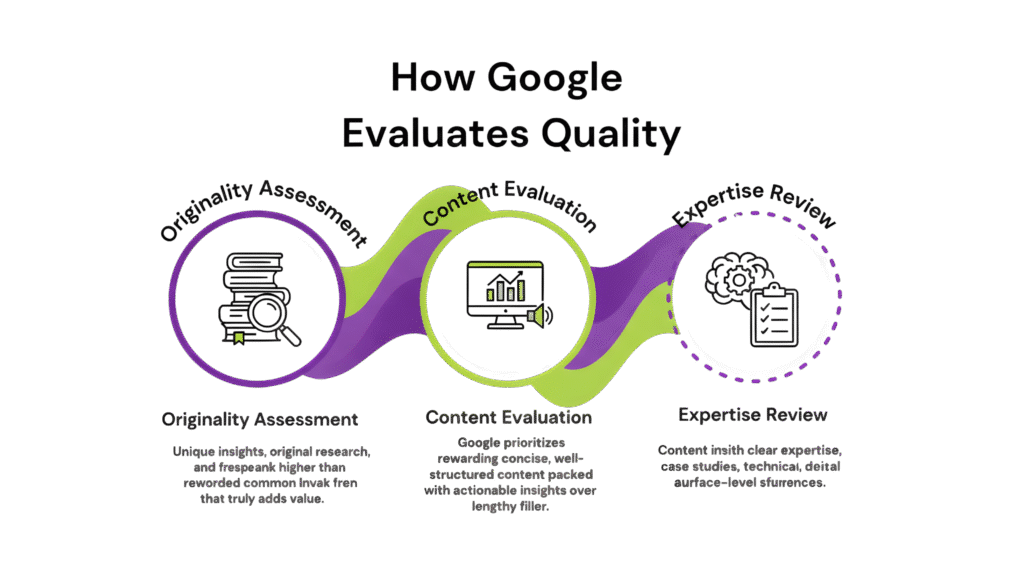
Stories that resolve intent quietly earn confidence over time. White hat link building that looks correct but fails to guide users forward slowly loses momentum, even if nothing appears broken.
Many pages appear well written on the surface. Their topics make sense and internal reviews find no obvious gaps. Yet, their performance plateaus or drifts without clear cause.
From Google’s perspective, this is not a failure of execution, it’s a signal problem. The system isn’t questioning whether content is acceptable, it’s questioning whether it can be relied on.
A single strong page proves capability, not dependability. When dependability remains unclear, visibility stalls quietly rather than collapsing outright.
Usefulness is no longer about thoroughness in the traditional sense. Google isn’t measuring how much information a page contains or how comprehensively it covers a topic. It’s measuring whether confusion decreases.
When users stop bouncing between results or searching altogether, usefulness becomes visible. These signals indicate that intent was resolved efficiently. When journeys stretch or loop, quality weakens quietly. The content may be accurate, but accuracy alone no longer defines usefulness in 2026.
Authority follows the same contextual logic. It is no longer a global reputation signal that transfers easily across topics. Google assigns authority within clearly defined boundaries, based on repeated performance in those areas.

A site may come off as authoritative within one topic cluster and still seem uncertain in another. This is because expansion often introduces ambiguity before it creates strength. Hence, authority feels more fragile, even for established brands.
In modern digital economies, authority depends on repeated relevance, not brand scale. It must be earned separately in each context among the clientele, it can not be harboured.
User behaviour plays a supporting role in google’s quality factors, but not a decisive one. Engagement metrics do not force rankings upward. They reinforce or weaken interpretations already forming.
Content quality now takes longer to establish because Google resists early judgment. It waits for repetition and looks for consistency across time and context. Once confidence forms, however, it tends to hold. Trusted sources become defaults. Visibility stabilises rather than fluctuates.
At the bottomline, Google is no longer asking whether content is good anymore. It’s asking whether it can trust the source to behave reliably, under pressure, at scale.
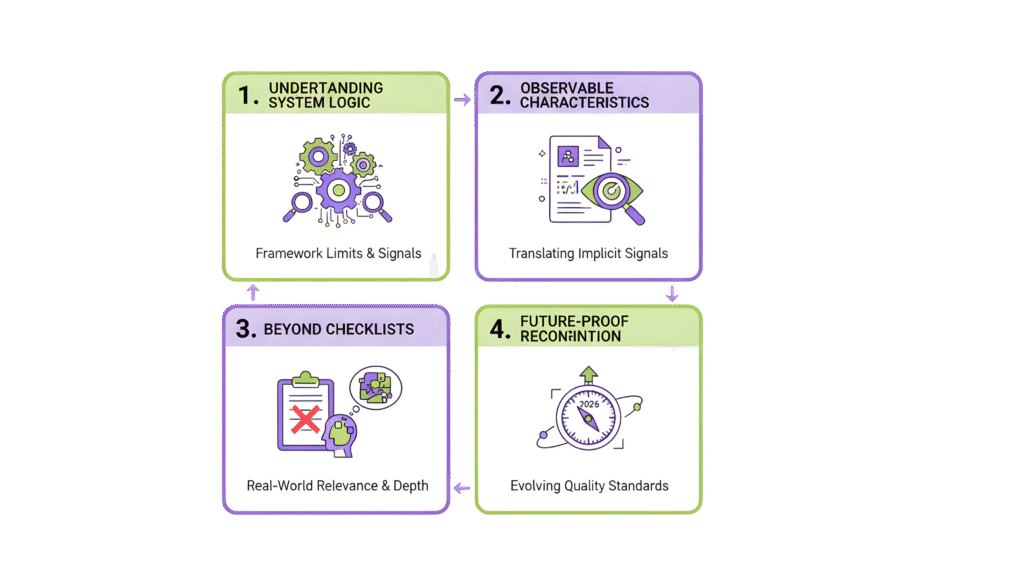
Traditional definitions of content quality were built for an earlier search system.
Depth, length, keyword coverage, optimisation and backlinks once aligned cleanly with ranking outcomes. When those inputs were present, visibility followed with reasonable consistency.
In 2026, those inputs still exist, but they no longer predict results reliably. Teams execute the same strategies and see different outcomes. The problem is not declining standards or execution gaps, it is that Google’s interpretation layer has evolved beyond those surface indicators.
Let’s study the reasons why traditional definitions of “high quality content” break down nowadays:
Word count used to be a placeholder for informational completeness. Longer pages covered more angles, reduced ambiguity & satisfied broader query intent. That approach worked well when search engines rewarded exhaustive explanation.
Today, Google faces an overabundance of long-form content. Length no longer signals resolution, in many cases, it may even signal inefficiency. So, word count no longer correlates with usefulness. Google now interprets excess length as unresolved intent, not added value.
Keyword coverage frameworks were designed to mirror search demand distribution. Covering enough variations used to ensure relevance across many query permutations back in the day.
Modern search intent is far more constrained. Users arrive for resolutions, not discovery. When content matches keyword patterns but fails to answer the underlying question of the query, user satisfaction collapses.
Google detects this through post-click behaviour. If searches repeat, paths extend, queries reformulate then coverage exists, but intent may yet stay unresolved..
White hat link building is a foundational authority signal. However, authority no longer compensates for unresolved experience. Earlier systems allowed trusted domains to carry weaker pages through inertia.
But modern systems demand authority and experience to reinforce each other. When behavioural outcomes fail to stabilise, link equity is discounted faster. Authority without resolution produces only temporary movement, not sustained confidence.
This is why rankings often lift briefly, then plateau. Google quality factors now treat authority as conditional, not absolute.
Presentation quality once functioned as a trust amplifier.
Structured layouts, refined language, and visual hierarchy signalled professionalism and reduced perceived risk.
In 2026, polish is assumed. When polish masks unclear thinking, disengagement accelerates. Higher presentation quality raises user expectations, reducing tolerance for ambiguity.
Well-presented uncertainty performs worse than unpolished clarity. Google observes the resulting behavioural contrast and adjusts confidence downward.
Optimisation frameworks historically rewarded expansion. Additional headings, internal links and semantic reinforcement increased perceived relevance and topical coverage.
But modern systems interpret repetition differently. Redundant explanations slow user progress while over-signalling introduces noise without improving resolution. Pages feel heavier without delivering additional clarity.
Google does not penalise over-optimisation directly. It suppresses confidence. Over-optimised pages rarely fail outright, they just stop earning additional visibility.
This reframing sets up the next section. Now, we will examine how modern quality is recognised and reinforced as the dominant signal.
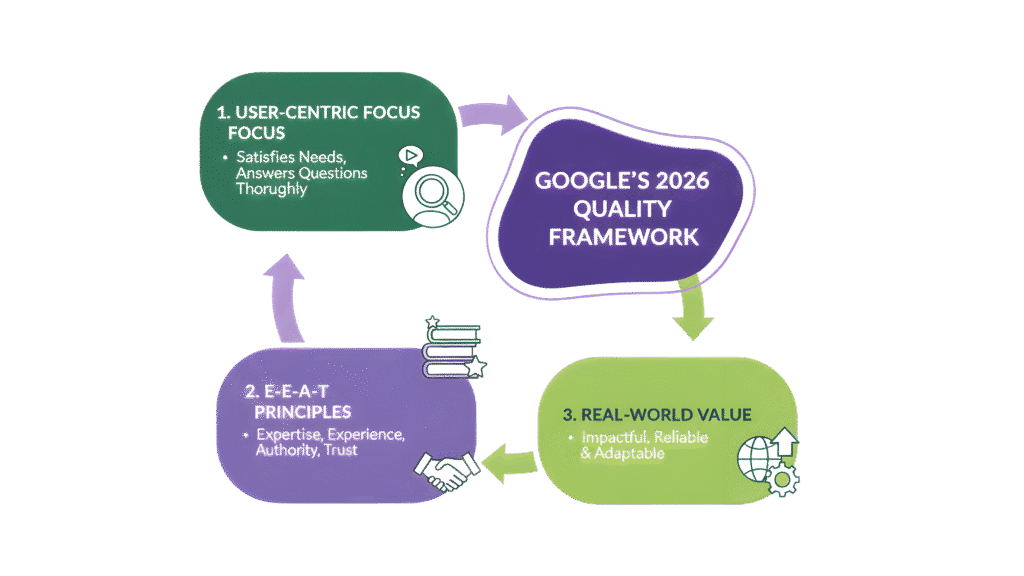
Once you stop treating content as output, patterns become visible. In 2026, the idea of high quality content 2026 is less about writing talent and more about information behaviour post publishing.
Search engines now judge content the same way busy procurement teams do, by how much effort it saves, how confidently it explains & whether real users treat it like a source or skip past it quietly.
Most brands assume high quality content 2026 means longer pages, more media, more keywords, more optimisation layers. But, Google quality factors have evolved to reward interpretation, user behaviour and topic continuity across pages, not just inside them.
In this section, let’s enlist What Google Considers “High Quality Content” in 2026 (Explained Simply):
Pages ranking without backlinks often share a quiet trait. They end the search, not extend it. In 2026, content that ranks reliably answers the question as it was asked. It does not attempt to cover every possible subtopic just to appear comprehensive.
For example, when a buyer searches anything, a strong page surfaces the exact causes, the approval chain friction and the commercial impacts. It does not introduce unrelated solutions or expand into extra technical breakdowns.
Adding such clarity reduces additional searches on your reader’s end. Fewer searches signal a higher relevance and content credibility.
When a page resolves doubts confidently, engines interpret this as intent satisfaction. This satisfaction reinforces your topical footprint.
Information architecture is no longer cosmetic. It is a ranking determinant. The structure of any content page must reflect the reasoning sequences that users follow. This sequencing reduces cognitive load & allows viewers to scan and process insights quickly.
Headings must guide true understanding, not tricks to drive scanning of the content. In 2026, content that sequences information well moves faster in AI Overview features. These features extract meaning clusters easily when headings explain the section purpose clearly.
Adding section clarity reinforces Google quality factors by maintaining consistent terminology across your site’s content networks. Ultimately, the structure should feel native, predictable and safe for buyers.
In 2026, expansive adjectives, emotional claims or repeated sentences weaken credibility. Insiders avoid overclaiming and dramatics because it creates friction. The strongest content says one thing clearly and supports it with proof.
Precise language earns trust and wins AI & editorial scrutiny easily. For search engines, proof is stronger than readability charm.
Fewer claims with stronger substantiation win more attention. This includes stats, expert insights or micro-case snippets showing real outcomes without revealing confidential information.
Presenting statements backed with research is more reliable than repeatedly implying that your content is high quality. This is how insiders maintain a steady informational edge.
Engagement is not forced retention. It is a natural interaction. In 2026, readers scroll when they are curious and navigate when they want more clarity. These behaviours validate the content’s usefulness, not its ability to hold attention.
Natural scrolling patterns increase visibility by earning trust. They boost long-term engagement while forced time-on-page drops credibility instantly. Ultimately, engines track meaningful interactions, not staged ones.
Specialists study dwell patterns, click-through rates and scroll depth to measure how readers move on platforms. These patterns reflect real interest from intentful users. The content that reflects this interest strengthens Google’s understanding of your site’s in a topic cluster.
Authority is not earned through isolated articles. It compounds through loops of recognition.
In 2026, topic ownership across pages matters more than a single high-authority placement. They support white hat link building by aligning messaging, data clusters, and narrative tone.
White label link building companies that integrate clean editorial trails ensure link retention. They prevent removal spikes. They maintain narrative fit. This ensures your site avoids growth ceilings.
High quality content in 2026 is defined by outcomes. Pages that clarify, resolve and reduce their reader’s uncertainty, signal their value through user behaviour, not through declarations.
As Google’s systems mature, quality becomes less about meeting criteria and more about earning trust consistently. Content that performs well, does it quietly, by syncing structure, clarity & authority with how users actually seek answers.
For experts like Fastlinko, this means shifting focus away from producing “better SEO content” and toward building useful content systems. So that quality is reinforced across pages, signals and user experience.
Quality, now, is not what you say your content is., it’s what users confirm it to be. In 2026, this perspective makes or breaks your content strategy.
User signals reflect real-world feedback. Time on page, scroll depth, and follow-up actions show whether content helped or stalled the reader. When these signals align positively, Google gains confidence that the content deserves visibility beyond initial discovery.
They reinforce each other. Helpful content attracts engagement. Engagement supports authority. Authority earns links and mentions. When these signals align, Google sees consistency. Quality is no longer one factor; it’s the outcome of multiple signals pointing in the same direction.
Because completeness isn’t measured in words. A short page that answers the core question cleanly can outperform a longer one that overexplains. Google reads satisfaction through behaviour. When users leave confident, length becomes irrelevant.
Content loses quality when it stops reflecting current user needs. Outdated examples, unclear positioning, or diluted focus reduce usefulness. As behaviour changes, content must adapt. Quality fades when pages remain static while expectations evolve.
