
How US Agencies Use Guest Posting to Build Authority for Clients
January 30, 2026









When it comes to the B2B content marketing trends US, investors and early adopters respond to search engine signals, not stories.
In tech startups, these stakeholders are more than passive observers. Investors hawk eye content marketing for tech startups at every level, and early adopters test whether a product delivers on its promise.
These startups track how influence moves across investor perception, customer trust, and pipeline velocity to win over competitors who treat content as a broadcast tool.
Top-performing content marketing companies connect every digital asset of yours into a strategic loop of resources available online. This approach maintains your market positioning, builds authority, and drives growth.
In this industry, content marketing companies’ SEO strategy is examined repeatedly to assess the content ROI benchmarks and the team’s execution skills. In 2025, content marketing companies for tech startups will fuel adoption, funding, and market credibility.
With this blog, let’s deep dive into what US technology startups expect from content marketing companies in 2025, with case studies & benchmarks.
Content in tech startups has evolved from storytelling to strategy.
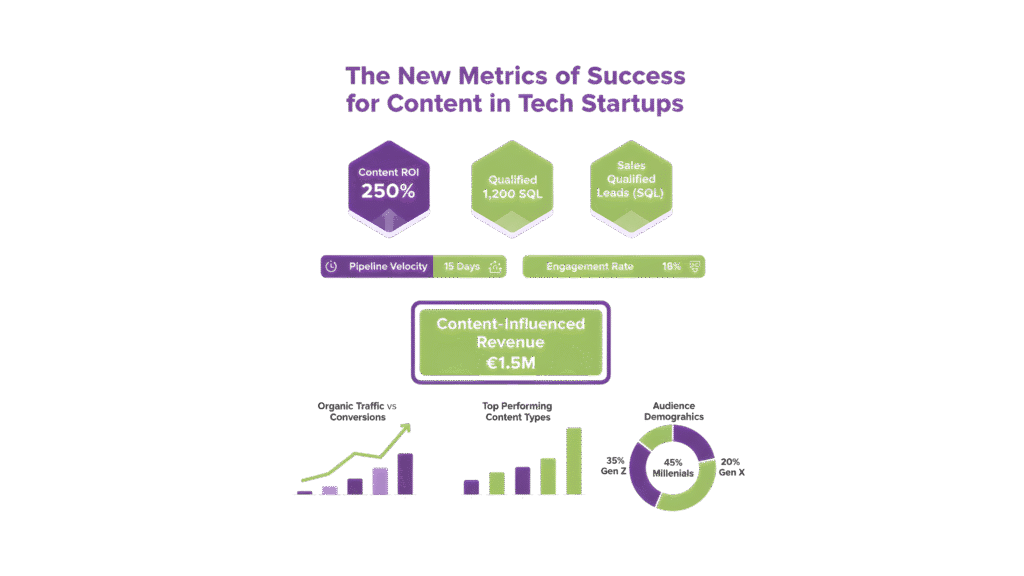
The new metrics of success for content in tech startups have undergone a lot of changes in recent times. In 2025, the performance of content marketing for tech startups draws on how it can propel the business forward.
Now, content marketing companies aren’t judged by the volume of their published content.
With evolving content standards and regulations, startups are now under more pressure to prove that every post, playbook, or webinar creates measurable commercial impact. Let’s take a look at what decides your content’s success today:
A few years ago, content strategies were quantity-led. Write more, post often, and hope for visibility. This exhaustive approach no longer works.
The smartest startups now track how each asset performs against real revenue-linked outcomes and not just vanity metrics.
They measure:
Now, founders and investors look for proof that their content isn’t just filling online channels with volume, but directly shaping revenue outcomes with intent.
Startups in crowded tech spaces use content as a mirror for product-market clarity.
Every guide, technical deep-dive, or narrative piece is assessed against one key criterion – whether it shows how the product solves a real-world problem or not. The most effective teams integrate content into their go-to-market (GTM) rhythm which coordinates the efforts to launch features, enter markets, and engage customers.
Strategic alignment for tech startups focuses on:
Content marketing success is a simple concept. It only focuses on precise communication, an undeniable positioning, actionable strategies, and a memorable brand presence.

In crowded tech markets, brand credibility moves faster than ad visibility.
Investors, partners, and early adopters are always on the lookout for leading startups with potential to grow. These stakeholders tend to notice startups with clear content expertise sooner than the rest.
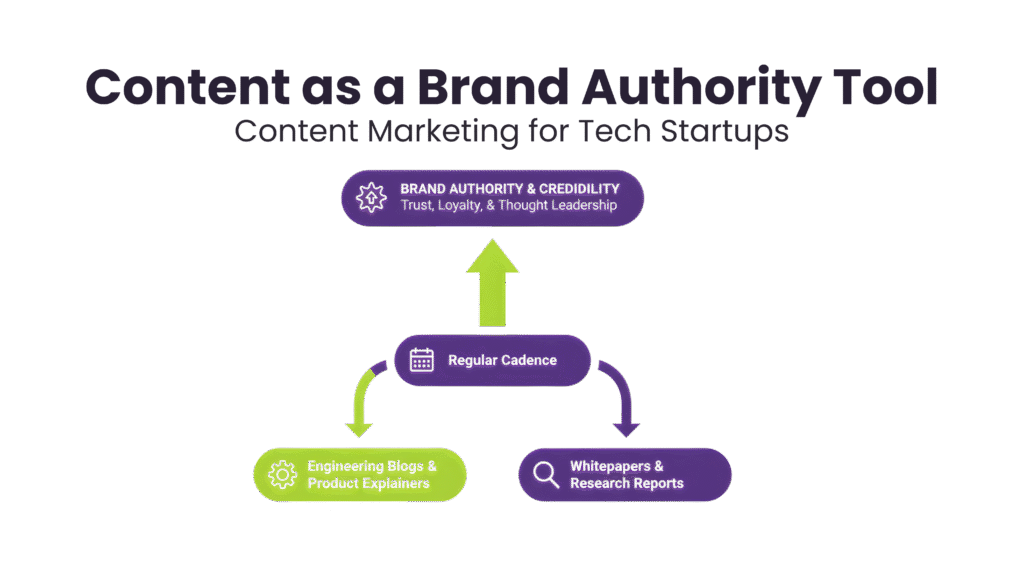
Content can be used as a brand authority tool by channeling:
Digital traffic is easy to chase, but brand leadership and topical insight are harder to prove. The best content marketing companies measure the depth of pieces instead of the reach of their work. They focus on metrics like:
Revenue attribution of your content marketing strategy is an expert tip that grows your visibility and revenue alike. By connecting analytics to CRM data, startups now treat content as part of their sales funnel.

Brands that can prove their ROI through storytelling end up gaining investor confidence faster as their content becomes proof of execution discipline, not just a communication effort.
Understanding these expectations lays the foundation for deciding which content marketing company truly delivers for your startup.
In the fast-paced world of US tech startups, content marketing companies are playing a very important role. Content marketing for tech startups now demands professionals who operate like co-founders.
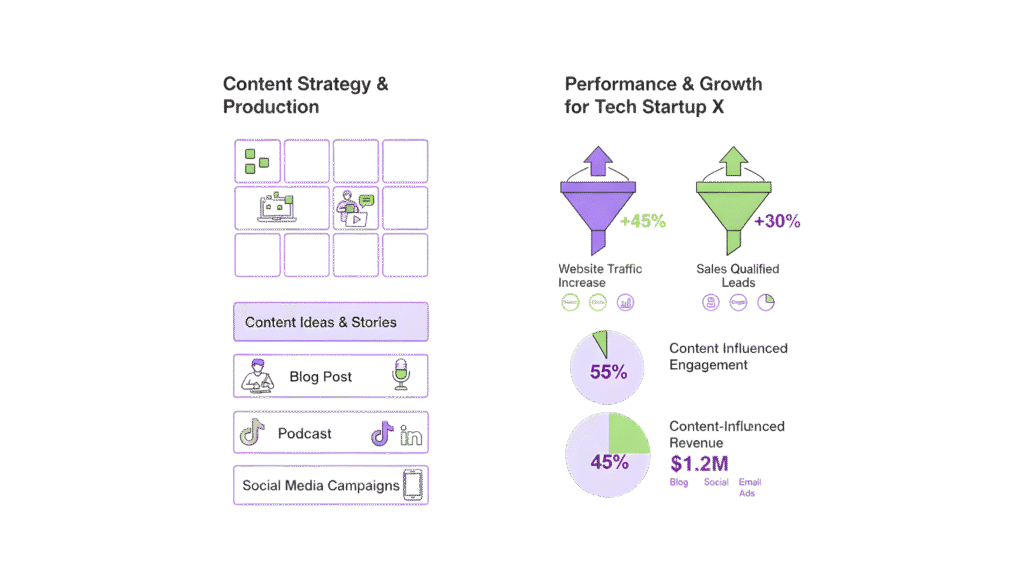
These startups are looking for individuals in content marketing who understand the product, market, and buyer psychology. Every piece of content must do more than educate. It must influence decisions, accelerate the pipeline, and amplify authority.
Startups want agencies that think strategically. They want the best content marketing companies that act like growth partners, not just vendors.
Here’s how content marketing companies make a real difference to tech startups, changing their brand’s trajectory:

A strong content marketing company starts by understanding your brand’s roadmap. They cover everything from product launches, GTM plans, to sales cycles. Their method involves:
This close alignment means that the content strategy for these startups moves ahead of the product. It supports pipeline generation by using demo signups for trials for users when the content hits the buyers at the right time. Let’s understand this with a case study.
DreamApp, a US-based SaaS startup, wanted to maximize its platform’s sign-ups for a major new feature release. Fastlinko, a leading content marketing company, created preview blog posts, technical explainers, and use-case comparisons for them weeks before launch. They also supported the sales team with concise ROI sheets and product one-pagers.
The result was astounding. Feature adoption grew 40% faster, and trial sign-ups doubled in two months, all because content marketing was integrated at every stage alongside the startup’s product and sales teams.
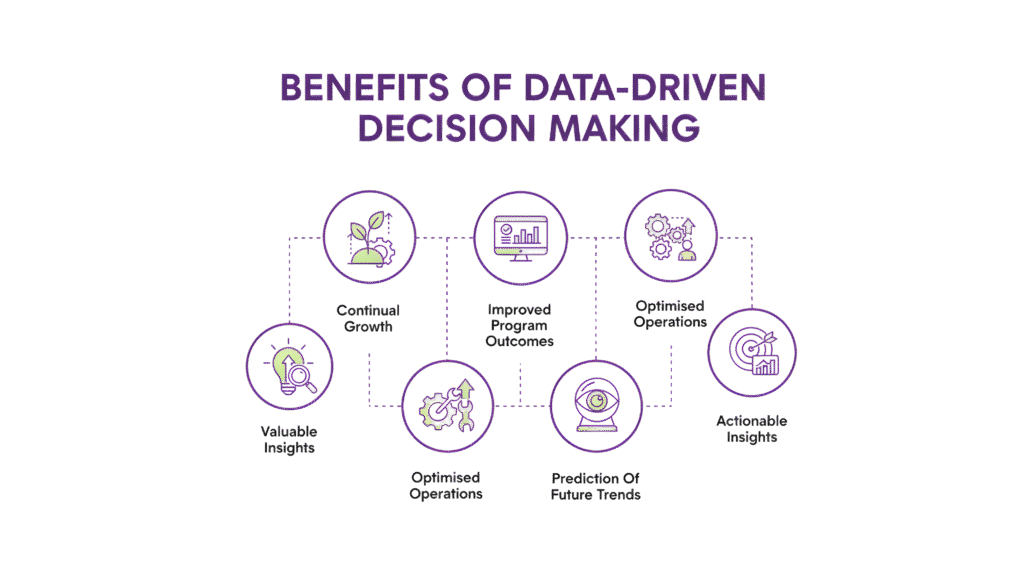
Effective content marketing for tech startups is rooted in data, not guesswork. The best content marketing companies:
Take NotifyVisitors, a B2B SaaS platform pushing to scale quality demo leads.
Fastlinko examined their past content performance to pinpoint the formats, case studies and technical guides with the strongest results. They then tested multiple headlines and messaging approaches to maximize impact.
The outcome was striking. Demo sign-ups surged 2.5x and time-on-site improved by 36%. This shows how a data-driven approach transforms insights to fuel adoption, accelerate the pipeline, and deliver measurable business results.
Writing is one thing. Getting it seen by the right audience is another.
For example, TALS Technologies, a US B2B tech startup, partnered with Fastlinko to reach CTOs and IT buyers.
Fastlinko transformed technical whitepapers into blog posts, LinkedIn threads, and discussions in niche technical communities. In doing so, they crafted custom messaging for each digital channel.
The result was clear. Search visibility of TALS jumped 400%, and 8 enterprise deals were sourced directly from content engagement on LinkedIn and forums.
Thus, targeted & multi-channel distribution converts content into revenue, not just impressions.
Content marketing today isn’t a side channel for communication. It is the core engine for digital growth.
Tech startups aim to extract all measurable impact from content marketing companies. Every asset must influence buyer decisions, accelerate the sales pipeline, and establish brand authority.

Let’s take a look at what US tech startups expect from content marketing companies in 2025
Whether people try the product, sign up for demos, or move closer to purchase is the actual metric of performance and not how many posts were published or how many likes they got.

The goal is a content system that adapts as the business evolves, always supporting what the company is trying to achieve next.
In 2025, startups see content as a strategic engine. The right agency converts insights into assets, assets into engagement, and engagement into real business outcomes.
In tech startups, content isn’t just communication.
It’s a visible trace of decisions, priorities, and timing. A well-timed whitepaper or a landing page that meets the hidden objections of users changes how the brand is read and acted upon.
Teams that interconnect these pieces successfully create a chain of digital signals that secretly hint at expertise and readiness to engines. Each release informs some details about the next, showing what resonates with users and what stalls attention.
In 2025, the real edge lies in treating content like a system, not a marketing checklist. Content marketing companies like Fastlinko that grasp this concept transform every brand touchpoint into momentum and measurable influence across viewers.
This smart digital angle turns small, precise actions into the larger patterns that determine a startup’s trajectory.
Startups want strategies that combine thought leadership, product storytelling, and user education. They expect agencies to use audience research, keyword targeting, and interactive formats to reach decision-makers effectively, drive engagement, and support measurable growth across both short-term campaigns and long-term brand positioning.
Agencies provide full-service solutions, from ideation and copywriting to distribution and analytics. They act as an extension of the startup’s marketing team, producing consistent content that meets high standards without overloading internal staff, enabling startups to maintain visibility and growth while focusing on product development.
Tech startups often benefit most from case studies, whitepapers, explainer videos, and interactive demos. These formats educate prospects, demonstrate expertise, and shorten sales cycles, making them more effective than generic blog posts. Agencies select formats based on audience behaviour, platform performance, and measurable engagement potential.
Agencies track metrics like organic traffic, inbound leads, demo requests, and content engagement. By analysing conversions and cost per acquisition, they ensure campaigns are aligned with startup goals. Regular performance reports allow startups to see which content types deliver measurable growth and justify marketing investments.
